
Medicare Part A is the hospital insurance part of Original Medicare. It helps pay for inpatient hospital stays, short-term skilled nursing care, hospice and some home health care. Most people get Medicare Part A without paying a monthly premium, but it is not free when you use it. Deductibles and daily coinsurance can add up quickly during a long hospital stay.
This guide explains what Medicare Part A covers, what it doesn’t, the 2026 costs, how benefit periods work and how to protect yourself from large hospital bills.
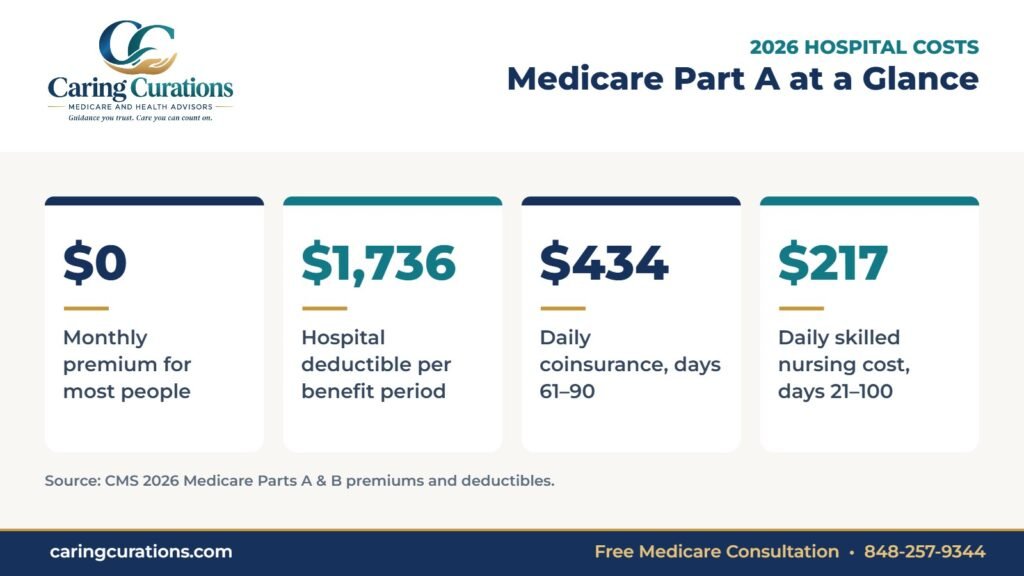
Quick answer: Medicare Part A covers inpatient hospital care, skilled nursing facility care after a qualifying hospital stay, hospice and some home health care. In 2026, most people pay no Part A premium. If you are admitted to the hospital, you pay a $1,736 deductible for each benefit period, then $0 for days 1 to 60, $434 a day for days 61 to 90 and $868 a day for lifetime reserve days. (CMS.gov)
What Is Medicare Part A?
Original Medicare has two parts. Medicare Part A is hospital insurance, and Medicare Part B is medical insurance for doctor visits, outpatient care and preventive services. Together, they form the base of your Medicare coverage.
Medicare Part A is run by the federal government. You can use it at any hospital in the U.S. that accepts Medicare. If you choose a Medicare Advantage plan instead, the plan must cover everything Medicare Part A covers, but it sets its own costs and network rules.
What Medicare Part A Covers
Inpatient hospital care
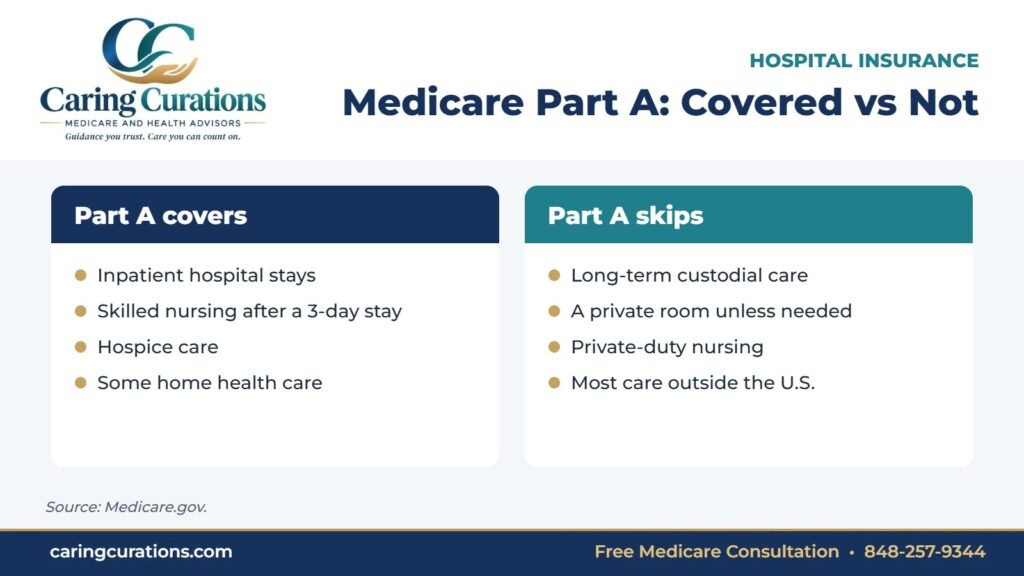
Medicare Part A covers care when you are formally admitted to a hospital as an inpatient by a doctor’s order. This includes:
- A semi-private room and meals
- General nursing care
- Drugs you receive as part of your inpatient treatment
- Hospital services and supplies
- Inpatient care in critical access hospitals, inpatient rehabilitation facilities and long-term care hospitals
- Inpatient mental health care in a general or psychiatric hospital (with a 190-day lifetime limit for psychiatric hospitals)
Skilled nursing facility care
Medicare Part A covers short-term care in a skilled nursing facility (SNF) after a qualifying inpatient hospital stay of at least 3 days. The care must be daily skilled care, such as rehab therapy or wound care, that you need for a condition treated in the hospital. Medicare Part A covers up to 100 days per benefit period.
Hospice care
If a doctor certifies that you are terminally ill with a life expectancy of 6 months or less, Medicare Part A covers hospice care. This includes pain relief, symptom management and support for you and your family. You pay little or nothing for hospice, though there may be a small copay for drugs and respite care.
Home health care
Medicare Part A and Part B both help cover part-time skilled nursing, physical therapy and other home health services if you are homebound and a doctor orders the care. You usually pay $0 for covered home health services.
Blood
If you need blood during an inpatient stay, Medicare Part A covers it after the first 3 pints, unless the hospital gets the blood at no cost.
What Medicare Part A Doesn’t Cover
Medicare Part A has important gaps. It generally doesn’t cover:
- Long-term custodial care, such as help with bathing, dressing and eating in a nursing home
- A private room, unless it is medically necessary
- Personal items in your hospital room, such as a phone or television
- Private-duty nursing
- Doctor services while you are in the hospital, which are billed under Part B
- Care outside the U.S., except in limited situations
Long-term care is the biggest gap. Many families are surprised to learn that Medicare Part A stops paying once care becomes custodial. Medicaid, long-term care insurance or personal savings usually pay for that care.
Medicare Part A Costs in 2026
The Part A premium
Most people pay no monthly premium for Medicare Part A because they or a spouse paid Medicare taxes for at least 40 quarters (about 10 years) of work. If you have fewer work credits, you can buy Part A:
| Work history | 2026 Part A monthly premium |
|---|---|
| 40 or more quarters | $0 |
| 30 to 39 quarters | $311 |
| Fewer than 30 quarters | $565 |
Hospital costs
| Inpatient hospital stay | What you pay in 2026 |
|---|---|
| Deductible | $1,736 per benefit period |
| Days 1–60 | $0 after the deductible |
| Days 61–90 | $434 per day |
| Days 91 and beyond | $868 per lifetime reserve day (up to 60 days over your lifetime) |
| After lifetime reserve days | All costs |
Skilled nursing facility costs
| Skilled nursing facility stay | What you pay in 2026 |
|---|---|
| Days 1–20 | $0 |
| Days 21–100 | $217 per day |
| Days 101 and beyond | All costs |
A 100-day skilled nursing stay can cost you more than $17,000 in coinsurance under Original Medicare alone. That is why many people add a Medigap policy or choose a Medicare Advantage plan with a yearly out-of-pocket limit. See our full breakdown of how much Medicare costs in 2026.
How Medicare Part A Benefit Periods Work
Medicare Part A uses benefit periods instead of a calendar year. This confuses many people.
- A benefit period begins the day you are admitted as an inpatient to a hospital or skilled nursing facility.
- It ends when you haven’t received inpatient hospital or skilled nursing care for 60 days in a row.
- If you are admitted again after a benefit period ends, a new benefit period starts, and you pay the $1,736 deductible again.
There is no limit on the number of benefit periods. Someone with several hospital stays in one year could pay the Part A deductible more than once. Medigap plans such as Plan G and Plan N pay the Part A deductible each time, which is one reason they are popular.
Inpatient vs Observation Status
One of the most important details about Medicare Part A is whether you are actually admitted. If the hospital keeps you under observation status, you are considered an outpatient, even if you stay overnight in a hospital bed.
That matters for two reasons:
- Your costs fall under Part B, which usually means 20% coinsurance for services, plus costs for some drugs.
- Observation days don’t count toward the 3-day inpatient stay needed for skilled nursing coverage.
If you or a loved one is in the hospital, ask, “Am I an inpatient or under observation?” Hospitals must give you a Medicare Outpatient Observation Notice (MOON) if you are under observation for more than 24 hours. Medicare also has an appeals process in some situations where observation status was later changed.

How to Get Medicare Part A
Automatic enrollment
If you already get Social Security or Railroad Retirement benefits when you turn 65, you are enrolled in Medicare Part A and Part B automatically. Your card arrives in the mail about three months before your 65th birthday.
Signing up yourself
If you aren’t receiving benefits yet, you sign up through Social Security, online, by phone or in person, during your Initial Enrollment Period. That is the 7-month window around your 65th birthday. Read our guide on when to sign up for Medicare for exact dates.
If you are still working
Many people still working at 65 take premium-free Medicare Part A, because it can act as secondary hospital coverage at no cost. But there is one important exception: if you contribute to a Health Savings Account (HSA), you must stop contributions once you have any part of Medicare. Our guide to Medicare when working past 65 explains the HSA rules.
Medicare Part A Late Enrollment Penalty
Most people never face a Part A penalty, because their Part A is premium-free. But if you have to buy Part A and you don’t sign up when first eligible, your premium may go up by 10%. You pay the higher premium for twice the number of years you could have had Part A but didn’t sign up.
For example, if you delayed buying Part A for 2 years, you would pay a 10% higher premium for 4 years. Learn more in our guide to the Medicare late enrollment penalty.
How to Fill the Gaps in Medicare Part A
Medicare Part A has no yearly out-of-pocket limit. To protect yourself from big hospital bills, you have three main options:
1. A Medigap policy
Medicare Supplement Insurance plans pay some or all of the Part A deductible, hospital coinsurance and skilled nursing coinsurance. Plan G, for example, covers all Part A cost-sharing. Learn more in What Is Medigap?
2. A Medicare Advantage plan
Medicare Advantage plans replace Original Medicare’s cost-sharing with their own copays, such as a fixed daily hospital copay for the first several days. Every plan has a yearly out-of-pocket limit for covered services. Our guide, What Is Medicare Advantage?, explains how they work.
3. Medicaid or a Medicare Savings Program
If your income is limited, the QMB program pays Part A and Part B premiums, deductibles and coinsurance. See our guide to Medicare Savings Programs.
Medicare Part A If You Are Under 65
You don’t have to be 65 to get Medicare Part A. You may qualify earlier if:
- You have received Social Security Disability Insurance (SSDI) or certain Railroad Retirement disability benefits for 24 months. Your Medicare starts automatically in the 25th month.
- You have ALS (Lou Gehrig’s disease). Your Medicare starts the same month your disability benefits begin.
- You have End-Stage Renal Disease (ESRD) and need regular dialysis or a kidney transplant.
The same Medicare Part A costs apply whether you qualify by age or disability. People under 65 may have fewer Medigap choices, because federal law doesn’t require insurers to sell Medigap to people under 65. New York, however, requires Medigap insurers to offer policies to people with Medicare under 65.
Your Rights When Leaving the Hospital
If you are a hospital inpatient under Medicare Part A, you have the right to a safe discharge. You should receive a notice called “An Important Message from Medicare About Your Rights” within 2 days of being admitted, and again before you are discharged.
If you think you are being discharged too soon, you can ask for a fast appeal:
- Contact the Beneficiary and Family Centered Care Quality Improvement Organization (BFCC-QIO) listed on the notice, no later than your planned discharge date.
- Stay in the hospital while the review happens. You generally won’t be charged for the extra days while you wait for a decision, except for normal coinsurance and deductibles.
- The QIO reviews your case, usually within a day or two, and tells you its decision.
A similar fast appeal is available if a skilled nursing facility, home health agency or hospice plans to end your covered services.
Medicare Part A vs Medicare Advantage Hospital Coverage
If you choose a Medicare Advantage plan, you still have Medicare Part A, but the plan pays your hospital bills instead of Original Medicare. The costs work differently:
| Original Medicare Part A | Typical Medicare Advantage plan | |
|---|---|---|
| Hospital deductible | $1,736 per benefit period | Usually none; a daily copay instead |
| Hospital cost-sharing | $0 for days 1–60, then daily coinsurance | A set copay per day for the first several days |
| Skilled nursing | $0 days 1–20, then $217 per day | Plan copays, often starting earlier |
| Yearly limit | None | Yes, up to $9,250 in network in 2026 |
| Hospital choice | Any hospital that accepts Medicare | Network rules and prior authorization may apply |
Neither option is best for everyone. Compare your expected hospital use, your budget and your preferred hospitals before you decide. Our guide to Medicare Advantage vs Original Medicare walks through the trade-offs.
Medicare Part A Examples
Example 1: A 5-day hospital stay
Joan, 71, has Original Medicare without a Medigap policy. She is admitted for 5 days for pneumonia. Under Medicare Part A, she pays the $1,736 deductible, and Medicare covers the rest of her room, meals, nursing and hospital drugs. Her doctor visits in the hospital are billed separately under Part B.
Example 2: Hospital stay followed by rehab
Frank, 78, has hip surgery and spends 4 days as an inpatient. He then goes to a skilled nursing facility for 30 days of rehab. He pays the $1,736 hospital deductible, $0 for the first 20 days of rehab, and $217 a day for days 21 to 30, or $2,170. With a Medigap Plan G, all of these Part A costs would be covered.
Example 3: Observation status
Diane spends two nights in the hospital under observation. Because she was never admitted, Medicare Part A doesn’t pay. Her bills fall under Part B, and if she needs rehab afterward, she won’t meet the 3-day inpatient requirement for skilled nursing coverage.
Medicare Part A Checklist
- Confirm whether you qualify for premium-free Part A based on your or your spouse’s work history.
- Sign up during your Initial Enrollment Period if you aren’t enrolled automatically.
- Stop HSA contributions before your Medicare coverage starts.
- Decide how you will cover Part A deductibles and coinsurance: Medigap, Medicare Advantage or Medicaid.
- During any hospital stay, ask whether you are an inpatient or under observation.
- Keep your Medicare Summary Notices to check what Part A paid.
Frequently Asked Questions About Medicare Part A
Is Medicare Part A free?
For most people, Medicare Part A has no monthly premium. But you still pay a deductible and coinsurance when you use hospital or skilled nursing care.
Does Medicare Part A cover doctor visits?
No. Doctor visits, including doctors who see you in the hospital, are covered under Part B. Learn more in our guide to Medicare Part B.
Does Medicare Part A cover nursing home care?
Only short-term skilled nursing care after a qualifying hospital stay, up to 100 days per benefit period. It doesn’t cover long-term custodial care.
Can I have Medicare Part A without Part B?
Yes. Some people who are still working keep only Part A. But if you don’t have qualifying employer coverage, delaying Part B can lead to a late penalty.
Does Medicare Part A have an out-of-pocket maximum?
No. Original Medicare has no yearly limit on what you pay. A Medigap policy or a Medicare Advantage plan can help limit your costs.
How many hospital days does Medicare Part A cover?
Medicare Part A covers up to 90 days per benefit period, plus 60 lifetime reserve days you can use once over your lifetime. Days 61 to 90 and lifetime reserve days have daily coinsurance.
What is a lifetime reserve day?
Lifetime reserve days are 60 extra hospital days Medicare gives you for your whole lifetime, for stays longer than 90 days. In 2026, each one costs $868. Once you use them, they don’t renew.
Related guides: Medicare and VA benefits.
Get Help Understanding Medicare Part A
Medicare Part A is the foundation of your hospital coverage, but its costs and rules can catch people off guard. Caring Curations is an independent Medicare agency at 26 Bolivar St in Staten Island, New York. We help you understand Medicare Part A and compare Medigap and Medicare Advantage options that protect you from large hospital bills.
Book a free Medicare consultation or call 848-257-9344. We are licensed in 25 states, and our help is always free.







7 Responses