

When a serious illness reaches the point where treatment is no longer working, many families start asking what Medicare will pay for next. The Medicare hospice benefit is designed for exactly this moment, and for most people it covers nearly all of the care, comfort and support they need at no cost. Knowing how it works ahead of time can take a lot of stress off you and your family.
This guide explains who qualifies for the Medicare hospice benefit, how certification works, what is covered and what isn’t, what you might pay, how benefit periods work, and how hospice fits with Medicare Advantage. It also covers choosing a hospice provider and what happens if you decide to stop hospice care.
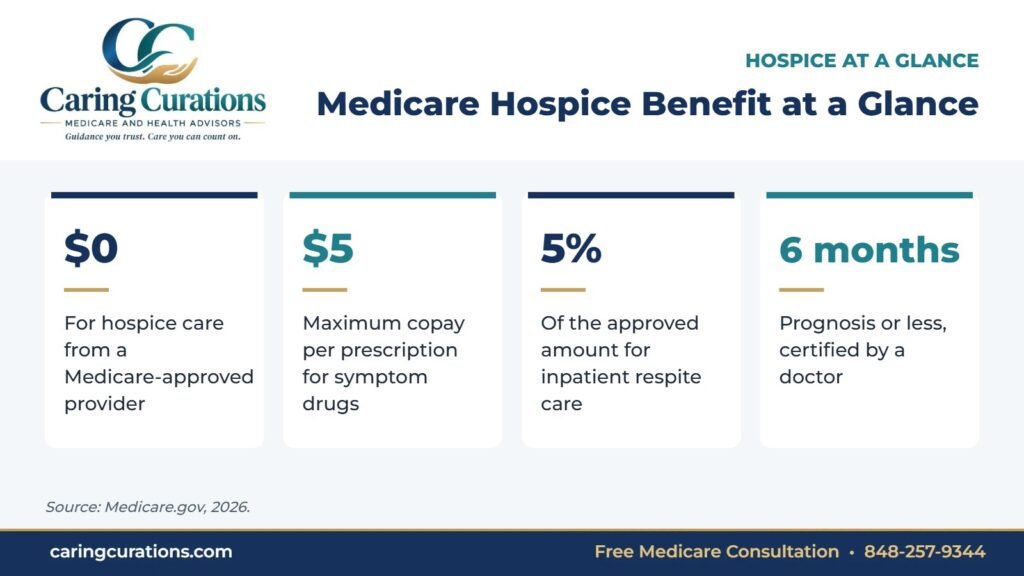
Quick answer: Medicare Part A covers hospice care if your hospice doctor and your regular doctor (if you have one) certify that you are terminally ill with a life expectancy of 6 months or less, and you choose comfort care instead of treatment to cure your illness. You pay $0 for hospice care from a Medicare-approved provider, up to $5 per prescription for pain and symptom drugs, and 5% of the Medicare-approved amount for inpatient respite care. Room and board at home or in a nursing home isn’t covered. (Medicare.gov)
What Is the Medicare Hospice Benefit?
Hospice is a type of care for people who are terminally ill. Its goal is comfort and quality of life, not cure. A hospice team manages pain and symptoms and supports the emotional and spiritual needs of the patient and the family.
The Medicare hospice benefit is part of Medicare Part A, the hospital insurance part of Original Medicare. Most people who have premium-free Part A already have the Medicare hospice benefit and don’t need to buy anything extra. You can read more about what Part A includes in our guide to Medicare Part A.
Hospice is not a place. Most hospice care happens wherever the patient lives: a private home, an apartment, an assisted living community or a nursing home. Hospice teams visit on a schedule and are on call around the clock.
Who Is Eligible for the Medicare Hospice Benefit?
To use the Medicare hospice benefit, all of the following must be true:
- You have Medicare Part A.
- A doctor certifies a terminal prognosis. Your hospice doctor and your regular doctor, if you have one, certify that you are terminally ill with a life expectancy of 6 months or less if the illness runs its normal course.
- You accept comfort care. You agree to palliative care to relieve symptoms instead of treatment to cure your terminal illness.
- You sign an election statement. You sign a statement choosing hospice care instead of other Medicare-covered treatment for your terminal illness and related conditions.
- You use a Medicare-approved hospice. The hospice provider must be certified by Medicare.
The 6-month prognosis is a medical estimate, not a deadline. Many people live longer than 6 months on hospice, and the Medicare hospice benefit continues as long as a doctor recertifies that they remain terminally ill.
Common conditions that lead to hospice
Cancer is the condition most people associate with hospice, but many hospice patients have other illnesses. These include advanced heart failure, COPD and other lung disease, dementia including Alzheimer’s disease, kidney failure, liver disease, stroke and ALS. For the Medicare hospice benefit, what matters is the prognosis, not the specific diagnosis.
How Certification for the Medicare Hospice Benefit Works
Certification is the doctor’s formal statement that you meet the medical requirements for the Medicare hospice benefit. Here is how it usually works:
- Referral. Your doctor, a hospital discharge planner or your family can contact a hospice to ask for an evaluation.
- Evaluation. A hospice nurse or doctor reviews your medical records and meets with you to discuss your condition and goals.
- Certification. The hospice medical director and your attending doctor, if you have one, certify your terminal prognosis in writing.
- Election. You or your legal representative sign the Hospice Election Statement.
- Plan of care. The hospice team works with you and your family to create a written plan of care that lists the services you will receive.
After the first 6 months, a hospice doctor or nurse practitioner must meet with you face to face before each new benefit period to recertify that you are still terminally ill. If your condition improves or stabilizes, you may be discharged from hospice and can return later if your health declines.
What the Medicare Hospice Benefit Covers
Once you choose hospice, the Medicare hospice benefit covers the services in your plan of care that relate to your terminal illness and related conditions. Covered services can include:
- Doctor and nurse practitioner services
- Nursing care, including visits from registered nurses
- Hospice aide and homemaker services, such as help with bathing and personal care
- Medical equipment, such as a hospital bed, wheelchair or walker
- Medical supplies, such as bandages and catheters
- Prescription drugs for pain relief and symptom control
- Physical therapy, occupational therapy and speech-language pathology
- Social work services
- Dietary counseling
- Spiritual and grief counseling for you and your family
- Short-term inpatient care for pain and symptoms that can’t be managed at home
- Short-term inpatient respite care to give a family caregiver a rest
- Any other Medicare-covered service needed to manage pain and symptoms, as recommended by the hospice team
The hospice provider is responsible for coordinating all of this care. That means one team, one phone number and one plan, which many families find is a relief after months of juggling specialists and appointments.
The four levels of hospice care
The Medicare hospice benefit recognizes four levels of care, and a patient can move between them as needs change:
- Routine home care: regular visits wherever you live. This is the most common level.
- Continuous home care: more intensive nursing at home for short periods during a crisis, such as uncontrolled pain.
- General inpatient care: short-term care in a hospital, hospice facility or nursing home when symptoms can’t be managed at home.
- Inpatient respite care: a short stay in a facility so a family caregiver can rest.
What the Medicare Hospice Benefit Doesn’t Cover
Once hospice starts, the Medicare hospice benefit will not pay for some things related to your terminal illness:
- Treatment meant to cure your terminal illness or related conditions
- Prescription drugs meant to cure the illness, rather than control symptoms or relieve pain
- Care from providers the hospice didn’t arrange for your terminal illness. You can keep seeing your regular doctor if you choose them as your attending doctor.
- Room and board at home, in a nursing home or in a hospice residential facility, except during short-term inpatient or respite stays the hospice arranges
- Hospital and ambulance care related to your terminal illness that the hospice team didn’t arrange
Care for health problems that are not related to your terminal illness is still covered by Original Medicare or your plan, with the usual deductibles and coinsurance. For example, if a hospice patient with lung cancer breaks a wrist in a fall, Medicare still covers treatment for the wrist under the normal rules.
Comfort Care vs Curative Care
The biggest decision in choosing hospice is moving from curative care to comfort care. It helps to understand the difference clearly.
- Curative care aims to cure the disease or stop it from progressing. Examples include chemotherapy meant to shrink a tumor, surgery or dialysis for kidney failure.
- Comfort care, also called palliative care, aims to relieve pain, shortness of breath, anxiety, nausea and other symptoms so you feel as well as possible.
Choosing hospice doesn’t mean giving up on care. Hospice patients often receive more attention, not less, with frequent nurse visits and a team focused on how they feel day to day. Some treatments that might look curative, like radiation to ease bone pain, can sometimes be part of a hospice plan if their purpose is comfort.
Palliative care without hospice
Palliative care is also available outside of hospice. People with serious illnesses can get palliative care while still receiving treatment to cure their condition. Outside of hospice, these services are usually covered under Part B, with the normal deductible and 20% coinsurance.
Medicare Hospice Benefit Costs and Cost-Sharing
For most people, the Medicare hospice benefit is one of the least expensive parts of Medicare. Here is what you can expect to pay with Original Medicare:
| Service | What you pay |
|---|---|
| Hospice care from a Medicare-approved provider | $0 |
| Outpatient drugs for pain and symptom control | Up to $5 per prescription |
| Inpatient respite care | 5% of the Medicare-approved amount, capped at the Part A deductible |
| Short-term inpatient care for symptoms | $0 |
| Medical equipment and supplies in the plan of care | $0 |
| Room and board at home or in a nursing home | Not covered by Medicare |
| Care unrelated to the terminal illness | Usual Medicare deductibles and coinsurance |
The Part A deductible in 2026 is $1,736, which sets the cap on respite care coinsurance. In practice, respite costs are usually far lower because stays are short.
How Medigap helps
If you have a Medicare Supplement (Medigap) policy, most plans pay the hospice drug copays and respite coinsurance. Plans A through N cover hospice coinsurance in full, except Plan K, which pays 50%, and Plan L, which pays 75%. Learn more in What Is Medigap?
Paying for room and board
Room and board is the cost that surprises families most. If a hospice patient lives in a nursing home or assisted living community, Medicare pays for the hospice services but not the monthly rent or daily room rate. People with limited income and savings may qualify for Medicaid to help with nursing home room and board. See our guide to dual eligibility for Medicare and Medicaid.
Respite care: a break for caregivers
Caring for a loved one at home is hard work. Respite care lets your loved one stay in a Medicare-approved facility, such as a hospice inpatient unit, hospital or nursing home, so the main caregiver can rest, travel or take care of personal matters.
Under the Medicare hospice benefit, respite stays can last up to 5 days at a time, and you can use respite more than once, on an occasional basis. The hospice arranges the stay. You pay 5% of the Medicare-approved amount for the inpatient respite days.
Many caregivers wait too long to ask. If you are exhausted, tell the hospice nurse or social worker. Using respite care is part of the benefit, not a sign of failure.
Medicare Hospice Benefit Periods
Hospice coverage is organized into benefit periods:
- Two 90-day benefit periods, followed by
- An unlimited number of 60-day benefit periods
At the start of each period, a doctor must recertify that you are still terminally ill. Starting with the third benefit period, a hospice doctor or nurse practitioner must see you face to face before recertifying. There is no lifetime limit on the Medicare hospice benefit as long as you continue to meet the requirements.
You also have the right to change your hospice provider once during each benefit period. You don’t need a reason, and changing providers doesn’t end your hospice coverage.

Using the Medicare Hospice Benefit at Home vs in a Facility
Most people choose to receive hospice care at home, surrounded by family and familiar things. But the Medicare hospice benefit also covers care in other settings.
| Setting | How hospice works there | Room and board |
|---|---|---|
| Your own home | Hospice team visits on a schedule, with 24/7 on-call support | You cover your normal living costs |
| Nursing home | Hospice team works alongside the nursing home staff | Not covered by Medicare; private pay, long-term care insurance or Medicaid |
| Assisted living | Hospice visits like at home | Not covered by Medicare |
| Hospice inpatient unit | Short-term care for symptoms or respite | Covered during approved short-term stays |
A key point: hospice at home doesn’t mean nurses are in the house all day. Family members or hired caregivers usually provide most of the daily hands-on care, with the hospice team teaching, supporting and visiting. If you need more help at home before hospice is appropriate, read about Medicare home health care. For long-term stays, see our guide to Medicare nursing home coverage.
Medicare Advantage and Hospice
If you are in a Medicare Advantage plan, you can still use the Medicare hospice benefit. Here is how it works:
- Original Medicare pays for hospice. Once you elect hospice, Original Medicare, not your Advantage plan, pays the hospice provider for care related to your terminal illness.
- You can stay in your plan. Your Medicare Advantage plan generally continues to cover care that isn’t related to your terminal illness, along with extra benefits like dental or vision, as long as you stay enrolled and pay any plan premium.
- Any Medicare-approved hospice works. You aren’t limited to hospices in your plan’s network, although some plans have relationships with local hospices.
A CMS test program that let some Advantage plans include hospice in their coverage ended at the end of 2024, so in 2026 hospice for Advantage members is handled through Original Medicare. If you have questions about your plan type, see What Is Medicare Advantage?
Drug Coverage Under the Medicare Hospice Benefit
The hospice provider covers drugs for pain relief and symptom control related to your terminal illness, with a copay of up to $5 per prescription. Your Part D plan does not pay for these drugs.
Drugs for conditions unrelated to your terminal illness, such as a cholesterol pill or thyroid medicine, can still be covered by your Part D plan or your Medicare Advantage drug coverage. Keep your Part D plan active while on hospice. If you need a refresher on drug plans, read our Medicare Part D guide.

How to Choose a Hospice Provider
Most areas have several hospice agencies, and quality can vary. In Staten Island and across New York, families often have a choice between nonprofit and for-profit hospices, hospital-based programs and independent agencies. You can compare Medicare-approved hospices on Medicare Care Compare.
Questions worth asking each hospice:
- Is your hospice Medicare-approved and able to bill the Medicare hospice benefit?
- How quickly can you start care after a referral?
- How often will a nurse visit, and who answers the phone at night and on weekends?
- How fast does a nurse come out during a crisis?
- Do you provide continuous home care when symptoms are hard to control?
- Where do you provide inpatient and respite care?
- What bereavement support do you offer the family after a death?
- Do you have volunteers, and what do they help with?
Ask your doctor, hospital social worker or friends who have used hospice for recommendations. A good hospice will answer these questions clearly and without pressure.
Revoking the Medicare Hospice Benefit
Choosing hospice is never permanent. You have the right to stop hospice care at any time, for any reason. This is called revoking hospice.
- How to revoke: You sign a revocation statement with the date your hospice care ends. The hospice can give you the form.
- What happens next: Your regular Original Medicare or Medicare Advantage coverage for curative treatment resumes.
- Remaining days: When you revoke, you give up any days left in your current benefit period.
- Coming back: If you later become eligible again, you can re-elect hospice and begin a new benefit period.
People revoke for many reasons, such as wanting to try a new treatment or a clinical trial, or because their condition improves. Revoking the Medicare hospice benefit doesn’t affect your other Medicare rights.
Medicare Hospice Benefit Examples
Example 1: Hospice at home with family support
Dorothy, 82, lives with her daughter in Staten Island and has advanced heart failure. Her cardiologist and a hospice doctor certify a prognosis of 6 months or less. A hospice nurse visits twice a week, an aide helps with bathing, and the hospice delivers a hospital bed and oxygen. Under the Medicare hospice benefit, Dorothy pays a few dollars for each of her symptom medicines and nothing for the visits or equipment.
Example 2: Respite care for a tired caregiver
Frank, 77, is on hospice for lung cancer. His wife, Maria, is his main caregiver and needs to attend her sister’s wedding. The hospice arranges a 5-day respite stay at a local nursing home. Frank’s Medigap Plan G pays the 5% respite coinsurance, so the couple owes nothing for the stay.
Example 3: Medicare Advantage and a decision to revoke
Helen, 70, has a Medicare Advantage plan and elects hospice for advanced cancer. Original Medicare pays the hospice, and her plan still covers her dental cleanings. Two months later, her oncologist tells her about a clinical trial. Helen signs a revocation statement, her plan’s regular coverage resumes, and she knows she can return to hospice later if she needs it.
Common Mistakes With the Medicare Hospice Benefit
- Waiting too long. Many people start hospice only in the last few days of life and miss months of support. Ask about hospice early.
- Assuming hospice means giving up. Hospice is active care focused on comfort, and it supports the whole family.
- Expecting Medicare to pay nursing home rent. Room and board isn’t covered, so plan for that cost.
- Dropping Part D. Drugs unrelated to the terminal illness still need drug coverage.
- Thinking the choice is final. You can revoke hospice or change providers once each benefit period.
- Not asking for respite. Caregiver burnout is real, and respite care is part of the benefit.
- Getting outside treatment without telling the hospice. Care related to your terminal illness that the hospice didn’t arrange may not be covered.
Medicare Hospice Benefit Checklist for Families
- Talk with the doctor about prognosis and goals of care.
- Confirm Part A coverage and find your Medicare card.
- Compare two or three Medicare-approved hospices.
- Decide who will be the attending doctor.
- Review advance directives and health care proxy forms.
- Keep Part D or plan drug coverage active for unrelated medicines.
- Plan for room and board costs if care will be in a facility.
- Ask the hospice about respite care and bereavement support.
Frequently Asked Questions About the Medicare Hospice Benefit
How long does the Medicare hospice benefit last?
There is no set limit. After two 90-day periods, Medicare covers an unlimited number of 60-day periods, as long as a doctor recertifies that you are terminally ill.
What happens if I live longer than 6 months on hospice?
Nothing bad happens. If you are still terminally ill, the hospice recertifies you and care continues. If your condition improves, you may be discharged and can return later if needed.
Can I keep my own doctor under the Medicare hospice benefit?
Yes. You can choose your regular doctor or nurse practitioner as your attending provider, and they work with the hospice team on your care.
Does the Medicare hospice benefit pay for 24-hour care at home?
Usually not. Routine hospice care includes scheduled visits and 24/7 phone support. Continuous home care is available for short periods during a medical crisis, but ongoing round-the-clock caregiving isn’t covered.
Is hospice covered if I have a Medicare Advantage plan?
Yes. Original Medicare pays for hospice care related to your terminal illness, and you can stay in your Advantage plan for other covered services and extra benefits.
Can I go to the hospital while on hospice?
Yes, but call the hospice first. If the hospice arranges the hospital stay for your terminal illness, it is covered. Hospital care for unrelated problems is covered under your regular Medicare benefits.
Can I change my mind after choosing hospice?
Yes. You can revoke hospice at any time by signing a revocation statement, and you can re-elect hospice later if you qualify.
Get Help Understanding the Medicare Hospice Benefit
Facing a terminal illness is hard enough without worrying about coverage. If you or a loved one is considering hospice and has questions about the Medicare hospice benefit, Medigap, Medicare Advantage or drug coverage, we can help you understand your options. Caring Curations is an independent Medicare agency at 26 Bolivar St in Staten Island, New York. We help families review their coverage so they know what is paid for and what to plan for.
Book a free Medicare consultation or call 848-257-9344. We are licensed in 25 states, and our help is always free.