
If you plan to use Original Medicare with a supplement policy, one deadline matters more than almost any other. The Medigap Open Enrollment Period is a one-time, 6-month window when you can buy any Medigap policy sold in your state without answering health questions, and in most states you never get it back once it passes.
This guide explains when the Medigap Open Enrollment Period starts, what guaranteed issue rights protect you afterward, how medical underwriting works outside the window, what trial rights are, how delaying Part B while you work affects your timing, and why the rules are very different here in New York.
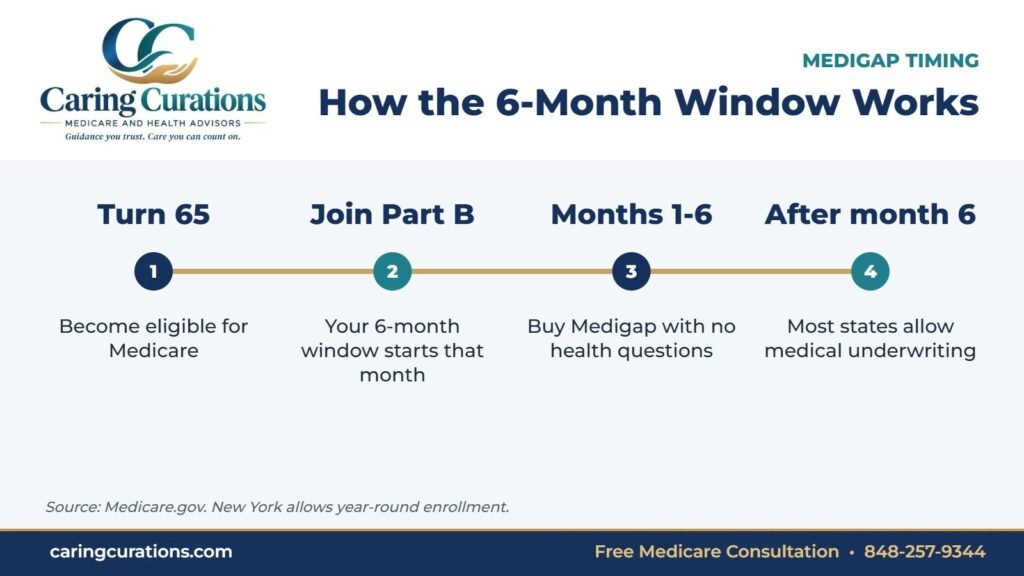
Quick answer: The Medigap Open Enrollment Period lasts 6 months and starts the first month you are both 65 or older and enrolled in Medicare Part B. During it, insurers must sell you any Medigap policy they offer at the same price as a healthy person. After it ends, most states let insurers use medical underwriting. New York is different: insurers must sell Medigap year-round and can’t charge more based on age or health. (Medicare.gov)
What Is the Medigap Open Enrollment Period?
Medigap, also called Medicare Supplement Insurance, is private coverage that helps pay the costs Original Medicare leaves behind, such as the Part B 20% coinsurance and the Part A hospital deductible. If you are new to these plans, start with our guide to what Medigap is.
The Medigap Open Enrollment Period is a federal protection. For 6 months, an insurance company can’t:
- Refuse to sell you any Medigap policy it offers in your state
- Charge you more because of your health or past medical conditions
- Offer you only some of its plans because of your health
It is a one-time window. It doesn’t repeat each year, and it is separate from the fall Annual Enrollment Period, which applies to Medicare Advantage and Part D plans, not Medigap.
When Does Your Medigap Open Enrollment Period Start?
Your window starts the first month you have Part B and are 65 or older. Both conditions must be true. Then it runs for 6 months in a row, and it can’t be paused or restarted.
Common timing examples
| Your situation | When your window starts | When it ends |
|---|---|---|
| Part B starts June 1, the month you turn 65 | June 1 | November 30 |
| You delay Part B while working and start it at 67 on March 1 | March 1 | August 31 |
| You get Part B at 62 due to disability | Federal window starts the month you turn 65 | 6 months later |
| You live in New York | The federal Medigap Open Enrollment Period still applies | New York lets you buy year-round anyway |
Insurers often let you apply up to several months before your Medigap Open Enrollment Period begins, so your policy can begin the same day as your Medicare. Applying early is a smart way to avoid a gap.
What Happens During Open Enrollment
During your Medigap Open Enrollment Period, you can buy any standardized plan an insurer sells in your area, such as Plan G or Plan N, and pay the same rate as anyone else your age in your area with that insurer. Compare the two most popular options in our guide to Medigap Plan G vs Plan N.
A note on pre-existing conditions
Even during your Medigap Open Enrollment Period, an insurer may be allowed to delay coverage of a pre-existing condition for up to 6 months if you didn’t have prior creditable health coverage. Each month of creditable coverage you had before, with no break of more than 63 days, shortens that waiting period by a month. Most people coming from a job-based plan or other health insurance have no waiting period at all.
Also keep in mind that Plan C and Plan F aren’t available to people who became eligible for Medicare on or after January 1, 2020.
Medical Underwriting After the Medigap Open Enrollment Period
In most states, once your 6 months end, Medigap insurers can use medical underwriting. That means they can:
- Ask detailed questions about your health, medications and treatment history
- Turn down your application
- Charge you a higher premium because of your health
- Decide which plans they will offer you
For someone with diabetes, heart disease, cancer history or another serious condition, that can make it hard or impossible to buy a Medigap policy later, or to switch from one plan to another. This is why so many advisors treat the Medigap Open Enrollment Period as the most important Medigap decision point.
Guaranteed Issue Rights
Outside the Medigap Open Enrollment Period, federal law still gives you guaranteed issue rights in certain situations. When one applies, an insurer must sell you certain Medigap policies, can’t charge more for health, and can’t apply a pre-existing condition waiting period. Common situations include:
- Your Medicare Advantage plan leaves Medicare, stops serving your area, or you move out of its service area.
- Your employer or union coverage that pays after Medicare is ending.
- Your Medigap insurer goes bankrupt, or your policy ends through no fault of your own.
- Your Medigap insurer or Medicare Advantage plan broke the rules or misled you.
- You are using a trial right (see below).
Guaranteed issue rights usually have a deadline, often 63 days after your old coverage ends. Keep any letters or notices that show when and why your coverage ended, because the insurer may ask for proof.

Trial Rights: Testing Medicare Advantage
Trial rights let you try Medicare Advantage without permanently losing access to Medigap. There are two kinds:
You joined Medicare Advantage when you first became eligible at 65
If you chose a Medicare Advantage plan when you first got Medicare at 65 and want to leave it within the first 12 months, you can switch to Original Medicare and buy any Medigap policy sold in your state with guaranteed issue rights.
You dropped Medigap to try Medicare Advantage for the first time
If you dropped a Medigap policy to join a Medicare Advantage plan for the first time, you have 12 months to change your mind. You can get your old Medigap policy back if the same insurer still sells it, or buy certain other plans if it doesn’t.
Trial rights are time-limited, so mark the 12-month date on your calendar. For the separate window to switch Medicare Advantage plans early in the year, see our guide to the Medicare Advantage Open Enrollment Period.
Delaying Part B While Working
Because the Medigap Open Enrollment Period begins with Part B, your timing around work matters. If you or your spouse are still working and have job-based coverage, you may be able to delay Part B without a penalty. Your 6-month Medigap window then waits until you actually enroll in Part B.
Why signing up for Part B too early can cost you
Some people sign up for Part B at 65 while they still rely on a large employer plan. That starts the Medigap Open Enrollment Period, even though they don’t need a supplement yet. By the time they retire, the window may be long gone.
If you plan to stay on a good employer plan, ask whether delaying Part B makes sense for you. Our guide to Medicare when working past 65 explains the rules and paperwork, and our Medicare Part B guide covers costs and penalties.
One caution: this applies only to coverage from current work. COBRA and retiree coverage don’t let you delay Part B without risking a penalty.

How New York’s Medigap Rules Are Different
New York is one of only a handful of states that go well beyond the federal minimum. If you live in Staten Island or anywhere else in New York, two state rules change the picture.
Continuous open enrollment
New York requires Medigap insurers to accept applications all year, not just during your Medigap Open Enrollment Period. Any New Yorker with Medicare can buy a Medigap policy, or switch to a different one, at any time, regardless of health. Insurers can’t turn you down because of a medical condition.
Community rating
New York Medigap premiums are community-rated, also called no-age-rated. An insurer charges everyone who buys the same plan in the same region the same price, whether they are 65 or 85, healthy or not. Premiums can vary by where you live in the state, and they can rise each year with state approval, but not because you got older or sicker. (Medicare Interactive)
Coverage for people under 65
Federal law doesn’t require insurers to sell Medigap to people under 65 with Medicare due to disability, and many states don’t. New York does. If you qualify for Medicare before 65, read our guide to Medicare under 65.
What still applies in New York
Even with year-round enrollment, an insurer may be able to apply a waiting period of up to 6 months for pre-existing conditions if you apply without recent creditable coverage and without a guaranteed issue right. Applying when you first get Part B, or within 63 days of losing other coverage, usually avoids that.
New York vs Most States at a Glance
| Rule | Most states | New York |
|---|---|---|
| When you can buy without health questions | 6-month window, plus guaranteed issue situations | Any time of year |
| Can you be turned down for health? | Yes, after the window in most cases | No |
| How premiums are set | Often by age (issue-age or attained-age) | Community-rated, not by age or health |
| Switching plans later | Usually requires medical underwriting | Allowed any time |
| Sold to people under 65 | Varies by state | Yes |
The trade-off
Community rating and year-round access mean a 65-year-old in New York often pays more than a 65-year-old in a state that prices by age. In exchange, an 80-year-old New Yorker can switch plans without health questions and pays the same rate as a newcomer. Over a long retirement, many people find that trade-off works in their favor.
Year-round access also doesn’t mean you should skip your Medigap Open Enrollment Period. Starting Medigap when your Part B begins avoids any pre-existing condition waiting period and any months of paying the Part B 20% on your own. If you’re comparing New York plans, look at both the current premium and how much each company has raised rates in past years, since all increases must be approved by the state.
If You Move to or From New York
Moving changes your Medigap options:
- Moving out of New York: You can usually keep your current Medigap policy, but if you want a new one in your new state, that state’s rules apply. Outside your Medigap Open Enrollment Period and without a guaranteed issue right, you may face medical underwriting.
- Moving into New York: You can buy or switch to a New York Medigap policy at any time under New York’s continuous open enrollment.
Before you move, compare your current premium with what the same plan would cost in your new state.
Medigap Open Enrollment Period and Part D Timing
Medigap and Part D run on different clocks, and it helps to line them up. Your Part D Initial Enrollment Period is the same 7-month window around your 65th birthday as Part A and Part B. If you delay Part B while working, you’ll also have a Special Enrollment Period to join a Part D plan within 63 days after your creditable drug coverage ends.
The simplest approach is to start your Medigap policy and your Part D plan on the same day your Part B begins. That way, your medical costs and your prescriptions are both covered from the first day, and you avoid a Part D late penalty. In 2026, Part D out-of-pocket costs for covered drugs are capped at $2,100 for the year.
What to Compare Before You Buy
All Medigap plans with the same letter have the same basic benefits, no matter which company sells them. That makes comparing easier, but price is only part of the story.
- Monthly premium today: The same Plan G can cost very different amounts from different insurers in the same ZIP code.
- Rate increase history: Ask how much the company has raised premiums in recent years. A low starting price can climb quickly.
- Household discounts: Some insurers offer a discount when both spouses enroll.
- Customer service and claims: Medigap claims are usually paid automatically, but you still want a company that answers the phone.
- Extras: Some policies include small add-ons, such as fitness or vision discounts. These are nice but shouldn’t drive your choice.
Outside New York, choosing carefully during your Medigap Open Enrollment Period matters even more, because switching later may require medical underwriting.
How to Use Your Medigap Open Enrollment Period Well
- Confirm your Part B start date. Your Medigap Open Enrollment Period starts that month if you are 65 or older.
- Decide between Medigap and Medicare Advantage. Think about networks, travel, how often you see doctors, and your budget.
- Choose a plan letter. Plan G and Plan N are the most popular for new enrollees. All plans with the same letter have the same benefits.
- Compare insurers. Prices for the same plan letter can differ widely from one company to another.
- Add a Part D plan. Medigap doesn’t include drug coverage.
- Apply early. Apply before your Part B start date so your coverage begins without a gap.
- Keep your paperwork. Save your Medicare card, Part B start letter and any coverage end notices.
For a full overview of plan letters and costs, see our Medicare Supplement insurance guide.
Medigap Open Enrollment Period Examples
Example 1: Buying on time
Carol turns 65 in April and starts Part A and Part B on April 1. Her Medigap Open Enrollment Period runs from April through September. She applies for Plan G in February, before her Part B starts, so her coverage begins on April 1. Her history of high blood pressure doesn’t affect her price.
Example 2: Waiting while working
Steven keeps working at a large company until 68 and delays Part B with his employer plan. When he retires, he enrolls in Part B starting July 1. His Medigap Open Enrollment Period starts then, not at 65, and he buys Plan N with no health questions.
Example 3: A New Yorker switching later
Elena, 74, lives in Staten Island and has had Plan N for years. She now sees specialists often and wants fewer copays. Because New York has continuous open enrollment, she switches to Plan G with no health questions, and her new premium is based on her region and plan, not her age or health.
Common Mistakes With Medigap Enrollment
- Letting the Medigap Open Enrollment Period pass by accident. In most states, you may never get the same chance again.
- Signing up for Part B too early. If you rely on a large employer plan, starting Part B early can use up your window.
- Confusing Medigap with Medicare Advantage enrollment periods. The fall Annual Enrollment Period doesn’t give you Medigap rights.
- Assuming every state works like New York. If you move, your new state’s rules apply.
- Missing the 63-day deadline. Guaranteed issue rights don’t last forever.
- Comparing on price alone. Look at a company’s rate increase history and service, not just this year’s premium.
- Forgetting drug coverage. Medigap doesn’t cover prescriptions, so add a Part D plan on time.
Frequently Asked Questions About the Medigap Open Enrollment Period
How long is the Medigap Open Enrollment Period?
It lasts 6 months, starting the first month you are 65 or older and enrolled in Part B. It happens only once.
Can I buy a policy after my Medigap Open Enrollment Period ends?
Yes, but in most states, insurers can use medical underwriting, which means they can turn you down or charge more. You may still have guaranteed issue rights in certain situations. In New York, you can buy any time.
Does the Medigap Open Enrollment Period happen every year?
No. It is a one-time window. The fall Annual Enrollment Period is for Medicare Advantage and Part D plans, not Medigap.
What if I delay Part B because I’m still working?
Your Medigap Open Enrollment Period doesn’t start until you enroll in Part B, so you keep it for when you retire, as long as you are delaying Part B based on coverage from current work.
Can I switch Medigap plans in New York?
Yes. New York requires continuous open enrollment, so you can switch plans or companies at any time without being turned down for health reasons.
Are Medigap premiums in New York based on age?
No. New York requires community rating, so insurers can’t charge more based on age or health. Premiums can differ by region and plan.
Get Help With Your Medigap Open Enrollment Period
Choosing a Medigap plan is one of the most lasting decisions you’ll make in Medicare, and the right time to buy depends on your state, your Part B date and your health. Caring Curations is an independent Medicare agency at 26 Bolivar St in Staten Island, New York. We help you time your Medigap Open Enrollment Period, compare Plan G, Plan N and other plans from multiple carriers, and explain how New York rules affect your options.
Book a free Medicare consultation or call 848-257-9344. We are licensed in 25 states, and our help is always free.







One Response