
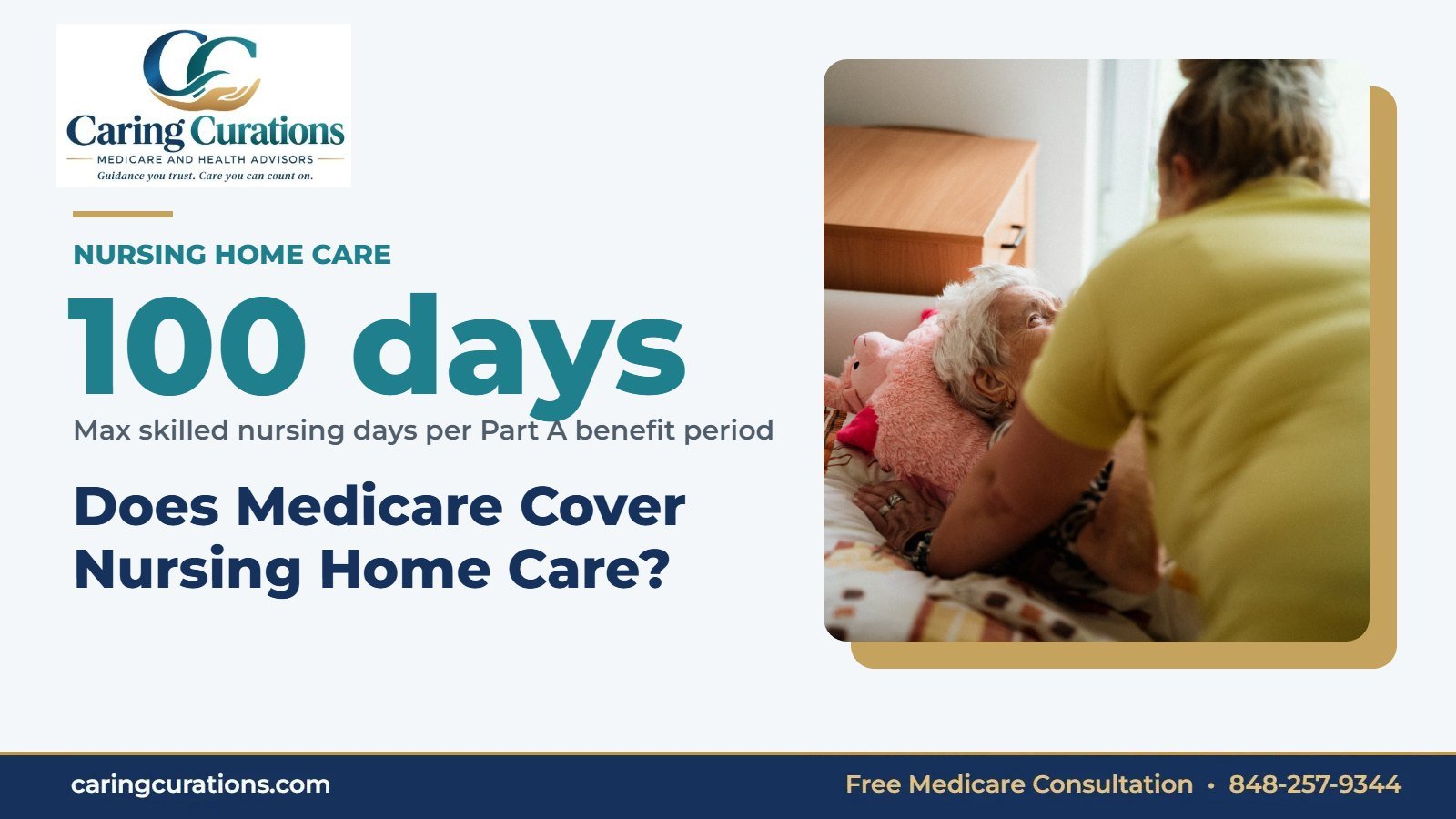
One of the most common questions families ask us is whether Medicare will pay for a nursing home. Medicare nursing home coverage exists, but it is limited to short-term skilled care after a hospital stay, usually for rehab or recovery, and it never pays for more than 100 days in a benefit period. Long-term custodial care, the kind most people picture when they hear “nursing home,” is generally not covered at all.
This guide explains how Medicare nursing home coverage works, the difference between skilled nursing and custodial care, the 3-day hospital rule, the trap of observation status, what you pay day by day in 2026, what happens after day 100, and how Medicaid and long-term care insurance fit in, including for families here in New York.

Quick answer: Medicare Part A covers care in a Medicare-certified skilled nursing facility (SNF) for up to 100 days per benefit period, but only after a qualifying inpatient hospital stay of at least 3 days and only while you need daily skilled care. In 2026 you pay $0 for days 1 to 20 after the Part A deductible, $217 a day for days 21 to 100, and all costs after that. Medicare does not cover long-term custodial care. (Medicare.gov)
What Is Medicare Nursing Home Coverage?
When people say “nursing home,” they can mean two different kinds of care. Medicare nursing home coverage treats them very differently, so it helps to separate them from the start.
- Skilled nursing care is short-term medical care and rehab given or supervised by licensed nurses and therapists. Examples include wound care, IV medications, and physical therapy after a hip replacement or stroke.
- Custodial care is help with everyday activities, such as bathing, dressing, eating, using the bathroom and moving around. It is often needed for months or years, for example by people living with dementia.
Medicare Part A can pay for skilled nursing care in a skilled nursing facility. It does not pay for custodial care when that is the only care you need. Many nursing homes provide both kinds of care under one roof, which is why Medicare nursing home coverage causes so much confusion.
For a full overview of hospital coverage, see our guide to Medicare Part A.
Who Qualifies for Medicare Nursing Home Coverage
To get Medicare nursing home coverage in a skilled nursing facility, you generally must meet all of these conditions:
- You have Part A and days left in your benefit period.
- You had a qualifying inpatient hospital stay of at least 3 days in a row.
- You enter the SNF within about 30 days of leaving the hospital.
- A doctor says you need daily skilled care, such as skilled nursing or therapy, that can only be given in a SNF as a practical matter.
- The facility is Medicare-certified.
- The care is for a condition treated during your hospital stay, or one that started while you were in the SNF for that condition.
Skilled care does not have to make you better to be covered. Medicare also covers skilled care that helps maintain your condition or slows its decline, as long as you need skilled staff to provide it.
The 3-Day Inpatient Rule for Medicare Nursing Home Coverage
The 3-day rule trips up more families than any other part of Medicare nursing home coverage. You need at least 3 days in a row as a formally admitted hospital inpatient.
Here is how the days are counted:
- The count starts on the day you are admitted as an inpatient.
- The day you are discharged does not count.
- Time in the emergency room before admission does not count.
- Time under observation does not count, even if you stay overnight in a regular hospital bed.
That means someone who spends a night in the emergency room and then two nights as an inpatient may not meet the rule, even though they were in the hospital for three nights.
Exceptions to the 3-day rule
Some Medicare Advantage plans waive the 3-day requirement, and some doctors and hospitals that are part of certain Medicare programs, called Accountable Care Organizations, can also waive it. If you have Original Medicare, assume the rule applies unless your doctor tells you otherwise in writing.
Observation Status: A Hidden Trap in Medicare Nursing Home Coverage
Hospitals sometimes keep patients under “observation” while they decide whether to admit them. Observation is billed as outpatient care under Part B, even if you sleep in a hospital room for days.
Because observation days are not inpatient days, they don’t count toward the 3-day rule. A patient can spend four nights in the hospital under observation and then find that Medicare won’t cover the rehab stay that follows.
How to protect yourself
- Ask every day: “Am I an inpatient, or am I under observation?”
- Watch for the MOON notice. Hospitals must give you a Medicare Outpatient Observation Notice if you are under observation for more than 24 hours. It explains that you are an outpatient and how that affects your costs.
- Talk to the doctor. Only a doctor can admit you. If you believe you need inpatient care, ask the doctor to review your status.
- Know your appeal rights. In some cases, people who were switched from inpatient to observation may be able to appeal.
What Medicare Nursing Home Coverage Includes
When you qualify, Part A covers a broad set of services during your SNF stay:
- A semi-private room and meals
- Skilled nursing care
- Physical, occupational and speech-language therapy
- Medical social services
- Medications given in the facility
- Medical supplies and equipment used in the facility
- Dietary counseling
- Ambulance transportation in certain cases, when other travel would endanger your health
Medicare does not cover a private room unless it is medically necessary, or personal items such as a phone or television in your room.
Choosing a skilled nursing facility
Hospital discharge planners usually give families a list of nearby facilities, often with little time to decide. You can compare Medicare-certified facilities, including their staffing and inspection results, with Medicare’s Care Compare tool on Medicare.gov.
Before you choose, ask each facility a few practical questions:
- Is the facility certified by Medicare, and does it have a bed available now?
- If I have a Medicare Advantage plan, is the facility in my plan’s network?
- How many hours of therapy will I get each day, and on which days?
- Who will tell me when Medicare coverage is expected to end?
- Can the facility provide long-term care later if I need it?
Visiting in person, even briefly, tells you a lot about cleanliness, staffing and how residents are treated. If you can’t visit, ask a family member or friend to go for you.
Medicare Nursing Home Coverage Costs in 2026
Your costs depend on how many days you have used in the current benefit period. Here is what you pay with Original Medicare in 2026:
| Days in the SNF | What you pay in 2026 | Notes |
|---|---|---|
| Days 1 to 20 | $0 per day | After the $1,736 Part A deductible for the benefit period |
| Days 21 to 100 | $217 per day | Medigap may cover this coinsurance |
| Day 101 and beyond | All costs | Medicare stops paying for the SNF stay |
| Custodial care only | All costs | Medicare does not cover it at any point |
The $1,736 deductible is the same one that covers your hospital stay. If you already paid it for the hospital stay that qualified you for SNF care, you don’t pay it again in that benefit period.
Days 21 to 100 can add up quickly. A full 80 days at $217 a day comes to $17,360. That is why many people with Original Medicare choose a Medigap plan that pays the SNF coinsurance.
The 100 Days of Medicare Nursing Home Coverage Are Not Guaranteed
Many people hear “100 days” and assume Medicare will pay for 100 days no matter what. That isn’t how it works. The 100 days is a maximum, not a promise.
Medicare nursing home coverage lasts only while you continue to need and receive daily skilled care. If you stop improving in therapy and no longer need skilled services, or if your care becomes only custodial, Medicare coverage can end well before day 100. Many SNF stays end within a few weeks.
If the facility decides your Medicare nursing home coverage is ending, it must give you a written notice. You have the right to a fast appeal, and the notice explains how to request one. Families should read these notices carefully and act quickly.
How Benefit Periods Reset Medicare Nursing Home Coverage
SNF days are counted per benefit period, not per year. A benefit period starts the day you are admitted as a hospital inpatient or to a SNF. It ends when you have gone 60 days in a row without inpatient hospital or SNF care.
Once a benefit period ends, a new one can begin with your next qualifying hospital stay, and your 100 SNF days start over. You would pay the Part A deductible again for the new benefit period. There is no limit on the number of benefit periods you can have.
What Happens After Day 100
After 100 days in a benefit period, your Medicare nursing home coverage ends. Part B may still cover some doctor visits and outpatient therapy, but the room, board and nursing care are your responsibility.
At that point, families usually look at four options:
- Pay privately from savings or income
- Long-term care insurance, if you bought a policy earlier
- Medicaid, if you meet your state’s income and asset rules
- Care at home, sometimes with Medicare home health services for skilled needs
Read our guide to Medicare home health care to see what Medicare covers if you return home.
Skilled Care vs Custodial Care
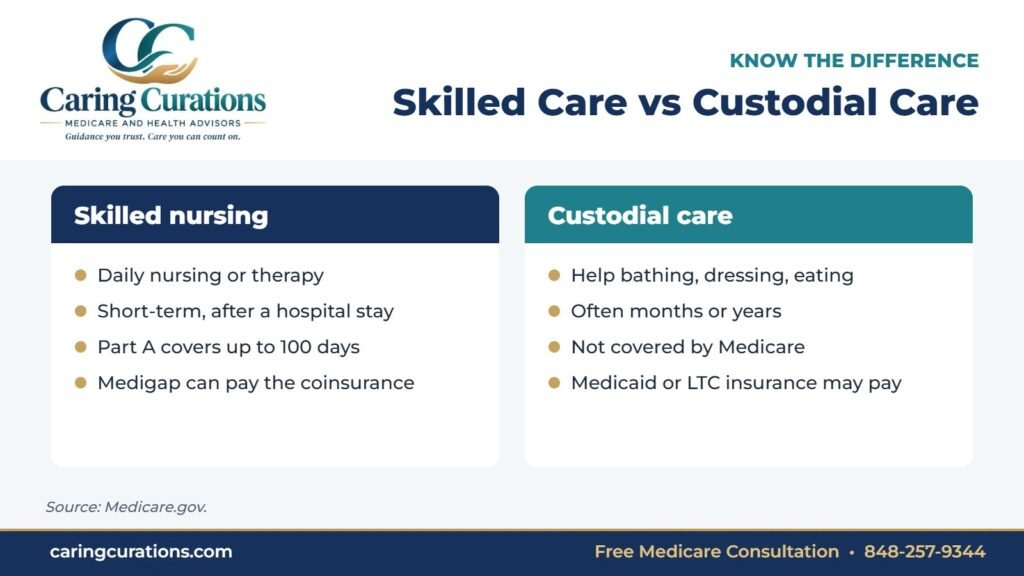
The table above covers costs. This side-by-side shows how Medicare nursing home coverage treats each kind of care:
| Skilled nursing care | Custodial care | |
|---|---|---|
| What it is | Medical care from nurses and therapists | Help with daily activities |
| How long | Usually short-term | Often months or years |
| Hospital stay needed | Yes, 3 inpatient days with Original Medicare | No |
| Medicare pays | Up to 100 days per benefit period | No |
| Other ways to pay | Medigap or a Medicare Advantage plan | Medicaid, long-term care insurance or savings |
Medicare is clear that it doesn’t cover custodial care when that is the only care you need. You can read its explanation on the Medicare.gov long-term care page.
Medigap, Medicare Advantage and Medicare Nursing Home Coverage
Medigap
Most Medigap plans, including Plans C, D, F, G, M and N, pay the full SNF coinsurance for days 21 to 100. Plans K and L pay part of it. Plans A and B do not cover it. Medigap still stops at day 100, because it only fills gaps in Medicare nursing home coverage. Compare popular options in Medigap Plan G vs Plan N.
Medicare Advantage
Medicare Advantage plans must provide Medicare nursing home coverage, but they set their own costs and rules. Many plans charge a daily copay starting on an earlier day than Original Medicare, and many require prior authorization before you enter a facility. Some plans waive the 3-day hospital rule. You usually need to use a facility in the plan’s network.
The good news is that SNF costs count toward the plan’s yearly out-of-pocket limit, up to $9,250 in network in 2026. Learn more in Medicare Advantage vs Original Medicare.
Medicaid and Long-Term Care in New York
For long-term custodial care, which falls outside Medicare nursing home coverage, Medicaid is the main public program that pays. Nursing home care can cost many thousands of dollars a month in New York, so Medicaid often becomes essential once savings run low.
Key points for New York families:
- Income and asset limits apply. New York sets its own limits, and they change each year. Your home may be exempt in some cases, such as when a spouse still lives there.
- There is a look-back period. For nursing home Medicaid, New York reviews asset transfers made in the 5 years before you apply. Gifts made during that time can delay eligibility.
- Spouses are protected. A spouse who stays at home can keep a share of the couple’s income and assets under spousal protection rules.
- Medicaid can pay after Medicare. If you have both programs, Medicaid can help with the SNF coinsurance and then cover long-term nursing home care.
Rules are detailed, and an elder law attorney can help with planning. Read our guide to dual eligible Medicare and Medicaid to learn how the two programs work together.

Long-Term Care Insurance
Long-term care insurance is private coverage that picks up where Medicare nursing home coverage stops, helping pay for custodial care in a nursing home, assisted living facility or at home. It is separate from Medicare and Medigap.
- Policies usually pay a daily or monthly benefit once you need help with a set number of daily activities, or have a cognitive impairment such as dementia.
- Premiums are lower when you buy at a younger age and in good health.
- Many people apply in their 50s or early 60s, because health problems can make it hard to qualify later.
- Some life insurance policies include long-term care riders as an alternative.
If you are still in your 50s or early 60s, it is worth pricing a policy before you need one.
Hospice Care in a Nursing Home
If a nursing home resident is terminally ill and chooses hospice, Medicare’s hospice benefit can cover hospice services in the facility. However, it generally does not pay for the room and board. See our guide to the Medicare hospice benefit for details.
Medicare Nursing Home Coverage Examples
Example 1: Joan recovers after hip surgery
Joan, 74, from Staten Island, has hip replacement surgery and stays in the hospital as an inpatient for 4 days. She moves to a Medicare-certified SNF for physical therapy. Medicare pays in full for her first 20 days. She goes home on day 26, and her Medigap Plan G pays the $217 daily coinsurance for days 21 to 26.
Example 2: Walter is under observation
Walter, 80, falls and spends 3 nights in the hospital, but he is under observation the whole time. When his doctor recommends rehab, the family learns he never had an inpatient stay. Original Medicare won’t cover the SNF, so they pay privately for a short rehab stay.
Example 3: Rose needs long-term care
Rose, 86, has advanced dementia and needs help with bathing, dressing and eating. She doesn’t need skilled care, so Medicare nursing home coverage doesn’t apply to her stay. Her family pays privately until her savings run low, then applies for New York Medicaid with help from an elder law attorney.
Common Mistakes With Medicare Nursing Home Coverage
- Expecting Medicare nursing home coverage to include long-term care. Medicare does not cover custodial care.
- Assuming you get 100 free days. Only the first 20 days are $0 after the deductible, and coverage ends when skilled care is no longer needed.
- Not checking inpatient status. Observation days don’t count toward the 3-day rule.
- Choosing a facility that isn’t Medicare-certified or isn’t in your Medicare Advantage network.
- Ignoring discharge notices. You have a right to a fast appeal if coverage is ending.
- Giving away assets without advice. Transfers within New York’s 5-year look-back can delay Medicaid.
- Waiting too long to look at long-term care insurance. Health changes can make you ineligible.
Frequently Asked Questions About Medicare Nursing Home Coverage
What does Medicare nursing home coverage include?
Only for short-term skilled nursing care after a qualifying hospital stay, for up to 100 days per benefit period. Medicare doesn’t pay for long-term custodial care.
How much does Medicare pay for a skilled nursing facility in 2026?
You pay $0 for days 1 to 20 after the Part A deductible, $217 a day for days 21 to 100, and all costs after day 100.
Do observation days count toward the 3-day rule?
No. Only days as a formally admitted inpatient count. Emergency room and observation time do not, even if you stay overnight.
Does Medigap pay for nursing home care?
Most Medigap plans pay the $217 daily coinsurance for days 21 to 100. Medigap doesn’t pay for custodial care or for SNF days after day 100.
Can Medicare nursing home coverage start over with another 100 days?
Yes, once your benefit period ends. That happens after 60 days in a row without inpatient hospital or SNF care. A new qualifying hospital stay can then start a new benefit period.
Who pays for long-term nursing home care?
Usually a mix of personal savings, long-term care insurance and Medicaid. Medicaid is the largest payer of long-term nursing home care in the United States.
Get Help With Medicare Nursing Home Coverage
A hospital discharge can happen fast, and families often have only a day or two to make decisions. Knowing how Medicare nursing home coverage works ahead of time helps you ask the right questions. Caring Curations is an independent Medicare agency at 26 Bolivar St in Staten Island, New York. We help you compare Medigap and Medicare Advantage plans with strong skilled nursing benefits, and we can explain how Medicare and Medicaid fit together.
Book a free Medicare consultation or call 848-257-9344. We are licensed in 25 states, and our help is always free.