
A walker after hip surgery, a hospital bed at home, oxygen for COPD or a CPAP machine for sleep apnea: these are all examples of Medicare durable medical equipment, often called DME. Medicare Part B helps pay for this equipment when your doctor orders it for use in your home, but the rules about suppliers, renting and costs can catch people off guard.
This guide explains what counts as Medicare durable medical equipment, what you pay in 2026, how to get equipment from the right supplier, when Medicare rents versus buys, how common items like wheelchairs, oxygen and diabetic supplies are covered, and how Medicare Advantage plans handle equipment.

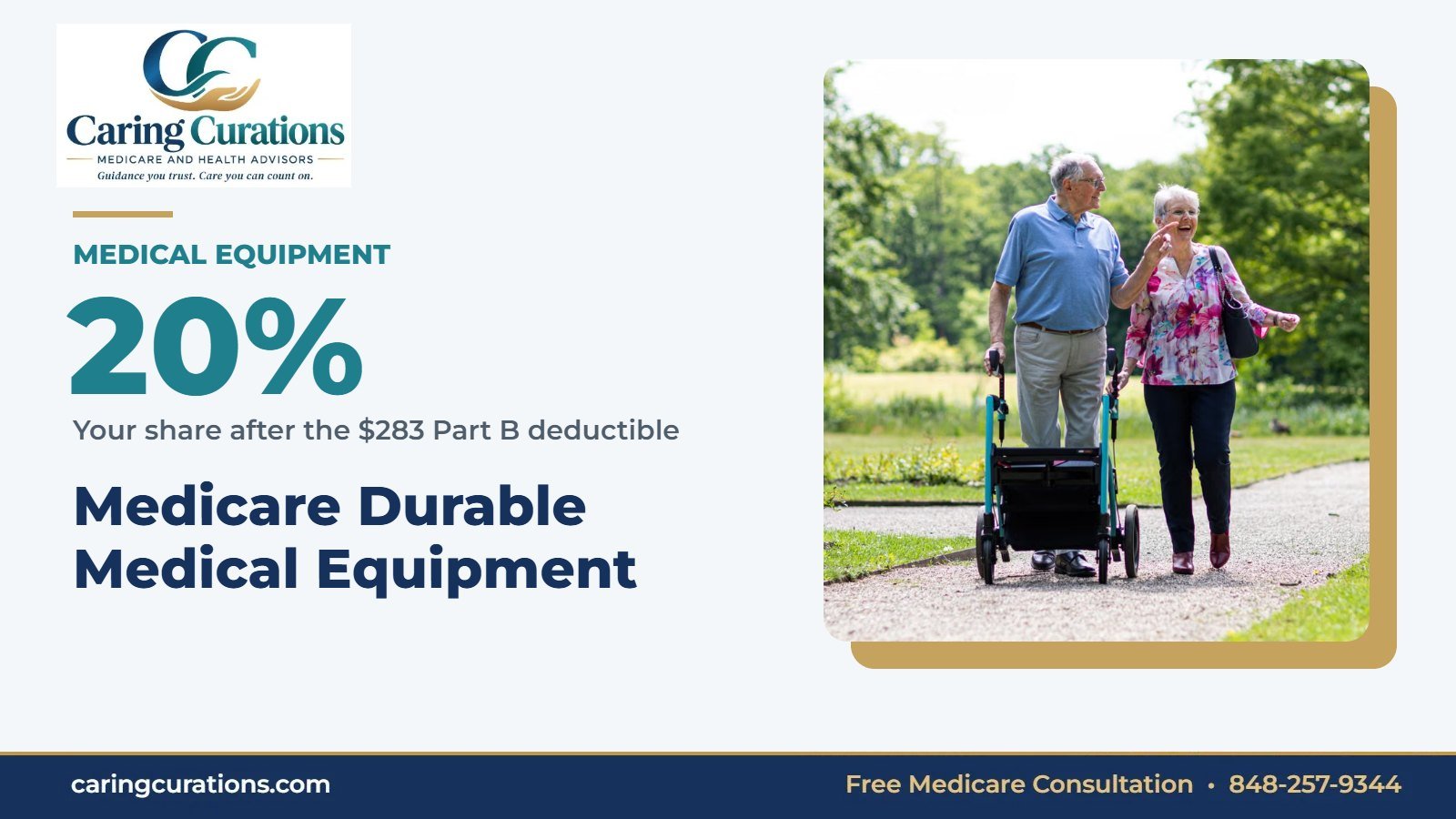
Quick answer: Medicare Part B covers medically necessary durable medical equipment that your doctor orders for use in your home. In 2026, after the $283 Part B deductible, you pay 20% of the Medicare-approved amount if your supplier accepts assignment. Medicare pays only for equipment from Medicare-enrolled suppliers. Some items are rented, some are bought, and some become yours after a set number of rental payments. (Medicare.gov)
What Counts as Medicare Durable Medical Equipment?
Medicare has a specific definition. To count as Medicare durable medical equipment, an item must:
- Be durable, meaning it can stand up to repeated use
- Serve a medical purpose
- Be generally useful only to someone who is sick or injured
- Be used in your home
- Be expected to last at least 3 years
Items that are mainly for comfort or convenience, such as grab bars, stair lifts, bath seats or air conditioners, usually don’t qualify, even if they make daily life easier. Disposable items like bandages also aren’t DME, although some supplies used with covered equipment are covered.
Why “used in your home” matters
Medicare durable medical equipment is covered for use in your home. A nursing home where you live long term can count as your home, but a hospital or a skilled nursing facility stay doesn’t, because those facilities must provide the equipment you need during a covered stay.
What Medicare Durable Medical Equipment Covers
Medicare durable medical equipment includes a wide range of items. Common examples include:
- Mobility aids: canes, crutches, walkers, manual wheelchairs, power wheelchairs and scooters
- Bedroom and bathroom equipment: hospital beds and commode chairs
- Breathing equipment: CPAP devices, oxygen equipment and accessories, nebulizers and respiratory assist devices
- Diabetes equipment: blood sugar monitors, test strips, lancets, continuous glucose monitors and insulin pumps
- Other items: infusion pumps and supplies, patient lifts, pressure-reducing mattresses and lymphedema pumps
Coverage for each item has its own medical rules. Your doctor’s records must show why you need the equipment, and some items need extra documentation before Medicare will pay.
What You Pay for Medicare Durable Medical Equipment in 2026
Medicare durable medical equipment falls under Part B, so the usual Part B costs apply:
- Part B premium: $202.90 a month for most people in 2026
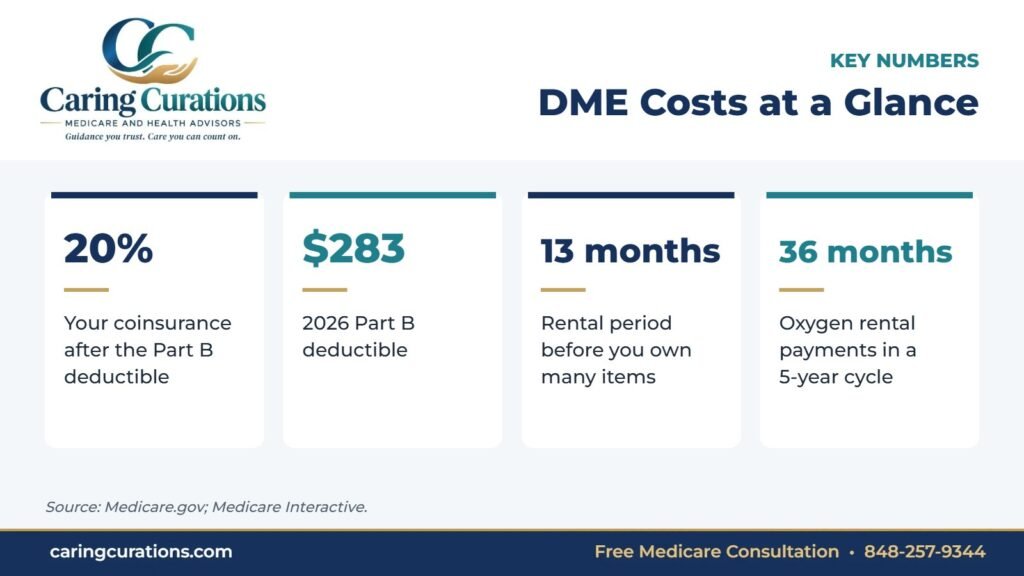
- Part B deductible: $283 for the year
- Coinsurance: 20% of the Medicare-approved amount after you meet the deductible, if the supplier accepts assignment
For example, if the Medicare-approved amount for a walker is $100 and you have already met your deductible, Medicare pays $80 and you pay $20. The cost of Medicare durable medical equipment can add up, especially for power wheelchairs or monthly oxygen rentals, so it is worth checking your share before you order.
Learn more about Part B costs in our guides to Medicare Part B and how much Medicare costs in 2026.
How to Get Medicare Durable Medical Equipment
Getting Medicare durable medical equipment involves a few steps. Skipping one can mean a denied claim.
- See your doctor. Your doctor or another Medicare-enrolled provider must order the equipment and document why you need it. For some items, such as power wheelchairs, Medicare requires an in-person exam first.
- Get a written order. The order should list the equipment, your diagnosis and how long you will need it.
- Choose a Medicare-enrolled supplier. Medicare only pays suppliers enrolled in Medicare.
- Ask about assignment. Confirm the supplier accepts assignment before you get the item.
- Check prior authorization. Some items need approval before delivery. The supplier usually handles the request.
- Keep your paperwork. Save the order, delivery receipt and any notices from the supplier.
Suppliers, Assignment and Medicare Durable Medical Equipment
The supplier you choose has a big effect on what you pay for Medicare durable medical equipment. Medicare uses two terms you should know.
Medicare-enrolled suppliers
If a supplier isn’t enrolled in Medicare, Medicare won’t pay for the equipment at all. You can find enrolled suppliers of Medicare durable medical equipment using the medical equipment supplier search on Medicare.gov, or by calling 1-800-MEDICARE.
Participating suppliers and assignment
Participating suppliers always accept assignment. That means they accept the Medicare-approved amount as full payment and can only charge you the deductible and 20% coinsurance.
Non-participating suppliers are enrolled in Medicare but don’t have to accept assignment. They can charge you more than the Medicare-approved amount, and you may have to pay the full amount up front and wait for Medicare to reimburse its share. For rented equipment, the supplier must accept assignment for all rental months, or you could face larger bills.
Always ask, in plain words: “Are you enrolled in Medicare, and do you accept assignment?”
Renting vs Buying Medicare Durable Medical Equipment
Medicare decides whether each piece of Medicare durable medical equipment is rented or bought, depending on its type.
Items Medicare buys
Lower-cost items, such as canes, many walkers and some diabetes supplies, are usually purchased outright. You own them from the start.
Capped rental items
Many items, such as hospital beds, manual wheelchairs and CPAP machines, are rented month to month. For many of these items, after 13 months of continuous rental payments, you own the equipment. You pay 20% of each month’s rental amount along the way.
Oxygen equipment
Oxygen follows its own rules. You rent oxygen equipment and can’t buy it:
- For the first 36 months, Medicare pays the supplier a monthly rental that includes the equipment, oxygen, supplies and maintenance. You pay 20% of each month’s payment.
- After 36 months, rental payments stop, but the supplier must keep providing the equipment for up to 24 more months, for a five-year cycle in total. You may still pay coinsurance for oxygen contents and some maintenance.
- After five years, you can get new equipment and start a new cycle, either with the same supplier or a different one.
If you need oxygen for less than five years, the supplier picks up the equipment when you no longer need it. (Medicare Interactive)
Medicare Durable Medical Equipment Costs at a Glance
| Equipment | How Medicare pays | What you pay with Original Medicare |
|---|---|---|
| Cane or walker | Usually purchased | 20% after the $283 Part B deductible |
| Manual wheelchair | Rented, often yours after 13 months | 20% of each rental payment |
| Power wheelchair or scooter | Rented or bought; may need prior authorization and an in-person exam | 20% of the approved amount |
| Hospital bed | Rented, often yours after 13 months | 20% of each rental payment |
| CPAP device | Rented; you must show you use it | 20% of each rental payment, plus supplies |
| Oxygen equipment | Rented in a five-year cycle | 20% of monthly payments for 36 months |
| Glucose monitor, strips, lancets, CGM | Covered under Part B for people with diabetes | 20% after the deductible |
Common Medicare Durable Medical Equipment and Special Rules
Walkers, canes and wheelchairs
Medicare durable medical equipment for mobility is covered when your doctor documents that you need it to move around your home. A manual wheelchair or walker is usually the first step. Power wheelchairs and scooters are covered only if you can’t use a cane, walker or manual wheelchair safely at home, and they require an in-person exam and a written order from your doctor.
Hospital beds
A hospital bed may be covered if your condition requires positioning that a regular bed can’t provide, or special features like raising the head of the bed. Your doctor’s notes must explain the need.
CPAP machines
Medicare covers CPAP for people diagnosed with obstructive sleep apnea. Coverage usually starts with a 3-month trial. To keep coverage, your doctor must confirm that you are using the machine and that it is helping. Masks, tubing and filters are covered on a replacement schedule.
Oxygen
Oxygen equipment is covered when your doctor orders it and tests show low oxygen levels that meet Medicare’s criteria. Portable oxygen may also be covered if you are active at home and need it to move around.
Diabetic supplies and CGMs
Part B covers blood sugar monitors, test strips, lancets and control solutions for people with diabetes. It also covers continuous glucose monitors, or CGMs, for people who use insulin or have a history of problematic low blood sugar, when a doctor orders one. Insulin used with a covered insulin pump is covered under Part B, and your cost for a month’s supply of that insulin is capped at $35.
Prior Authorization for Some Items
For some Medicare durable medical equipment, you need prior authorization before the supplier delivers the item. This includes some power wheelchairs and certain other higher-cost items on Medicare’s required list.
The supplier usually submits the request with your doctor’s records. If Medicare approves it, the supplier can deliver the item with confidence that it will be covered. If it is denied, the supplier can fix missing information and resubmit. Ask your supplier whether your item needs prior authorization and how long it usually takes.
Competitive Bidding and Your Supplier
Medicare’s Competitive Bidding Program sets prices for some Medicare durable medical equipment by having suppliers bid for contracts in specific areas. When the program is active in your area, you may need to use a contract supplier for those items so Medicare will pay.
Most product categories have been in a temporary gap period, which means you can generally use any Medicare-enrolled supplier for now. CMS has announced a new round of the program, expected to start no later than January 1, 2028, which is set to include items such as CGMs delivered to your home. If you live in New York or anywhere else, your supplier or Medicare can tell you whether competitive bidding rules apply to your equipment.
Repairs, Replacement and Supplies
Once you own a piece of Medicare durable medical equipment, Medicare may help pay for repairs when they are needed to keep it working. You pay 20% of the Medicare-approved amount for covered repairs.
- Rented equipment: the supplier is generally responsible for maintenance and repairs during the rental period.
- Owned equipment: Medicare may cover repairs and needed replacement parts.
- Replacement: Medicare may replace equipment that is lost, stolen or damaged beyond repair, or that has reached the end of its useful life, which is generally five years.
- Supplies: items like CPAP masks, oxygen tubing and test strips are covered on schedules set by Medicare.
Keep the supplier’s contact information handy and call them first when something breaks.
If you move, tell your supplier right away. For rented items and oxygen, the supplier may need to arrange service from a supplier near your new home, and a gap in service can interrupt your care. Moving to a new state can also change which suppliers your plan uses.
How Medicare Advantage Plans Cover Medicare Durable Medical Equipment
Medicare Advantage plans must cover all the Medicare durable medical equipment that Original Medicare covers, but the rules for getting it can be different:
- Network suppliers: most plans require you to use suppliers in their network.
- Prior authorization: many plans require approval for more types of equipment than Original Medicare does.
- Preferred brands: some plans cover only certain brands of items like diabetic test strips or CGMs.
- Costs: your copay or coinsurance depends on the plan. Many plans charge 20% coinsurance for DME, but it counts toward the plan’s yearly out-of-pocket limit, which can be as high as $9,250 in network in 2026.
Before you order, call your plan to confirm the supplier, the approval steps and your share of the cost. If you are new to these plans, read What Is Medicare Advantage?
How Medigap Helps With Medicare Durable Medical Equipment Costs
With Original Medicare, the 20% coinsurance has no yearly cap. For expensive equipment or long-term oxygen, that can add up. A Medigap policy can pay some or all of your 20% share. Plan G and Plan N cover Part B coinsurance, although Plan N may have small copays for some office visits and neither covers the Part B deductible for people new to Medicare.
Compare plans in What Is Medigap? and Medigap Plan G vs Plan N.
Medicare Durable Medical Equipment After a Hospital Stay
Many people first need Medicare durable medical equipment when they leave the hospital or a rehab facility. The hospital’s discharge planner often helps arrange the order and the supplier, but you can still ask whether the supplier is Medicare-enrolled and accepts assignment.
If you get Medicare home health services, your home health agency may help you get equipment, but Medicare durable medical equipment is billed separately and you still owe the 20% coinsurance for it. Learn more in our guide to Medicare home health care.

Medicare Durable Medical Equipment Examples
Ruth, 78: a hospital bed at home
Ruth, who lives on Staten Island, comes home after a hospital stay for heart failure and needs to sleep with her head raised. Her doctor orders a hospital bed. She rents it from a participating supplier and pays 20% of each month’s rental. After 13 months of continuous rental, the bed belongs to her.
George, 70: a CPAP machine
George is diagnosed with sleep apnea and starts CPAP therapy. During the first three months, his machine records how often he uses it. His doctor confirms it is helping, and Medicare continues coverage. His Medigap Plan G pays his 20% share after he meets the Part B deductible.
Linda, 67: a CGM with Medicare Advantage
Linda uses insulin and wants a continuous glucose monitor. Her Medicare Advantage plan covers CGMs but requires prior authorization and a network supplier. She calls the plan first, uses the supplier on its list and pays her plan’s coinsurance.
Common Mistakes With Medicare Durable Medical Equipment
- Buying from a supplier that isn’t enrolled in Medicare. Medicare won’t pay anything.
- Not asking about assignment. A non-participating supplier can charge more than the approved amount.
- Ordering before getting a doctor’s order. Without proper documentation, the claim can be denied.
- Answering ads that promise “free” equipment. Be wary of unsolicited calls offering braces or supplies in exchange for your Medicare number.
- Skipping prior authorization. For items that need it, delivery without approval can leave you with the bill.
- Not using a CPAP machine enough. Medicare may stop paying if you don’t meet the usage requirement.
- Assuming a Medicare Advantage plan works like Original Medicare. Plans may limit suppliers and brands.
Frequently Asked Questions About Medicare Durable Medical Equipment
How much does Medicare durable medical equipment cost?
Medicare Part B pays 80% of the Medicare-approved amount after you meet the $283 deductible in 2026. You pay the other 20%, if your supplier accepts assignment.
Do I need a prescription for Medicare durable medical equipment?
Yes. Your doctor or another Medicare-enrolled provider must order the equipment and document that it is medically necessary for use in your home.
Does Medicare cover walkers and wheelchairs?
Yes, when your doctor orders them for use in your home. Power wheelchairs and scooters have stricter rules and usually need an in-person exam and prior authorization.
Does Medicare cover continuous glucose monitors?
Yes, for people with diabetes who use insulin or have a history of problematic low blood sugar, when a doctor orders one. You pay 20% after the deductible with Original Medicare.
Will I own my Medicare durable medical equipment?
It depends. Some items are bought, many rented items become yours after 13 months of rental payments, and oxygen equipment is always rented.
Does Medicare cover stair lifts or grab bars?
No. These are considered home modifications or convenience items, not Medicare durable medical equipment. Some Medicare Advantage plans offer limited extra benefits for home safety.
What if my equipment breaks?
If you rent it, call the supplier, who is generally responsible for repairs. If you own it, Medicare may help pay for repairs or replacement.
Get Help With Medicare Durable Medical Equipment
Whether you need a walker after surgery or long-term oxygen, the right plan and supplier can keep your costs down and your care on track. Caring Curations is an independent Medicare agency at 26 Bolivar St in Staten Island, New York. We can explain how your plan covers Medicare durable medical equipment, compare Medigap and Medicare Advantage options from multiple carriers, and help you avoid surprise bills.
Book a free Medicare consultation or call 848-257-9344. We are licensed in 25 states, and our help is always free.






One Response