

Many veterans who turn 65 already have health care through the VA and wonder whether they need Medicare too. The short answer is that VA health care and Medicare are separate programs that don’t work together the way most insurance does. Understanding how VA benefits and Medicare fit together can help you avoid gaps in coverage, late penalties and unexpected bills.
This guide explains how Medicare and VA benefits work side by side, whether you should sign up for Part B, how drug coverage works, and which Medicare plans make sense for veterans.
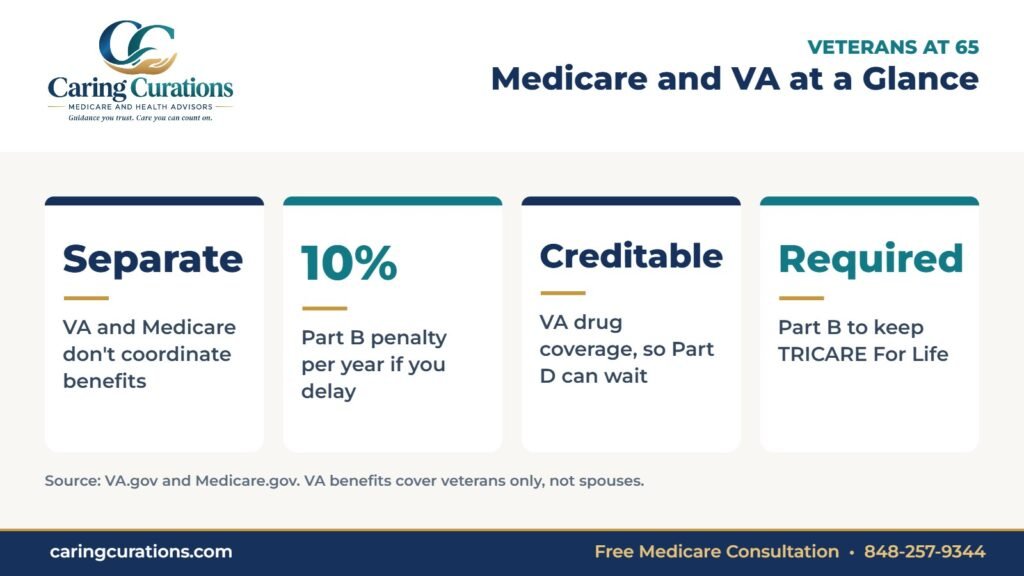
Quick answer: VA benefits generally pay only for care at VA facilities or care the VA authorizes. Medicare pays for care from non-VA doctors and hospitals. The two programs don’t coordinate benefits. VA health coverage isn’t considered job-based coverage, so if you delay Medicare Part B, you may pay a lifetime late penalty when you sign up later. VA drug coverage is creditable, so you can delay Part D without a penalty. (VA.gov)
How VA Benefits and Medicare Work Together
Most people with two kinds of health coverage have one that pays first and one that pays second. VA benefits and Medicare are different. Each program pays only for its own care:
- VA health care pays for care you receive at VA medical centers and clinics, or from community providers the VA authorizes in advance.
- Medicare pays for care you receive from doctors and hospitals outside the VA that accept Medicare.
Medicare generally can’t pay for care you get from the VA, and the VA generally doesn’t pay for care you get outside the VA without authorization. That is why many veterans keep both. Having Medicare gives you a choice of providers if VA care isn’t available nearby, has long wait times, or doesn’t offer the specialist you need.
Do Veterans Need Medicare?
You aren’t required to sign up for Medicare if you have VA benefits, but there are strong reasons to consider it:
- Choice of providers: Medicare lets you see doctors and hospitals outside the VA system.
- Emergencies: If you need emergency care at a non-VA hospital, VA coverage can be limited unless certain conditions are met. Medicare covers emergency care at any hospital that accepts Medicare.
- Changes in VA eligibility: VA funding and enrollment priorities can change. If you lose VA eligibility or move to a lower priority group, Medicare gives you a safety net.
- Avoiding penalties: Signing up for Part B on time avoids a lifetime penalty if you need it later.
- Family needs: VA benefits cover only the veteran, not a spouse. Your spouse will need their own Medicare.
Part A for Veterans
Most veterans qualify for premium-free Part A based on their work history. Because it usually costs nothing, it makes sense for most veterans to enroll in Part A at 65. It covers hospital stays at non-VA hospitals and gives you protection if you are admitted somewhere outside the VA. Learn more about Medicare Part A.
Part B for Veterans: The Key Decision
Part B is where veterans need to think carefully. In 2026, Part B costs $202.90 a month for most people. If you only use the VA, paying for Part B can feel unnecessary. But there is a catch.
The Part B penalty
VA health care isn’t considered coverage based on current employment. That means it doesn’t give you a Special Enrollment Period to sign up for Part B later without a penalty. If you skip Part B at 65 and sign up later, you may pay a penalty of 10% for each full 12-month period you went without it, for as long as you have Part B. You may also have to wait for the General Enrollment Period, from January 1 to March 31, to sign up.
See our guide to the Medicare late enrollment penalty for examples.
When delaying Part B may make sense
Some veterans choose to rely only on VA benefits, especially if they:
- Are in a high VA priority group, such as having a service-connected disability rating
- Live near a VA medical center that meets all their needs
- Are certain they won’t want care outside the VA
Even then, it’s worth weighing the risk of a lifetime penalty against the monthly premium. If you or your spouse are still working and have job-based coverage, you may be able to delay Part B without a penalty based on that coverage instead. Read our guide to Medicare when working past 65.
Prescription Drug Coverage With VA Benefits
VA drug coverage is considered creditable, meaning it is at least as good as standard Medicare drug coverage. That means:
- You can delay Part D without a late penalty as long as you keep VA drug coverage.
- If you later lose VA benefits, you can join a Part D plan within 63 days without a penalty.
- You can have both VA drug coverage and Part D, but you can’t use both for the same prescription.
Many veterans fill prescriptions through the VA, often through its mail-order pharmacy, because copays are low. A Part D plan may still help if you see non-VA doctors who prescribe medications that the VA won’t fill without a VA provider’s prescription. Learn more in our guide to Medicare Part D.
VA Benefits vs Medicare: Side-by-Side
| VA health care | Medicare | |
|---|---|---|
| Where you get care | VA facilities and VA-authorized community care | Any provider that accepts Medicare (or your plan’s network) |
| Who is covered | Eligible veterans only | People 65+ and certain people under 65 |
| Monthly premium | None | Part B premium; Part A usually free |
| Cost-sharing | Depends on priority group; many pay little or nothing | Deductibles, coinsurance or plan copays |
| Drug coverage | Included, with low copays | Part D or a Medicare Advantage plan with drug coverage |
| Spouse coverage | Not covered | Spouse gets their own Medicare |
| Emergency care outside the system | Covered only in certain situations | Covered at any Medicare hospital |

Medicare Advantage Plans for Veterans
Some Medicare Advantage plans are designed with veterans in mind. These plans often:
- Have a $0 monthly premium
- Don’t include Part D drug coverage, since veterans can use VA pharmacy benefits
- Offer a Part B premium reduction, or “giveback”
- Include dental, vision and hearing benefits
These plans can work well for veterans who use VA care and want extra benefits and access to non-VA doctors. But remember, you still need to check networks, copays and the yearly out-of-pocket limit, which can be as high as $9,250 in network in 2026. Read $0 premium Medicare Advantage plans and Medicare Advantage HMO vs PPO to compare options.
Medigap for Veterans
If you choose Original Medicare, a Medigap policy can cover the deductibles and coinsurance for care outside the VA. Medigap can be a good fit if you want to see any doctor who accepts Medicare without worrying about networks. Compare popular plans in Plan G vs Plan N.
Keep in mind that the VA doesn’t bill Medicare, but it may bill a Medigap policy or other private insurance for care related to conditions that aren’t service-connected. You won’t owe the VA any balance the insurer doesn’t pay, and insurance payments may reduce your VA copays.
TRICARE For Life and VA Benefits
Military retirees often have TRICARE as well as VA benefits. TRICARE For Life is different from VA health care:
- TRICARE For Life requires Part A and Part B. If you are eligible for TRICARE For Life and don’t enroll in Part B, you may lose your TRICARE coverage.
- With TRICARE For Life, Medicare pays first for covered services, and TRICARE pays second.
- You can still use VA benefits at VA facilities.
If you have TRICARE, enrolling in Part B at 65 is usually essential.
VA Benefits and Your Spouse
VA health care covers eligible veterans, not their spouses. Your spouse will usually need their own Medicare when they turn 65. Some spouses and dependents of veterans with permanent and total service-connected disabilities may qualify for CHAMPVA, which works alongside Medicare and requires Part A and Part B for those 65 and older.
How to Decide What’s Right for You
- Review your VA priority group and the costs you pay at the VA.
- Think about access. How far is your nearest VA facility? How long are wait times for appointments?
- List any non-VA doctors you see or would like to see.
- Consider your spouse’s needs.
- Compare Part B costs with the potential penalty.
- Decide between Original Medicare with Medigap or a Medicare Advantage plan if you enroll in Part B.
- Review your choice every fall during Open Enrollment.
VA Community Care and Medicare
Through the VA Community Care program, the VA can authorize you to see a non-VA provider, for example when VA care isn’t available nearby or wait times are too long. When the VA authorizes community care in advance, your VA benefits pay for it, not Medicare.
The key word is authorized. If you see a non-VA provider without VA approval, VA benefits usually won’t pay, and you would need Medicare or other insurance to cover the visit. Before any non-VA appointment, ask yourself which coverage you are using, and tell the provider’s office.
What Happens If Your VA Benefits Change?
VA benefits depend on your eligibility and priority group, and those can change. For example:
- Your income may change, affecting your priority group and copays.
- Congress may change VA funding, which can affect enrollment for some priority groups.
- You may move to an area where VA services are limited or far away.
If you already have Medicare, these changes are much easier to handle. If you delayed Part B, you may face a late penalty and a wait for coverage. This is one of the main reasons the VA itself encourages veterans to sign up for Medicare when they first become eligible.
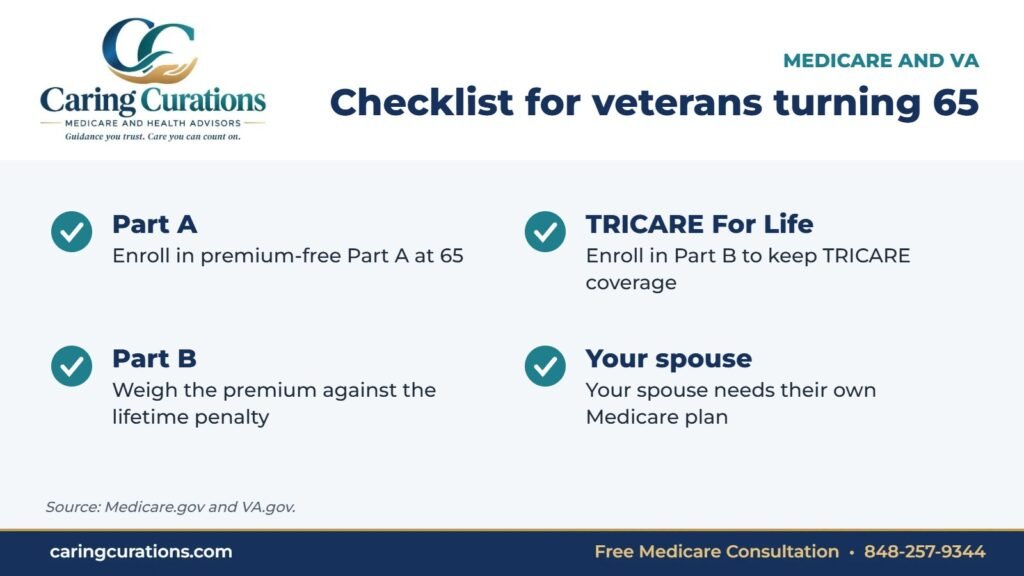
Checklist for Veterans Turning 65
- Confirm your VA enrollment and priority group.
- Enroll in premium-free Part A during your Initial Enrollment Period.
- Decide whether to enroll in Part B, weighing the premium against the lifetime penalty risk.
- If you have TRICARE For Life, enroll in Part B to keep that coverage.
- Keep VA drug coverage, or join a Part D plan if you prefer non-VA pharmacies.
- Compare Medigap and Medicare Advantage options if you enroll in Part B.
- Make sure your spouse has their own Medicare plan in place.
- Keep your VA benefits and Medicare cards with you.
New to Medicare? Our guide on when to sign up for Medicare explains your enrollment window step by step.
VA Benefits and Medicare Examples
Example 1: VA only, with a penalty risk
Robert, 65, is a Vietnam veteran who uses his local VA clinic. He decides to skip Part B. Three years later, he moves to a town far from a VA medical center and wants to see local doctors. He has to sign up during the General Enrollment Period and now pays a Part B penalty of 10% for each full year he waited, for as long as he has Part B.
Example 2: Both VA and Medicare
Linda, 66, is an Air Force veteran in Staten Island. She uses the VA for prescriptions and routine care but enrolls in Part A and Part B and a $0 premium Medicare Advantage plan without drug coverage. She can see a local specialist quickly when the VA wait is long, and she keeps her low VA drug copays.
Example 3: Military retiree with TRICARE For Life
James, 65, retired from the Army after 22 years. He enrolls in Part A and Part B to keep TRICARE For Life, which pays most of what Medicare doesn’t. He also keeps his VA benefits for a service-connected condition.
Common Mistakes Veterans Make With Medicare
- Assuming VA benefits count as job-based coverage. They don’t, so delaying Part B can lead to a penalty.
- Dropping Part B with TRICARE For Life. This can end your TRICARE coverage.
- Buying a Part D plan you don’t need. VA drug coverage is creditable, so you may not need Part D.
- Forgetting the spouse. Your spouse needs their own coverage plan.
- Expecting VA and Medicare to split a bill. They don’t coordinate. Each pays only for its own care.
Frequently Asked Questions About Medicare and VA Benefits
Can I have both VA benefits and Medicare?
Yes. Many veterans have both. VA pays for care at VA facilities, and Medicare pays for care from non-VA providers.
Do I have to sign up for Part B if I have VA benefits?
No, but if you delay and sign up later, you may pay a lifetime late penalty, because VA coverage doesn’t qualify you for a Special Enrollment Period.
Do I need Part D if I have VA drug coverage?
Usually not. VA drug coverage is creditable, so you can delay Part D without a penalty as long as you keep it.
Will Medicare pay for care at a VA hospital?
Generally no. Medicare doesn’t pay for care at VA facilities. The VA covers that care under your VA benefits.
Can a Medicare Advantage plan work with VA benefits?
Yes. You can use your Medicare Advantage plan for non-VA care and your VA benefits for VA care. Some plans are designed specifically for veterans.
Does the VA cover hearing aids?
Many veterans enrolled in VA health care can get hearing aids through the VA. Read our guide, Does Medicare Cover Hearing Aids?
Can I use VA benefits and Medicare for the same visit?
No. For each visit, you choose which coverage to use. VA benefits pay for VA or VA-authorized care, and Medicare pays for other care.
If I have a service-connected disability, do I still need Medicare?
It’s optional, but many veterans with service-connected ratings still enroll in Part A and consider Part B for access to non-VA providers and for their family’s peace of mind.
Does the VA bill Medicare for my care?
No. The VA doesn’t bill Medicare or Medicaid. It may bill Medigap or other private insurance for care that isn’t related to a service-connected condition.
Can I drop Part B later if I only use VA benefits?
You can, but if you want it back later, you may have to wait for the General Enrollment Period and pay a penalty. Think carefully before dropping it.
Can my spouse use my VA benefits?
No. VA health care covers the veteran only. Your spouse needs their own coverage, such as Medicare at 65, job-based insurance or, in some cases, CHAMPVA if you have a permanent and total service-connected disability.
Should I tell a non-VA doctor that I have VA benefits?
Yes. Tell the office which coverage you are using before your visit. If the VA authorized the care, the provider bills the VA. If not, the provider bills Medicare or your Medicare plan, and you pay any normal cost-sharing.
Get Help Coordinating Medicare and VA Benefits
Every veteran’s situation is different, and the right mix of VA benefits and Medicare depends on your health, location and family. Caring Curations is an independent Medicare agency at 26 Bolivar St in Staten Island, New York. We help veterans and their spouses understand how Medicare fits with VA and TRICARE coverage, and compare plans from multiple carriers.
Book a free Medicare consultation or call 848-257-9344. We are licensed in 25 states, and our help is always free.







3 Responses