
Depression, anxiety, grief and memory worries are common as people get older, and many people are not sure whether Medicare will help pay for care. The good news is that Medicare mental health coverage is broader than most people expect, covering therapy, psychiatry, hospital care, prescription drugs and many telehealth visits.
This guide to Medicare mental health coverage explains what Original Medicare covers, which providers you can see, what you pay in 2026, how inpatient and partial hospitalization care work, how drugs are covered, what to know about telehealth, and how Medicare Advantage and Medigap fit in.
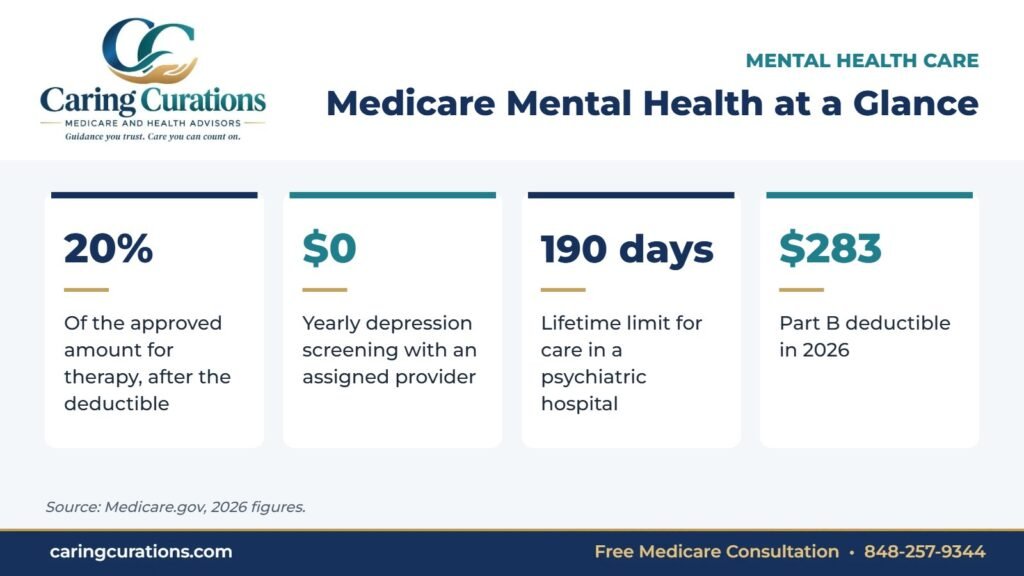
Quick answer: Medicare Part B covers outpatient mental health care, including therapy and psychiatry. After the $283 Part B deductible, you generally pay 20% of the Medicare-approved amount. Licensed marriage and family therapists and mental health counselors have been covered since 2024. Part A covers inpatient psychiatric care, with a 190-day lifetime limit in freestanding psychiatric hospitals. Part D covers most mental health medications. (Medicare.gov)
How Medicare Mental Health Coverage Works
Medicare mental health coverage is split across Medicare’s parts, the same way physical health care is:
- Part A covers inpatient mental health care in a general hospital or a psychiatric hospital.
- Part B covers outpatient care, such as therapy, psychiatrist visits, testing, partial hospitalization and intensive outpatient programs.
- Part D covers prescription drugs you take at home, such as antidepressants.
- Medicare Advantage (Part C) plans must cover everything Original Medicare covers, usually with their own networks and copays.
Substance use disorder care is part of Medicare mental health coverage too. Medicare treats both as medical care, not as an extra.
Outpatient Therapy and Psychiatry Under Part B
Part B covers a wide range of outpatient services to diagnose and treat mental health conditions, including:
- Individual and group psychotherapy
- Family counseling, when the main purpose is to help with your treatment
- Psychiatric evaluations and diagnostic tests
- Medication management with a psychiatrist or other prescriber
- Care in a doctor’s office, a clinic, a hospital outpatient department or a community mental health center
What you pay
For most outpatient visits, you pay the Part B deductible first ($283 in 2026). After that, you generally pay 20% of the Medicare-approved amount, as long as your provider accepts assignment. If you get care in a hospital outpatient clinic, you may also owe the hospital a copayment or coinsurance.
Medicare mental health coverage has no set limit on the number of therapy sessions, as long as the care is medically necessary. Read our full guide to Medicare Part B for how the deductible and coinsurance work.
Which Providers Medicare Mental Health Coverage Includes
Medicare covers outpatient mental health care from many kinds of licensed professionals, as long as they are allowed to practice in your state and enrolled in Medicare:
- Psychiatrists and other doctors
- Clinical psychologists
- Clinical social workers
- Clinical nurse specialists
- Nurse practitioners
- Physician assistants
- Marriage and family therapists
- Mental health counselors
The 2024 change for therapists and counselors
Starting January 1, 2024, Medicare began paying licensed marriage and family therapists and mental health counselors directly. Before that, many of these professionals couldn’t bill Medicare at all. The change greatly widened the reach of Medicare mental health coverage. In New York, that includes licensed mental health counselors (LMHCs) and licensed marriage and family therapists (LMFTs) who have enrolled in Medicare.
Before your first visit, ask the office two questions: “Are you enrolled in Medicare?” and “Do you accept assignment?” A provider who has opted out of Medicare can still see you, but Medicare won’t pay, and you’ll owe the full bill under a private contract.
Depression Screening and Wellness Visits
Medicare mental health coverage includes one depression screening each year at no cost to you if your provider accepts assignment. The screening must be done in a primary care setting that can provide follow-up treatment and referrals.
Your “Welcome to Medicare” preventive visit and your yearly wellness visit also include a review of your risk for depression. These visits are a good time to mention changes in mood, sleep, memory or appetite. Learn what else is covered in our guide to the Medicare annual wellness visit.
Medicare also covers yearly alcohol misuse screening and, for people who qualify, brief counseling sessions, plus an annual cognitive assessment as part of the wellness visit if you or your doctor have concerns about memory.
Inpatient Psychiatric Care Under Part A
If you need to be admitted for mental health treatment, the Part A side of Medicare mental health coverage pays for inpatient care in either a general hospital or a psychiatric hospital. Part A costs are the same as for any hospital stay and are charged per benefit period.
| Inpatient days (each benefit period) | What you pay in 2026 |
|---|---|
| Days 1 to 60 | $1,736 deductible, then $0 per day |
| Days 61 to 90 | $434 per day |
| Days 91 and beyond (lifetime reserve days) | $868 per day, for up to 60 lifetime reserve days |
| After lifetime reserve days are used | All costs |
| Mental health services from doctors during your stay | 20% of the Medicare-approved amount (Part B) |
The 190-day lifetime limit
Part A pays for up to 190 days of inpatient care in a freestanding psychiatric hospital during your lifetime. This limit doesn’t apply to mental health care you receive as an inpatient in a general hospital, including a psychiatric unit within a general hospital. (Medicare.gov)
Most people with Medicare mental health coverage never come close to the 190-day limit. It matters most for people with a serious mental illness who need repeated or long stays. If you or a family member has used psychiatric hospital days in the past, keep track of them. Learn more about hospital costs in our guide to Medicare Part A.
Partial Hospitalization and Intensive Outpatient Programs
Some people need more support than a weekly therapy session but don’t need to stay in a hospital overnight. Medicare mental health coverage includes two structured programs for this, both under Part B.
Partial hospitalization
Partial hospitalization is a full-day program of mental health care for people who need at least 20 hours of services per week. It is offered by hospital outpatient departments and community mental health centers. A doctor must certify that you would otherwise need inpatient care.
Intensive outpatient program
Since January 1, 2024, Medicare also covers intensive outpatient programs. These are part-time programs for people who need at least 9 hours of services per week, offered by hospital outpatient departments, community mental health centers, rural health clinics, federally qualified health centers and opioid treatment programs.
For both programs, you generally pay a percentage of the Medicare-approved amount for each day of service after the Part B deductible. Ask the program for an estimate before you start.
Prescription Drugs for Mental Health Under Part D
Medications you take at home, such as antidepressants, anti-anxiety medications, mood stabilizers and antipsychotics, are covered by Part D or by a Medicare Advantage plan that includes drug coverage.
Part D plans are required to cover all or substantially all drugs in certain protected classes, which include antidepressants, antipsychotics and anticonvulsants. That gives Medicare mental health coverage strong drug protections, but plans can still use prior authorization or step therapy for some drugs, and copays vary by plan.
In 2026, your out-of-pocket costs for covered Part D drugs are capped at $2,100 for the year. If your income is limited, Extra Help can lower your premium and copays a great deal. See our guides to Medicare Part D and Medicare Extra Help. Each fall, check that your mental health medications are still on your plan’s drug list for next year, since formularies change and this part of Medicare mental health coverage is easy to overlook.
Medicare Mental Health Coverage and Telehealth
Telehealth has become one of the most popular ways to get mental health care. You can talk with a therapist or psychiatrist by video from home, which helps if you have trouble getting around or live far from providers.
What is settled
- Medicare covers telehealth for outpatient mental health care, including psychotherapy and medication management.
- Federal law allows people to receive mental health telehealth at home, not just at a clinic.
- In some cases, audio-only phone visits can be used for mental health care if you can’t use video or don’t want to.
- Your costs are generally the same as for an in-person visit.
What has kept changing
Telehealth rules within Medicare mental health coverage have changed several times since 2020. Congress and CMS have repeatedly extended the broad telehealth flexibilities that started during the pandemic. As of this writing, Medicare.gov says that through December 31, 2027, Medicare covers telehealth services you get from anywhere in the U.S. (Medicare.gov)
There is also a rule that can require an in-person visit with your mental health provider before you start telehealth care and at regular intervals afterward. That requirement has been set, delayed and revised more than once, and how it applies can depend on when you started care with your provider and on the latest action by Congress.
Because these rules move often, ask your provider directly: “Do I need an in-person visit for my telehealth sessions to be covered, and if so, when?” Medicare Advantage plans may also offer extra telehealth benefits of their own, so check your plan’s materials as well.
What Medicare Mental Health Coverage Doesn’t Include
Medicare covers care to diagnose and treat a mental health condition. It generally doesn’t pay for:
- Meals or transportation to and from mental health programs
- Support groups that mainly bring people together to socialize (group therapy led by a qualified provider is covered)
- Job skills testing or job training that isn’t part of treatment
- Care from a provider who has opted out of Medicare
- Long-term custodial care in a facility
Some Medicare Advantage plans add extras to their Medicare mental health coverage, such as rides to medical appointments, including mental health visits. Ask what your plan offers.
Substance Use Disorder Treatment
Medicare mental health coverage also includes treatment for alcohol and drug use disorders in many of the same settings as mental health care. This includes outpatient counseling, inpatient care, partial hospitalization and intensive outpatient programs.
Part B also covers opioid use disorder treatment through Medicare-enrolled opioid treatment programs, including medications such as methadone and buprenorphine, counseling and drug testing. You may owe a copayment, so ask the program what you will pay.

Medicare Advantage and Medicare Mental Health Coverage
A Medicare Advantage plan must offer at least the same Medicare mental health coverage as Original Medicare, but the way you get care can differ:
- Networks: You may need to use therapists and psychiatrists in the plan’s network. Mental health networks can be thinner than medical networks, so check before you enroll.
- Copays: Instead of 20% coinsurance, you’ll often pay a flat copay per therapy visit.
- Prior authorization: Some plans require approval for inpatient stays, partial hospitalization or certain drugs.
- Yearly limit: Your out-of-pocket costs for covered services are capped. In 2026, the limit can be as high as $9,250 in network.
If you already see a therapist you like, call the office and ask which Medicare Advantage plans they accept before you choose a plan. Our guide to Medicare Advantage vs Original Medicare walks through the trade-offs.
Medigap and Medicare Mental Health Coverage
If you have Original Medicare, a Medigap (Medicare Supplement) policy can pay some or all of the costs Medicare leaves behind, including:
- The 20% Part B coinsurance for therapy and psychiatry visits
- The Part A hospital deductible and daily coinsurance for inpatient stays
- Coinsurance for partial hospitalization and intensive outpatient programs
With Original Medicare and Medigap, you can see any mental health provider in the country who accepts Medicare, with no network and no referrals. That freedom can matter a great deal if you want to keep a long-term therapist. Medigap doesn’t cover prescription drugs, so you’ll want a Part D plan too. Learn more in our guide to what Medigap is.
Helping a Parent or Spouse Get Care
Many calls we get about mental health come from adult children or spouses, not the person who needs care. Older adults sometimes see depression or anxiety as a normal part of aging, or worry about what treatment will cost. Knowing the basics of Medicare mental health coverage can make that first conversation easier.
- Lead with what you’ve noticed. Changes in sleep, appetite, energy, interest in old hobbies or pulling away from friends are worth mentioning gently.
- Suggest the primary care doctor first. A regular checkup feels less intimidating than a first visit with a therapist, and the doctor can screen and refer.
- Take cost off the table. Explain that the yearly depression screening is free with a provider who accepts assignment and that therapy is covered under Part B.
- Offer practical help. Helping set up a video visit, sitting in on the first appointment or driving to a program can remove the biggest barriers.
Keep in mind that medical providers generally need your loved one’s permission to share details with you. Ask them to sign a release form at the provider’s office so you can help with scheduling and questions.
How to Use Your Medicare Mental Health Coverage
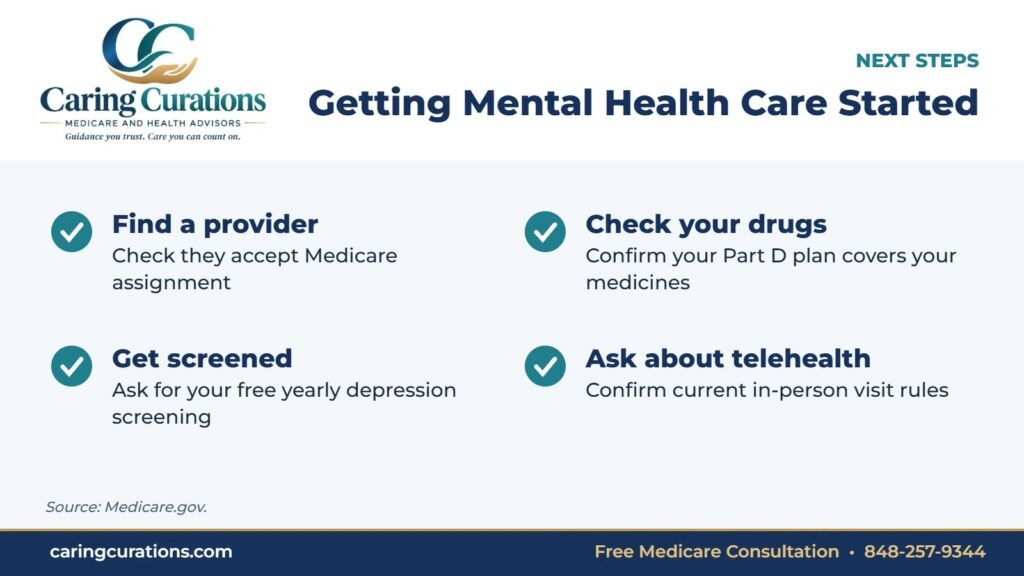
- Start with your primary care doctor. Ask for your yearly depression screening or mention your concerns. Your doctor can refer you to a specialist.
- Find a provider who takes Medicare. Use Medicare’s Care Compare tool or call your plan for a list of in-network providers.
- Confirm assignment or network status. This keeps your costs predictable.
- Check your drug coverage. Look up your medications in your Part D or Medicare Advantage plan’s formulary.
- Ask about telehealth. Confirm whether video or phone visits are available and whether an in-person visit is needed.
- Review your plan each fall. During the Annual Enrollment Period, October 15 to December 7, check that your providers and medications are still covered for next year.
Medicare Mental Health Coverage Examples
Example 1: Weekly therapy after a loss
Margaret, 72, of Staten Island lost her husband last year and has been struggling with depression. Her doctor refers her to a licensed mental health counselor who accepts Medicare. Under her Medicare mental health coverage, she pays 20% of each session after she meets the Part B deductible. Her Medigap Plan G covers that 20%, so she pays nothing more for therapy for the rest of the year.
Example 2: Telehealth psychiatry
Walter, 68, takes medication for anxiety and has trouble driving at night. He meets with his psychiatrist by video every two months. His provider’s office tells him exactly when he needs to come in person, and his Part D plan covers his medication with a low copay.
Example 3: An intensive outpatient program
Angela, 66, has a Medicare Advantage plan. After a hard few months, her psychiatrist recommends an intensive outpatient program three days a week. Her plan requires prior authorization, which her psychiatrist submits. Angela pays her plan’s copay for each program day, and her costs count toward her yearly out-of-pocket limit.
Common Mistakes With Medicare Mental Health Coverage
- Assuming therapy isn’t covered. Medicare mental health coverage includes therapy and psychiatry under Part B.
- Not asking if the provider takes Medicare. A provider who has opted out can bill you the full cost.
- Skipping the free screening. The yearly depression screening costs nothing with a provider who accepts assignment.
- Choosing a plan without checking the therapist. Make sure your provider is in network before you join a Medicare Advantage plan.
- Relying on old telehealth rules. The rules have changed several times, so confirm with your provider.
- Not checking the drug list. Make sure your medications are on your plan’s formulary each year.
- Waiting too long to ask for help. Mental health care works best when you start early.
Frequently Asked Questions About Medicare Mental Health Coverage
Does Medicare cover therapy?
Yes. Part B covers individual and group therapy from Medicare-enrolled providers. After the deductible, you generally pay 20% of the Medicare-approved amount.
Does Medicare cover licensed mental health counselors?
Yes. Since January 1, 2024, Medicare covers services from licensed mental health counselors and licensed marriage and family therapists who are enrolled in Medicare.
Does Medicare mental health coverage limit therapy sessions?
No set number. Medicare covers sessions as long as they are medically necessary and from a qualified provider.
What is the 190-day limit?
Part A pays for up to 190 days of inpatient care in a freestanding psychiatric hospital over your lifetime. Mental health stays in a general hospital don’t count toward it.
Can I see a therapist by video?
Yes. Medicare mental health coverage extends to telehealth, including from home. In-person visit rules have changed several times, so ask your provider what currently applies to you.
Does Medicare cover antidepressants?
Yes, through Part D or a Medicare Advantage plan with drug coverage. Antidepressants are a protected class, so plans must cover all or substantially all of them.
What if I’m in crisis?
If you or someone you love is in crisis, call or text 988 to reach the 988 Suicide and Crisis Lifeline, or call 911. Medicare covers emergency care at any hospital that accepts Medicare.
Get Help Comparing Medicare Mental Health Coverage
The right plan can make it easier to keep your therapist, afford your medications and get care quickly when you need it. Caring Curations is an independent Medicare agency at 26 Bolivar St in Staten Island, New York. We can check whether your providers and medications are covered and compare Medicare mental health coverage across Medigap, Medicare Advantage and Part D plans from multiple carriers.
Book a free Medicare consultation or call 848-257-9344. We are licensed in 25 states, and our help is always free.