

When you compare Medicare Advantage or Part D plans, you will see a score from 1 to 5 stars next to each one. These Medicare Star Ratings are Medicare’s official report card for plan quality, and they can tell you a lot about how a plan treats its members. They can also open a special chance to switch plans during the year.
This guide explains what the ratings measure, what the 2027 results show, how to use stars to compare plans, how the 5-star Special Enrollment Period works, what the low-performing icon means, and where stars fall short.
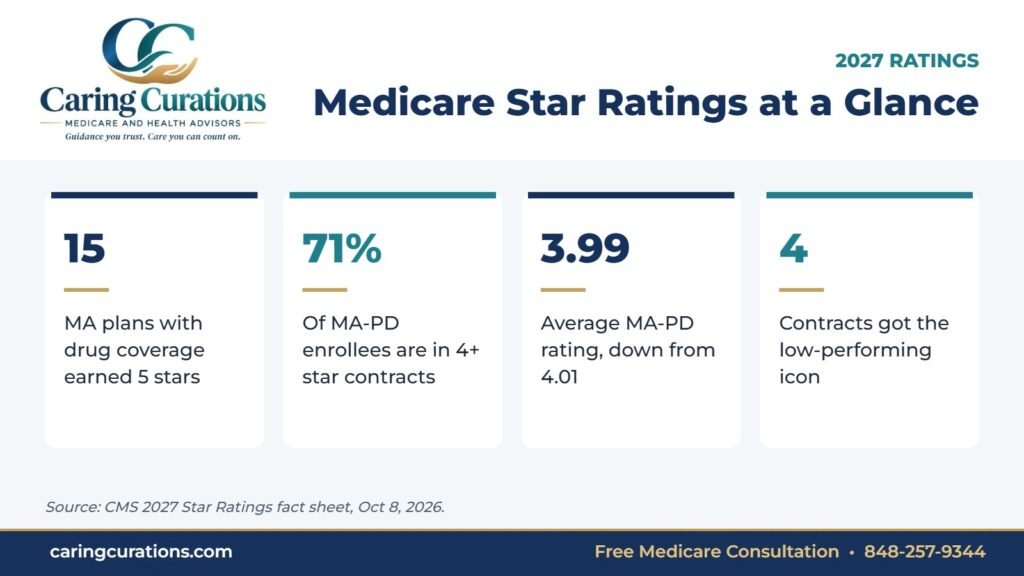
Quick answer: Medicare rates Medicare Advantage and Part D plans each fall on a scale of 1 to 5 stars, based on quality, member experience, customer service and drug safety. The 2027 ratings were released on October 8, 2026. Fifteen Medicare Advantage plans with drug coverage earned 5 stars, about 71% of those enrollees are in plans with 4 or more stars, and four contracts received the low-performing icon. (CMS.gov)
What Are Medicare Star Ratings?
The Centers for Medicare & Medicaid Services (CMS) gives each Medicare Advantage and Part D plan an overall score from 1 to 5 stars, in half-star steps. Medicare describes the scores this way:
- 5 stars: excellent
- 4 stars: above average
- 3 stars: average
- 2 stars: below average
- 1 star: poor
Medicare Star Ratings are given to a plan’s contract, not to each individual plan. One insurance company contract can include several plans in different counties, so all of those plans share the same rating.
Medicare Star Ratings apply only to Medicare Advantage plans and stand-alone Part D drug plans. Medigap policies and Original Medicare don’t have star ratings.
What Medicare Star Ratings Measure
Medicare Star Ratings are built from dozens of individual measures. In 2027, Medicare Advantage plans with drug coverage are rated on up to 43 measures, Medicare Advantage plans without drug coverage on up to 32, and stand-alone Part D plans on up to 13.
Medicare Advantage health plan measures
- Staying healthy: screenings, tests and vaccines, such as cancer screenings and flu shots
- Managing chronic conditions: how well the plan helps members with diabetes, heart disease and other long-term conditions
- Member experience: survey results on getting care quickly and how members rate the plan
- Complaints and changes: how often members complain or leave the plan
- Customer service: how the plan handles appeals and calls
Part D drug plan measures
- Customer service and call center access
- Member complaints and how many members leave
- Member experience with getting prescriptions filled
- Drug safety and pricing accuracy: medication adherence, safe prescribing and correct prices in Medicare Plan Finder
For 2027, CMS added two new Part D safety measures: one that tracks the concurrent use of opioids and benzodiazepines, and one that tracks the use of multiple anticholinergic medications in older adults. Both aim to reduce risky drug combinations.
How Medicare Star Ratings Are Calculated
Each measure gets its own score of 1 to 5 stars. CMS then combines those scores into category scores and one overall rating, rounded to the nearest half star.
Not every measure counts the same. In general:
- Outcome measures, such as how well members’ blood sugar or blood pressure is controlled, carry more weight than simple process measures.
- Member experience and access measures, such as how easy it is to get appointments and care, also carry extra weight.
- Improvement measures give credit to plans that get better from one year to the next.
- Process measures, such as whether a screening was done, count but usually carry less weight.
CMS also adjusts some scores for factors outside a plan’s control, such as a high share of members with low incomes or disabilities, and it can lower ratings when data is missing or a plan doesn’t follow the rules. The details are technical, but the goal is a fair comparison between plans that serve very different groups of people.
Where Medicare Star Ratings Data Comes From
The ratings combine several kinds of data:
- Member surveys about getting care, customer service and overall satisfaction
- Medical and pharmacy records that show whether members got recommended care
- Medicare’s own records, such as complaints, appeals and how many members leave a plan
- Plan reports and audits of call centers and pricing accuracy
Because the data is collected and checked over time, Medicare Star Ratings often reflect plan performance from a year or two earlier. A plan can improve or slip between the time the data is gathered and the time you enroll.
The 2027 Medicare Star Ratings: Key Results
CMS released the 2027 Medicare Star Ratings on October 8, 2026, just before the Annual Enrollment Period that runs from October 15 to December 7. These ratings apply to plans for the 2027 plan year.
Medicare Advantage plans with drug coverage
- 15 contracts earned 5 stars.
- About 37% of contracts, or 188 of 508, earned 4 stars or more.
- About 71% of enrollees are in contracts with 4 or more stars.
- The average rating, weighted by enrollment, is 3.99, down slightly from 4.01 the year before.
- Four contracts received the low-performing icon.
Stand-alone Part D plans
- No stand-alone Part D plans earned 5 stars for 2027.
- About 27% of these plans, 11 contracts, earned 4 stars or more.
- The enrollment-weighted average Part D rating rose to 3.22, from 3.01 the year before.
The takeaway: most people in Medicare Advantage are in plans rated 4 stars or higher, but 5-star plans are rare, and no stand-alone drug plan reached 5 stars this year. For a look at other plan changes coming next year, see 2027 Medicare Advantage plan changes.
Why Medicare Star Ratings Matter to Plans and to You
Medicare Star Ratings aren’t just a label. Medicare Advantage plans that earn 4 stars or more receive quality bonus payments from Medicare. The 2027 ratings will affect bonus payments in 2028.
Plans often use those bonuses to fund extra benefits, such as lower copays, dental and vision coverage, or a $0 premium. That’s one reason ratings can shift what plans offer from year to year. Learn more about how these plans keep costs low in $0 premium Medicare Advantage plans.
For you, higher Medicare Star Ratings usually mean a plan has a better track record of helping members get preventive care, managing chronic conditions and handling service problems well.
How to Use Medicare Star Ratings to Compare Plans
Medicare Star Ratings are a useful tool, but they should be one part of your decision, not the whole thing. Here is a practical way to use them:
- Start with what you need. Make a list of your doctors, hospitals, prescriptions and pharmacies.
- Narrow your choices to plans that include your doctors and cover your drugs.
- Then compare the stars. Among plans that fit, a 4 or 5-star plan is usually a safer choice than a 2 or 3-star plan.
- Look at the detail. In Medicare Plan Finder, you can see ratings by category, such as customer service or drug safety, not just the overall score.
- Compare total costs. Check premiums, copays, the drug deductible and the yearly out-of-pocket limit, which can be as high as $9,250 in network in 2026.
If you are new to these plans, start with What Is Medicare Advantage? and our guide to Medicare Advantage HMO vs PPO.
2027 Medicare Star Ratings by the Numbers
| 2027 rating fact | Medicare Advantage with drug coverage | Stand-alone Part D plans |
|---|---|---|
| Maximum number of measures | Up to 43 | Up to 13 |
| Contracts with 5 stars | 15 | 0 |
| Contracts with 4+ stars | About 37% (188 of 508) | About 27% (11 contracts) |
| Enrollees in 4+ star contracts | About 71% | About 22% |
| Average rating, weighted by enrollment | 3.99 (down from 4.01) | 3.22 (up from 3.01) |
| Low-performing icon | 4 contracts | Check Plan Finder |
Source: CMS 2027 Star Ratings fact sheet, October 8, 2026.

The 5-Star Special Enrollment Period
If a 5-star Medicare Advantage plan or Part D plan is available where you live, you can switch into it once during the year using the 5-star Special Enrollment Period. You don’t have to wait for the fall Annual Enrollment Period.
How it works
- You can use it once between December 8 and November 30 of the following year. For plans with 5-star ratings for 2027, that window runs from December 8, 2026, to November 30, 2027.
- You can move into a 5-star Medicare Advantage plan, a 5-star Part D plan or another 5-star Medicare plan available in your area.
- Your new coverage usually starts the first day of the month after the plan gets your request.
Watch your drug coverage
Be careful if you switch from a Medicare Advantage plan with drug coverage to a 5-star plan that doesn’t include drugs. You could lose your Part D coverage and have to wait until the next enrollment period to get it back, and you may owe a late enrollment penalty. Always confirm drug coverage before you use this period.
Because 5-star plans are rare, this option isn’t available everywhere. Read our full guide to the Medicare Special Enrollment Period for other ways to change plans. (KFF)
The Low-Performing Icon
Medicare Star Ratings also flag plans that have scored poorly for a long time. A plan gets a low-performing icon in Medicare Plan Finder when it has been rated below 3 stars for at least three years in a row. For 2027, four Medicare Advantage contracts with drug coverage received this icon, the same number as the year before.
If you are in one of these plans:
- Medicare may send you a notice explaining the plan’s low rating.
- You may qualify for a Special Enrollment Period to switch to a higher-rated plan.
- Plan Finder warns shoppers about these plans, and you may need to contact the plan directly to join one.
A low-performing icon doesn’t mean the plan will close, but it is a strong signal to review your options.
Medicare Star Ratings for Special Needs Plans
Special Needs Plans, including plans for people with both Medicare and Medicaid and plans for people with certain chronic conditions, also receive star ratings. Like other plans, they are rated at the contract level.
Because these plans serve members with more health and social needs, a 3.5 or 4-star rating can still reflect strong work. If you qualify for a Special Needs Plan, compare its rating with other plans you are eligible for, but give extra weight to care coordination, extra benefits and whether your current doctors take the plan.
What About New Plans With No Rating?
Some plans show “Plan too new to be measured” or “Not enough data available” in Plan Finder. This usually means the contract is new or too small to rate.
A new plan isn’t necessarily a bad plan. It just doesn’t have a track record yet. If you are considering one, look closely at the company’s other contracts, its network and its customer service reputation in your area.
Where Medicare Star Ratings Fall Short
Medicare Star Ratings are helpful, but they have blind spots:
- They are averages. A plan’s rating reflects all its members, not your specific doctors or conditions.
- They look backward. The data often comes from a year or two before the plan year.
- They don’t measure your costs. A 5-star plan may still have higher copays or not cover your drugs.
- They don’t measure networks. A plan’s stars won’t tell you whether your doctor or hospital is in network.
- They apply by contract. A plan in your county may share a rating with plans in very different areas.
That’s why a 4-star plan that fits your doctors and drugs is often a better choice than a 5-star plan that doesn’t.
It also helps to look at the trend. A plan that has moved from 3 stars to 4 stars over a few years may be improving its service, while a plan that keeps slipping may be struggling. Plan Finder and plan materials often show past ratings, so ask about them when you compare.
Questions to Ask Beyond Medicare Star Ratings
Before you join any plan, high-rated or not, ask these questions:
- Are my primary care doctor, specialists and preferred hospital in network for next year?
- Are all of my prescriptions on the formulary, and at what tier?
- Do any of my drugs or services need prior authorization or step therapy?
- What is the yearly out-of-pocket limit, and what are the hospital and specialist copays?
- Which pharmacies are preferred, and is mail-order available?
- What dental, vision and hearing benefits are included, and what are the limits?
- How does the plan score in the categories that matter most to me, such as customer service or managing chronic conditions?
Writing down the answers side by side for two or three plans makes the choice much clearer than looking at stars alone.
Checking Medicare Star Ratings During Open Enrollment
Every year, star ratings can change. A plan that was 4.5 stars last year might drop to 3.5, or the reverse. During each Annual Enrollment Period, from October 15 to December 7, take a few minutes to check your plan’s new rating along with its Annual Notice of Change.
If your plan’s rating drops, that alone isn’t a reason to panic. Read what changed, compare your plan’s costs and network with two or three alternatives, and switch only if another plan is a better fit for your needs.
Many people in New York and across the country simply let their plan renew without looking. For a list of common slip-ups, read Medicare Open Enrollment 2027: 7 Mistakes to Avoid. If you need drug coverage details, see our Medicare Part D guide.

Medicare Star Ratings Examples
Margaret, 71: using the 5-star period
Margaret is in a 3.5-star Medicare Advantage plan with drug coverage. In March, she learns a 5-star Medicare Advantage plan with drug coverage is available in her county, and it includes her doctors. She uses the 5-star Special Enrollment Period to switch, and her new plan starts April 1. She can’t use this period again until the next window opens December 8.
Joe, 68: avoiding a low-performing plan
Joe is comparing plans for 2027. One plan has a very low premium, but Plan Finder shows a low-performing icon because it has been rated below 3 stars for three years in a row. Joe chooses a 4-star plan with a slightly higher premium but better customer service scores and his preferred hospital in network.
Carol, 75: choosing fit over stars
Carol lives on Staten Island and sees a cardiologist she trusts. The only 5-star plan in her area doesn’t include him. She picks a 4-star PPO that does, and she keeps her care team. For Carol, the right network mattered more than an extra star.
Common Mistakes With Medicare Star Ratings
- Choosing by stars alone. A high rating doesn’t guarantee your doctors or drugs are covered.
- Ignoring the low-performing icon. Three years of low scores is a real warning sign.
- Losing drug coverage with the 5-star SEP. Switching to a 5-star plan without drug coverage can leave you without Part D.
- Using the 5-star SEP twice. You only get one switch per window.
- Not rechecking each fall. Ratings change every October.
- Looking for stars on Medigap. Medigap policies aren’t rated, so compare them by price and insurer instead.
Frequently Asked Questions About Medicare Star Ratings
When are Medicare Star Ratings released?
CMS releases new ratings every fall, before the Annual Enrollment Period. The 2027 ratings were released on October 8, 2026.
Where can I find a plan’s star rating?
Medicare Star Ratings appear in Plan Finder on Medicare.gov and in plan marketing materials. You can also ask a licensed agent or call 1-800-MEDICARE.
Do Medigap plans have Medicare Star Ratings?
No. Star ratings apply only to Medicare Advantage and Part D plans. Medigap policies are standardized, so you compare them by price and the insurer’s service.
How often can I use the 5-star Special Enrollment Period?
Once between December 8 and November 30 of the following year, and only to join a plan rated 5 stars that is available in your area.
What does a low-performing icon mean?
It means the plan has been rated below 3 stars for at least three years in a row. You may be able to switch to a higher-rated plan using a Special Enrollment Period.
Is a 5-star plan always the best choice?
No. A 5-star plan is a strong sign of quality, but it still needs to include your doctors, cover your drugs and fit your budget.
Why do Medicare Star Ratings change from year to year?
Ratings are recalculated every year based on updated data and measure changes. A plan’s score can rise or fall even if its benefits look the same.
Get Help Comparing Medicare Star Ratings
Star ratings are a great starting point, but the best plan is the one that fits your doctors, prescriptions and budget. Caring Curations is an independent Medicare agency at 26 Bolivar St in Staten Island, New York. We compare Medicare Star Ratings, networks and costs across multiple carriers, and we can tell you if a 5-star plan is available where you live.
Book a free Medicare consultation or call 848-257-9344. We are licensed in 25 states, and our help is always free.