

Medicare isn’t free, and for people on a fixed income, the monthly Part B premium alone can be a real strain. Medicare Savings Programs are state-run programs that help pay Medicare premiums, and in some cases deductibles and coinsurance, for people with limited income and resources. Many people who qualify for Medicare Savings Programs never apply, often because they assume they earn too much.
This guide explains the three main Medicare Savings Programs, the 2026 income and resource limits, special rules in New York, and how to apply.
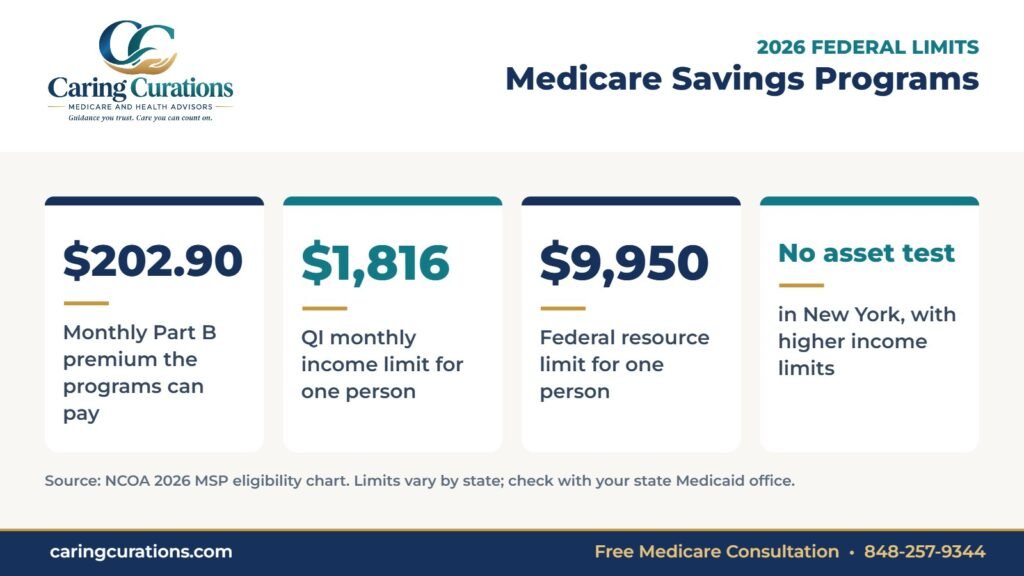
Quick answer: Medicare Savings Programs help pay your Part B premium of $202.90 a month in 2026, and the most generous program, QMB, also covers Part A and Part B deductibles and coinsurance. Under the federal limits, you may qualify with monthly income up to about $1,816 as an individual or $2,455 as a couple, and resources up to $9,950 or $14,910. Many states, including New York, have higher limits. (Medicare.gov)
What Are Medicare Savings Programs?
Medicare Savings Programs, often shortened to MSPs, are run by each state’s Medicaid office and funded jointly by the state and federal government. They are designed for people who have Medicare but struggle to afford its costs.
Depending on which program you qualify for, Medicare Savings Programs can pay for:
- Your Part B premium
- Your Part A premium, if you have to pay one
- Part A and Part B deductibles
- Coinsurance and copays for Medicare-covered services
There is one more important benefit. If you qualify for any of the Medicare Savings Programs, you automatically qualify for Extra Help, the federal program that lowers your Part D drug costs. That alone can save hundreds or thousands of dollars a year. Read more in our guide to Medicare Extra Help.
The 3 Main Medicare Savings Programs
There are three main Medicare Savings Programs available in most states. A fourth, smaller program helps certain working people with disabilities.
1. Qualified Medicare Beneficiary (QMB) Program
QMB is the most generous of the Medicare Savings Programs. It pays:
- Part A premiums (if you owe one)
- Part B premiums
- Part A and Part B deductibles
- Coinsurance and copays for Medicare-covered services
If you are in the QMB program, doctors and hospitals that accept Medicare are not allowed to bill you for Medicare-covered services, apart from small Medicaid copays in some states. This protection is called the QMB billing protection, and it applies even if you are enrolled in a Medicare Advantage plan.
2. Specified Low-Income Medicare Beneficiary (SLMB) Program
SLMB pays your Part B premium only. It is for people whose income is a little too high for QMB. In 2026, SLMB alone saves you $202.90 a month, or $2,434.80 a year.
3. Qualifying Individual (QI) Program
QI also pays your Part B premium only, for people with income slightly higher than the SLMB limit. QI is funded each year in blocks, so applications are approved on a first-come, first-served basis. People who had QI the previous year generally get priority. It is a good idea to apply early in the year.
4. Qualified Disabled and Working Individuals (QDWI) Program
QDWI pays the Part A premium for certain people under 65 who have a disability, returned to work and lost premium-free Part A because of their earnings. It is the smallest of the Medicare Savings Programs and has different income limits.
Medicare Savings Programs Income Limits for 2026
Federal limits are based on the federal poverty level and include a $20 general income disregard. Here are the 2026 federal standards that most states follow:
| Program | Monthly income limit (individual) | Monthly income limit (couple) | What it pays |
|---|---|---|---|
| QMB | $1,350 | $1,824 | Part A and B premiums, deductibles, coinsurance |
| SLMB | $1,616 | $2,184 | Part B premium |
| QI | $1,816 | $2,455 | Part B premium |
The 2026 federal resource limits for all three programs are $9,950 for an individual and $14,910 for a married couple. (NCOA)
What counts as income
States look at your gross monthly income, before deductions. This usually includes Social Security benefits, pensions, wages, annuity payments and interest. Some types of income are not counted, and states often apply extra disregards. For example, part of your earned income from work is usually excluded. Because of these rules, many people with income above the published limits still qualify.
What counts as resources
Resources include money in checking and savings accounts, stocks, bonds and mutual funds. The following are generally not counted:
- Your home
- One car
- Household goods and personal belongings
- A burial plot
- Up to $1,500 set aside for burial expenses per person
- Life insurance with a face value of $1,500 or less
Medicare Savings Programs in New York
If you live in New York, the rules are more generous than the federal standard. New York expanded its Medicare Savings Programs in 2023:
- No asset test. New York does not count your savings or other resources for Medicare Savings Programs.
- Higher income limits. In 2026, the New York QMB limit is about $1,856 a month for an individual and $2,509 for a couple. The QI limit is about $2,494 for an individual and $3,375 for a couple.
- SLMB was folded into QMB. Because the QMB limit was raised, New York no longer uses a separate SLMB program.
That means many New Yorkers with modest pensions and Social Security, who thought they earned too much, now qualify for help with their Part B premium. If you live in Staten Island or anywhere in New York and your monthly income is under about $2,500, it is worth checking. (Medicare Interactive)
Other states with different rules
Several other states also have higher limits or no asset test. Alaska and Hawaii have higher income limits, and some states such as Connecticut, Massachusetts and the District of Columbia have expanded eligibility. Because limits change every year, always check with your state Medicaid office or a local SHIP counselor for current figures.
How Medicare Savings Programs Save You Money
Here is what Medicare Savings Programs can be worth in 2026:
| Cost covered | 2026 amount | Who gets help |
|---|---|---|
| Part B premium | $202.90/month ($2,434.80/year) | QMB, SLMB, QI |
| Part B deductible | $283/year | QMB |
| Part A hospital deductible | $1,736 per benefit period | QMB |
| Part B coinsurance | Usually 20% of the Medicare-approved amount | QMB |
| Part D costs through Extra Help | Premium and deductible help, low copays | All MSP enrollees |
For someone with QMB who has a hospital stay and regular doctor visits, the savings can easily reach several thousand dollars a year. Even SLMB or QI adds about $200 a month back to your Social Security check, because the Part B premium is no longer deducted.

Who Should Apply for Medicare Savings Programs?
You should consider applying if any of these describe you:
- Your Part B premium takes a noticeable bite out of your Social Security check.
- You skip doctor visits or prescriptions because of copays.
- Your income is mostly Social Security, with little or no pension.
- You recently lost a spouse and your household income dropped.
- You live in New York or another state with higher limits or no asset test.
- You were denied in the past, but your income or your state’s rules have changed.
There is no penalty for applying and being turned down, and the application is free.
How to Apply for Medicare Savings Programs
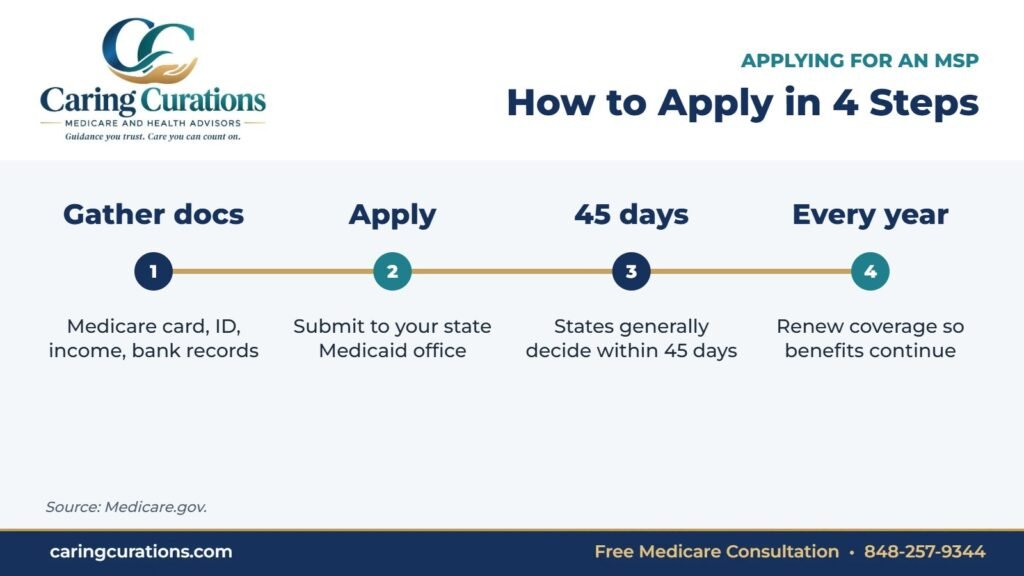
You apply for Medicare Savings Programs through your state Medicaid office, not through Social Security or Medicare. The process usually looks like this:
- Gather your documents. You will usually need your Medicare card, proof of identity, proof of address, your Social Security award letter, pension statements and recent bank statements (if your state counts resources).
- Get the application. Contact your state Medicaid office, apply online if your state allows it, or ask a SHIP counselor for help. In New York City, applications are handled by the Human Resources Administration (HRA); elsewhere in New York, by your local Department of Social Services.
- Submit and keep copies. Send the application and copies of your documents, and keep copies for yourself.
- Watch for a decision. States generally must decide within 45 days. If you are approved, your Part B premium will stop being deducted from your Social Security check, usually within a few months, and you may receive a refund for months already paid.
- Renew each year. Most states require you to renew Medicare Savings Programs coverage annually. Watch your mail so you don’t lose benefits.
Tips that make approval easier
- Apply even if you think you are slightly over the limit, because disregards may bring your countable income down.
- Answer every question on the form, and include a phone number where you can be reached.
- If you are denied, ask for the reason in writing. You have the right to appeal.
- If you can’t pay your Part A premium because you don’t have enough work history, ask about the state “buy-in” option.
Medicare Savings Programs and Medicare Advantage
You can be in a Medicare Savings Program and also have a Medicare Advantage plan. The program pays your Part B premium, and QMB members are also protected from being billed for Medicare-covered cost-sharing.
People with Medicare Savings Programs are considered partial dual eligibles. That opens the door to some extra choices:
- A monthly Special Enrollment Period that lets you leave a Medicare Advantage plan for Original Medicare with a stand-alone Part D plan, or switch Part D plans.
- Possible eligibility for certain Dual Eligible Special Needs Plans (D-SNPs), depending on your state and plan rules.
Learn more in our guides on Medicare Special Enrollment Periods and dual eligibility for Medicare and Medicaid.
Medicare Savings Programs vs Medicaid vs Extra Help
These three programs are often confused, but each one does a different job. Here is a simple comparison:
| Program | Run by | Main help | Where to apply |
|---|---|---|---|
| Medicare Savings Programs | State Medicaid office | Part B premium, and with QMB, deductibles and coinsurance | State Medicaid office |
| Full Medicaid | State Medicaid office | Broad health coverage, including long-term care and services Medicare doesn’t cover | State Medicaid office |
| Extra Help | Social Security and Medicare | Lower Part D premiums, deductibles and drug copays | Social Security, or automatic with an MSP or Medicaid |
Many people qualify for more than one. A person with full Medicaid automatically gets help with Medicare costs and Extra Help. A person with an MSP but not full Medicaid still gets Extra Help automatically. And a person with income a little too high for Medicare Savings Programs may still qualify for Extra Help on its own, because its limits are higher.
Medicare Savings Programs: Two Real-World Examples
Example 1: A retiree in Staten Island
Dorothy is 72 and lives alone in Staten Island. Her Social Security benefit is $1,700 a month, and she has about $30,000 in savings. Under the federal rules, her savings would be too high. But New York has no asset test, and her income is under the New York QMB limit. Dorothy applies through HRA and is approved for QMB.
Her $202.90 Part B premium is no longer taken out of her Social Security check, her Medicare deductibles and coinsurance are covered, and she automatically gets Extra Help for her prescriptions. Altogether, the help can be worth thousands of dollars a year.
Example 2: A married couple just over the line
James and Carol live in a state that follows the federal limits. Their combined Social Security income is $2,400 a month. That is too high for QMB and SLMB, but under the QI limit for couples. They apply early in the year and are approved for QI, which pays both of their Part B premiums. That puts more than $400 a month back in their budget.
Both examples show why it is worth checking, even if you aren’t sure you qualify.
What Happens After You Are Approved
Once your state approves you for one of the Medicare Savings Programs, several changes happen behind the scenes:
- Your Social Security check goes up. The Part B premium stops being deducted, usually within one to three months. Any premiums you paid after your effective date are generally refunded.
- You get Extra Help automatically. Medicare will send you a letter, usually on purple paper, confirming that you qualify. Your drug plan should lower your costs.
- You may be able to change plans. The monthly Special Enrollment Period for people with Extra Help lets you switch drug plans or move from Medicare Advantage to Original Medicare with a Part D plan.
- QMB members get billing protection. If a provider tries to bill you for Medicare-covered services, show your QMB notice or Medicaid card and ask them to stop billing you.
Keep your approval letter in a safe place. You may need to show it to providers, your pharmacy or your insurance plan.
Documents Checklist for Your Application
Having your paperwork ready makes the process faster. Before you apply, try to gather:
- Your red, white and blue Medicare card
- A photo ID, such as a driver’s license or state ID
- Proof of address, such as a utility bill or lease
- Your most recent Social Security benefit letter
- Pension, annuity or other income statements
- Recent pay stubs if you are still working
- Bank statements, if your state counts resources
- Your spouse’s income information, if you are married and living together
Common Myths About Medicare Savings Programs
“I own my home, so I won’t qualify.”
Your home is not counted as a resource. Owning your house does not stop you from getting help.
“These programs will take my house after I die.”
Federal law no longer allows states to recover Medicare Savings Program benefits from your estate. This protection has been in place since 2010. Full Medicaid benefits are different and may have estate recovery rules.
“I’ll lose my current plan.”
You generally keep your Medicare coverage. The program simply pays some or all of the costs.
“The limits are too low for me.”
Income disregards, higher state limits and no-asset-test states like New York mean many people with modest pensions qualify. It costs nothing to apply.
Frequently Asked Questions About Medicare Savings Programs
Who qualifies for Medicare Savings Programs?
People with Medicare Part A (or who are eligible for it) whose income and resources are under their state’s limits. Limits vary by state and program.
Do Medicare Savings Programs pay retroactively?
QMB generally starts the month after you are approved. SLMB and QI can be retroactive for up to three months before you applied, if you were eligible during those months.
Can I have a Medicare Savings Program and Medicaid?
Yes. Many people have both. Full Medicaid often covers services Medicare doesn’t, such as long-term care.
Will a Medicare Savings Program lower my Part D costs?
Yes. Anyone in a Medicare Savings Program automatically qualifies for Extra Help, which lowers Part D premiums, deductibles and copays.
Can someone help me apply?
Yes. Your State Health Insurance Assistance Program (SHIP) offers free help. Caring Curations can also help you understand your options and review your Medicare plan once you are approved.
Related guides: $0 premium Medicare Advantage plans.
Get Help With Medicare Savings Programs
If Medicare costs are stretching your budget, Medicare Savings Programs may help more than you expect. Caring Curations is an independent Medicare agency based in Staten Island, New York. We help people understand programs like these and choose plans that fit their budget, doctors and prescriptions.
Book a free Medicare consultation or call 848-257-9344. We are licensed in 25 states and contracted with 15 insurance carriers, and our help is always free.







3 Responses