
Medicare Part B is the medical insurance part of Original Medicare. It helps pay for doctor visits, outpatient care, lab tests, preventive screenings, medical equipment and much more. Unlike Part A, almost everyone pays a monthly premium for Medicare Part B, and signing up late can cost you for life.
This guide explains what Medicare Part B covers, what it costs in 2026, when to sign up, how to avoid the late penalty and how to protect yourself from the 20% coinsurance.
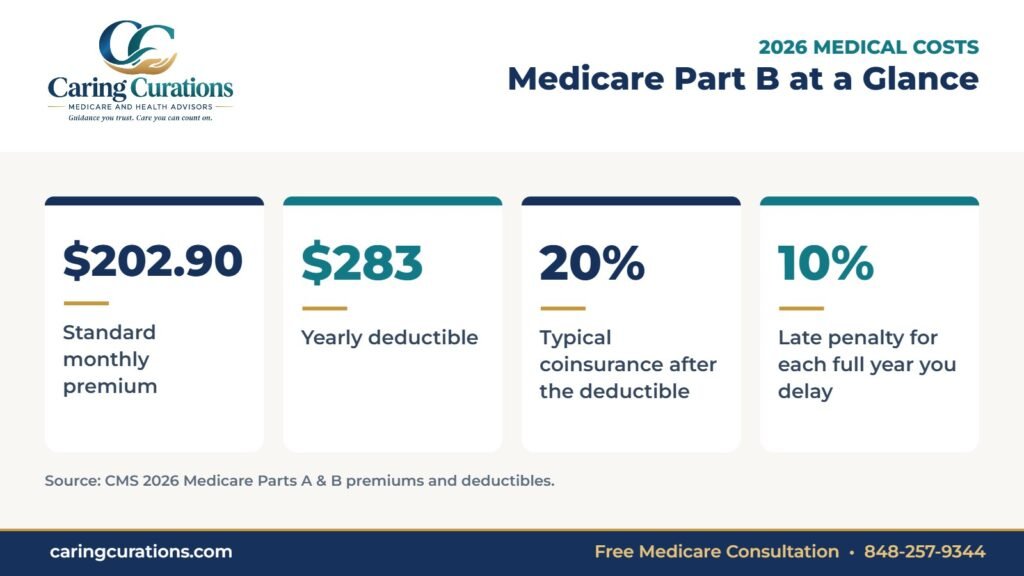
Quick answer: Medicare Part B covers medically necessary doctor services, outpatient care, preventive services, durable medical equipment and some drugs given in a doctor’s office. In 2026, the standard Medicare Part B premium is $202.90 a month and the yearly deductible is $283. After the deductible, you usually pay 20% of the Medicare-approved amount, with no yearly cap under Original Medicare. (CMS.gov)
What Is Medicare Part B?
Original Medicare has two parts. Part A covers hospital stays, and Medicare Part B covers the care you get outside the hospital or from doctors in any setting. Together, they cover most of your medically necessary care.
Medicare Part B is also required for most other types of Medicare coverage. You need it to join a Medicare Advantage plan or to buy a Medigap policy. That makes Medicare Part B one of the most important decisions you will make when you become eligible.
What Medicare Part B Covers
Doctor and outpatient services
- Visits to primary care doctors and specialists
- Doctor services while you are in the hospital
- Outpatient surgery and same-day procedures
- Emergency room visits and observation stays
- Lab tests, X-rays, MRIs and other imaging
- Outpatient physical, occupational and speech therapy
- Outpatient mental health care, including therapy and telehealth visits
- Ambulance services when medically necessary
Preventive services
Medicare Part B covers many preventive services at no cost to you when your doctor accepts Medicare assignment. These include:
- A “Welcome to Medicare” preventive visit within your first 12 months
- A yearly wellness visit
- Flu, COVID-19, pneumonia and hepatitis B shots
- Screening mammograms and colorectal cancer screenings
- Diabetes and cardiovascular screenings
- Depression screening
- Bone density tests for people at risk
Durable medical equipment
Medicare Part B helps pay for medical equipment your doctor orders for use at home, such as walkers, wheelchairs, hospital beds, oxygen equipment, CPAP machines and blood sugar monitors. You usually pay 20% after the deductible, and you should use suppliers that accept Medicare assignment.
Some prescription drugs
Medicare Part B covers a limited group of drugs, mostly ones you don’t take yourself at home, such as:
- Drugs given by infusion or injection in a doctor’s office
- Some oral cancer drugs
- Drugs used with certain medical equipment, such as nebulizers
- Insulin used with a traditional insulin pump, capped at $35 a month
Most other prescriptions are covered under Part D. Our guide to Medicare Part D explains drug coverage.
What Medicare Part B Doesn’t Cover
- Most prescription drugs you take at home
- Routine dental care and dentures
- Routine eye exams for glasses and contact lenses
- Hearing aids and exams for fitting them
- Long-term custodial care
- Cosmetic surgery
- Most care outside the U.S.
For help with dental, vision and hearing, see our dental, vision and hearing coverage page.
Medicare Part B Costs in 2026
| Cost | 2026 amount |
|---|---|
| Standard monthly premium | $202.90 |
| Yearly deductible | $283 |
| Coinsurance after the deductible | Usually 20% of the Medicare-approved amount |
| Most preventive services | $0 with providers who accept assignment |
| Yearly out-of-pocket limit | None under Original Medicare |
Higher premiums for higher incomes
If your 2024 income was above $109,000 as an individual or $218,000 as a married couple filing jointly, you pay more for Medicare Part B in 2026. This extra amount is called IRMAA. Premiums with IRMAA range from $284.10 to $689.90 a month. Read our full guide to IRMAA 2026.
Excess charges
Doctors who don’t accept Medicare assignment can charge up to 15% more than the Medicare-approved amount. This extra amount is called a Part B excess charge. You can avoid it by using providers who accept assignment, or with Medigap Plan G or Plan F, which cover excess charges.
How you pay the premium
If you get Social Security or Railroad Retirement benefits, your Medicare Part B premium is usually deducted from your monthly payment. If you don’t receive benefits yet, Medicare sends you a bill. You can pay online through your Medicare account, set up Medicare Easy Pay for automatic deductions from your bank account, or mail a check.
When to Sign Up for Medicare Part B
Your Initial Enrollment Period
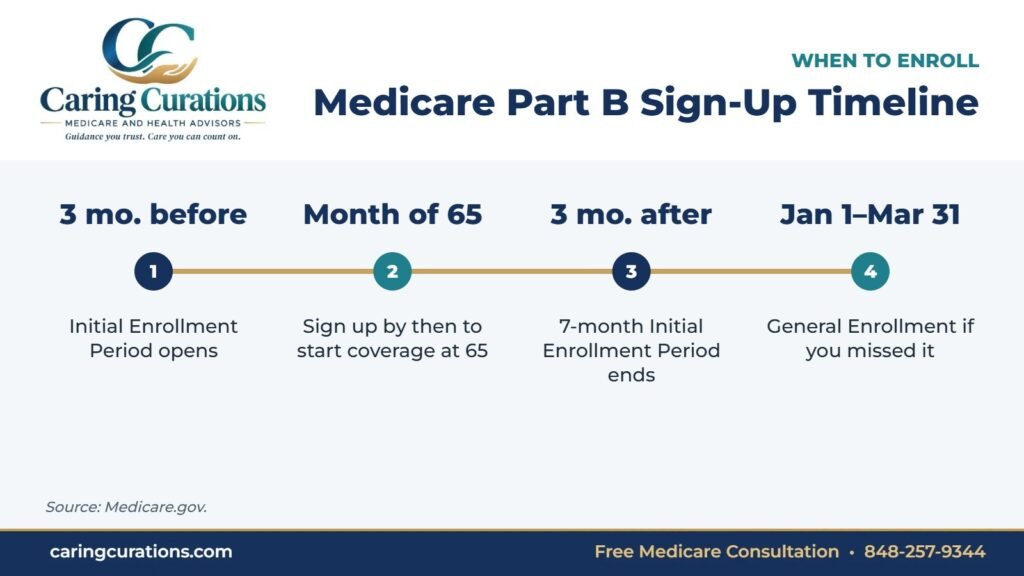
Most people sign up for Medicare Part B during their 7-month Initial Enrollment Period, which starts 3 months before the month you turn 65 and ends 3 months after it. If you sign up in the first 3 months, your coverage starts the month you turn 65. If you sign up later in the window, coverage starts the month after you sign up. See our guide on when to sign up for Medicare.
If you have job-based coverage
If you or your spouse are still working and have health coverage from that job, you may be able to delay Medicare Part B without a penalty. When the job or coverage ends, you have an 8-month Special Enrollment Period to sign up. This only applies to coverage from current employment, not COBRA or retiree coverage. Our guide to Medicare when working past 65 covers this in detail.
The General Enrollment Period
If you missed your Initial Enrollment Period and don’t qualify for a Special Enrollment Period, you can sign up during the General Enrollment Period from January 1 to March 31. Your coverage starts the month after you sign up, and you may owe a late penalty.
The Medicare Part B Late Enrollment Penalty
If you don’t sign up for Medicare Part B when you are first eligible, and you don’t have qualifying job-based coverage, you may pay a late penalty for as long as you have Part B.
The penalty is 10% of the standard premium for each full 12-month period you could have had Part B but didn’t. For example, if you waited 3 full years, you would pay 30% more, or about $60.87 extra per month in 2026, for life.
Our guide to the Medicare late enrollment penalty explains all three Medicare penalties and how to avoid them.

How to Protect Yourself From the 20% Coinsurance
The biggest risk with Medicare Part B is that the 20% coinsurance has no cap. A serious illness, such as cancer treatment or dialysis, can lead to tens of thousands of dollars in Part B bills. Here are the main ways people protect themselves:
Medigap
Medicare Supplement Insurance pays some or all of your Part B coinsurance. Plan G covers everything except the $283 Part B deductible. Plan N covers the coinsurance except for small copays for some office and emergency visits. Learn more in What Is Medigap?
Medicare Advantage
Medicare Advantage plans replace the 20% coinsurance with their own copays and coinsurance, and every plan has a yearly out-of-pocket limit for covered services. In 2026, that limit can be no higher than $9,250 in network. You still pay your Medicare Part B premium. See What Is Medicare Advantage?
Help for people with limited income
Medicare Savings Programs can pay your Medicare Part B premium, and the QMB program also pays your Part B deductible and coinsurance. Read our guide to Medicare Savings Programs.
Medicare Part B and Medicare Advantage “Giveback” Plans
Some Medicare Advantage plans include a Part B premium reduction, often advertised as a “giveback.” The plan pays part of your Medicare Part B premium, and the reduction shows up as a higher Social Security check.
These plans can save money, but be careful:
- The giveback amount varies by plan and county, and it is often much smaller than TV ads suggest.
- Giveback plans may have narrower networks or higher copays.
- People whose Part B premium is already paid by Medicaid or a Medicare Savings Program don’t benefit.
Always compare the full costs, not just the giveback.
Why Your Medicare Part B Start Date Matters for Medigap
Your Medicare Part B start date does more than start your medical coverage. It also starts your one-time Medigap Open Enrollment Period. This 6-month window begins the first month you are 65 or older and enrolled in Part B.
During this window, insurance companies in most states must sell you any Medigap policy they offer, at their best available price, regardless of your health. After it ends, insurers in most states can ask health questions and may charge more or turn you down.
There are a few exceptions. New York requires Medigap insurers to accept applications all year, without regard to health. Connecticut, Massachusetts and a few other states also have special rules. If you live elsewhere and plan to buy Medigap, timing your Medicare Part B enrollment carefully is important.
Understanding Your Medicare Part B Bills
Every few months, Medicare mails a Medicare Summary Notice (MSN) listing the Part B services you received, what the provider billed, what Medicare approved, what Medicare paid and what you may owe. You can also see this information sooner in your online Medicare account.
When you review your MSN:
- Check every service. Make sure you actually received each one on the date shown.
- Compare with provider bills. Don’t pay a provider more than the “maximum you may be billed” shown on your MSN.
- Look for denials. If Medicare denied a service you think should be covered, you can file an appeal. The MSN explains how and gives you a deadline, usually 120 days.
- Watch for fraud. Charges for equipment, tests or visits you never received could be a sign of Medicare fraud. Report them to 1-800-MEDICARE.
Medicare Part B Coverage After a Kidney Transplant
People who have Medicare only because of End-Stage Renal Disease usually lose Medicare 36 months after a successful kidney transplant. To help with the cost of transplant drugs, Medicare offers a special benefit that covers only immunosuppressive drugs, sometimes called Part B-ID. It has its own lower premium and is available to people who don’t have other qualifying coverage. If this applies to you or a family member, ask Social Security about enrolling before your regular Medicare ends.
Questions to Ask Your Doctor’s Office
A few questions can save you money under Medicare Part B:
- Do you accept Medicare assignment for all of my care?
- Is this visit a free preventive service, or will it be billed as a diagnostic visit?
- Will this test or procedure be done in your office, at a hospital outpatient department or at a free-standing center? Costs can differ.
- Is this medical equipment supplier enrolled in Medicare and accepting assignment?
- Do I need prior approval from my Medicare Advantage plan, if I have one?
Medicare Part B Examples
Example 1: A year of routine care
Carmen, 68, has Original Medicare with no supplement. She has her yearly wellness visit for free, then four specialist visits and some lab work totaling $1,500 in Medicare-approved charges. She pays the $283 deductible, then 20% of the remaining $1,217, or about $243. Her total Medicare Part B cost-sharing for the year is about $526, plus $2,434.80 in premiums.
Example 2: Cancer treatment
Howard, 72, needs chemotherapy and radiation, with $80,000 in Medicare-approved Part B charges. Without a Medigap policy, he would owe the $283 deductible and about $15,943 in coinsurance. With Plan G, he would pay only the $283 deductible. With a Medicare Advantage plan, his costs would be capped by the plan’s out-of-pocket limit.
Example 3: Signing up late
Linda retired at 64 and kept COBRA coverage until 67, thinking it would let her delay Part B. Because COBRA doesn’t count as current employment coverage, she now pays a 20% Medicare Part B penalty for life and had to wait for the General Enrollment Period to get coverage.
Medicare Part B Checklist
- Mark your Initial Enrollment Period on your calendar.
- If you are still working, confirm your employer has 20 or more employees and that your coverage is based on current employment.
- Don’t rely on COBRA or retiree coverage to delay Part B.
- Decide how you will cover the 20% coinsurance: Medigap, Medicare Advantage or help programs.
- Use doctors and suppliers who accept Medicare assignment.
- Book your free “Welcome to Medicare” visit in your first year.
- Watch for IRMAA notices if your income is higher.
Frequently Asked Questions About Medicare Part B
Is Medicare Part B mandatory?
No, but delaying it without qualifying job-based coverage can lead to a lifetime penalty and gaps in coverage. You also need Part B to join Medicare Advantage or buy Medigap.
How much is Medicare Part B in 2026?
The standard premium is $202.90 a month, and the deductible is $283 a year. Higher-income people pay more.
Can I drop Medicare Part B?
You can, but if you don’t have qualifying employer coverage, you may face a penalty and a wait to re-enroll. Talk to someone before you drop it.
Does Medicare Part B cover telehealth?
Yes. Medicare Part B covers many telehealth services, and expanded telehealth flexibilities have been extended through December 31, 2027. Mental health telehealth visits are covered on an ongoing basis.
Does Medicare Part B cover ambulance rides?
Yes, when other transportation would endanger your health. You usually pay 20% after the deductible.
Does Medicare Part B cover my yearly physical?
Medicare Part B covers a free yearly wellness visit to create or update a prevention plan. It doesn’t cover a traditional head-to-toe physical exam. If your doctor checks a new problem during the wellness visit, you may be billed for that part.
What is Medicare assignment?
A doctor who accepts assignment agrees to take the Medicare-approved amount as full payment. You only pay your deductible and coinsurance. Doctors who don’t accept assignment can charge up to 15% more.
Can I get Medicare Part B before 65?
Yes, if you qualify for Medicare because of a disability, ALS or End-Stage Renal Disease. The same Medicare Part B premium and rules apply.
Does Medicare Part B cover mental health care?
Yes. Medicare Part B covers outpatient mental health services, including visits with psychiatrists, psychologists, clinical social workers, licensed professional counselors and marriage and family therapists.
Does Medicare Part B cover diabetes supplies?
Yes. Medicare Part B covers blood sugar monitors, test strips, lancets, therapeutic shoes for some people with diabetes and diabetes self-management training. You usually pay 20% after the deductible.
Does Medicare Part B cover physical therapy?
Yes. Medicare Part B covers medically necessary outpatient physical, occupational and speech therapy when your doctor or therapist certifies the need. There is no hard yearly cap, but claims above a set threshold require extra documentation. You usually pay 20% after the deductible.
Related guides: Medicare and VA benefits and Plan G vs Plan N.
Get Help With Medicare Part B
Medicare Part B is a decision you only want to make once, and making it at the right time can save you thousands of dollars. Caring Curations is an independent Medicare agency at 26 Bolivar St in Staten Island, New York. We help you choose the right time to enroll and compare Medigap and Medicare Advantage options that protect you from the 20% coinsurance.
Book a free Medicare consultation or call 848-257-9344. Our help is always free.







9 Responses