
If your income is above a certain level, Medicare charges you more for Part B and Part D. This extra charge is called IRMAA, short for Income-Related Monthly Adjustment Amount. Understanding IRMAA 2026 rules can help you plan ahead, avoid surprises on your Social Security statement and, in some cases, lower what you pay.
This guide explains who pays IRMAA in 2026, the exact income brackets, how Social Security decides your amount, and the steps you can take if your income has dropped.
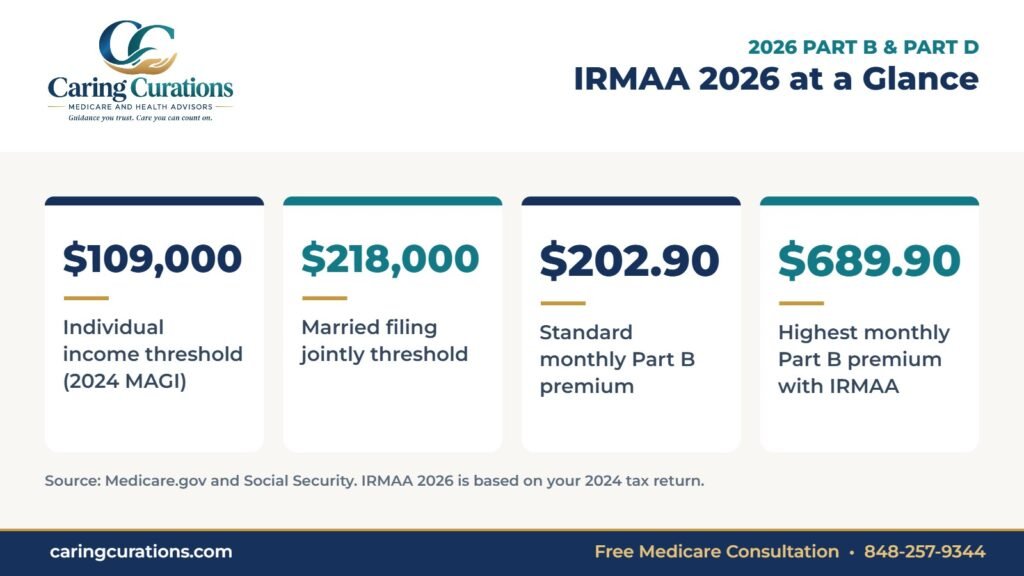
Quick answer: For IRMAA 2026, you pay a surcharge if your 2024 modified adjusted gross income (MAGI) was more than $109,000 as an individual or $218,000 as a married couple filing jointly. The standard Part B premium in 2026 is $202.90 a month. With IRMAA, Part B ranges from $284.10 to $689.90 a month, and Part D surcharges range from $14.50 to $91.00 a month on top of your plan premium. (Medicare.gov)
What Is IRMAA?
IRMAA is an extra amount that higher-income people with Medicare pay on top of their regular Part B premium and their Part D drug plan premium. It is not a penalty. It is part of how Medicare is funded: most people pay a premium that covers about a quarter of the cost of Part B, while people with higher incomes pay a larger share.
A few key points about IRMAA:
- The surcharge applies to Part B (medical insurance) and Part D (prescription drug coverage).
- It applies whether you have Original Medicare or a Medicare Advantage plan, because everyone with Part B pays the Part B premium.
- Social Security, not your insurance company, decides whether you owe it.
- It is recalculated every year based on your tax return from two years earlier.
Most people with Medicare never pay this surcharge, but if you are in that group, the amounts add up quickly. A married couple in the highest bracket can pay more than $16,000 a year in Part B premiums alone.
IRMAA 2026 Income Brackets for Part B
For IRMAA 2026, Social Security uses your 2024 tax return. Here are the Part B brackets and the total monthly Part B premium you would pay in each one:
| 2024 income (individual) | 2024 income (married filing jointly) | 2026 Part B monthly premium |
|---|---|---|
| $109,000 or less | $218,000 or less | $202.90 |
| $109,001 – $137,000 | $218,001 – $274,000 | $284.10 |
| $137,001 – $171,000 | $274,001 – $342,000 | $405.80 |
| $171,001 – $205,000 | $342,001 – $410,000 | $527.50 |
| $205,001 – $499,999 | $410,001 – $749,999 | $649.20 |
| $500,000 or more | $750,000 or more | $689.90 |
If you are married and file separately, and you lived with your spouse at any time during the year, the brackets are different: income up to $109,000 pays the standard premium, $109,001 to $390,999 pays $649.20, and $391,000 or more pays $689.90.
IRMAA 2026 Surcharges for Part D
The Part D charge works the same way, but instead of a total premium, you pay a fixed monthly surcharge on top of whatever your drug plan charges. This applies to stand-alone Part D plans and to the drug coverage inside a Medicare Advantage plan.
| 2024 income (individual) | 2024 income (married filing jointly) | 2026 Part D surcharge per month |
|---|---|---|
| $109,000 or less | $218,000 or less | $0 |
| $109,001 – $137,000 | $218,001 – $274,000 | $14.50 |
| $137,001 – $171,000 | $274,001 – $342,000 | $37.50 |
| $171,001 – $205,000 | $342,001 – $410,000 | $60.40 |
| $205,001 – $499,999 | $410,001 – $749,999 | $83.30 |
| $500,000 or more | $750,000 or more | $91.00 |
Even if your Medicare Advantage plan has a $0 premium, you still owe the Part D surcharge if your income is above the threshold. It is usually deducted from your Social Security check along with your Part B premium.
Why the brackets matter so much
The brackets work like a cliff, not a ramp. If your income is just $1 over a threshold, you pay the full surcharge for that bracket. For example, an individual with 2024 MAGI of $109,001 pays $81.20 more per month for Part B, plus $14.50 for Part D, compared with someone at $109,000. That is about $1,148 more for the year from a single dollar of income.
This is why it pays to know where your income falls before the end of each tax year.
How Social Security Calculates Your IRMAA 2026 Amount
Social Security uses your modified adjusted gross income (MAGI). For IRMAA, MAGI is your adjusted gross income (line 11 of Form 1040) plus any tax-exempt interest income (line 2a).
That means these types of income can count:
- Wages and self-employment income
- Traditional IRA and 401(k) withdrawals, including required minimum distributions
- Roth conversions
- Capital gains from selling stocks, a business or real estate
- Taxable Social Security benefits
- Pension income
- Interest and dividends, including tax-exempt municipal bond interest
Withdrawals from a Roth IRA that meet the rules are generally not counted, and neither is money you borrow, such as a reverse mortgage or a loan against a life insurance policy.
The two-year look-back
Your IRMAA 2026 amount is based on your 2024 tax return. If that return isn’t available, Social Security may use your 2023 return and update it later. This two-year delay is the reason many new retirees are surprised. If you earned a full salary in 2024 and retired in 2025, your 2026 premiums may still reflect your working income.
Social Security usually mails a notice in the fall or near the end of the year, explaining what you will pay in the coming year and how it was calculated.
Common Events That Trigger IRMAA
Many people who pay the surcharge aren’t wealthy in a lasting way. They had a one-time spike in income. The most common triggers include:
- Working your last full year before retiring
- Selling a home or rental property with a large gain above the home-sale exclusion
- A large Roth conversion in a single year
- Required minimum distributions from a large traditional IRA
- Selling a business or receiving a large bonus or severance payment
- Inheriting an IRA and taking distributions
Because the look-back is two years, an income spike in 2026 can raise your premiums in 2028. If you are planning a big financial move, it helps to think about how it affects your premiums before you make it.

How to Appeal IRMAA in 2026
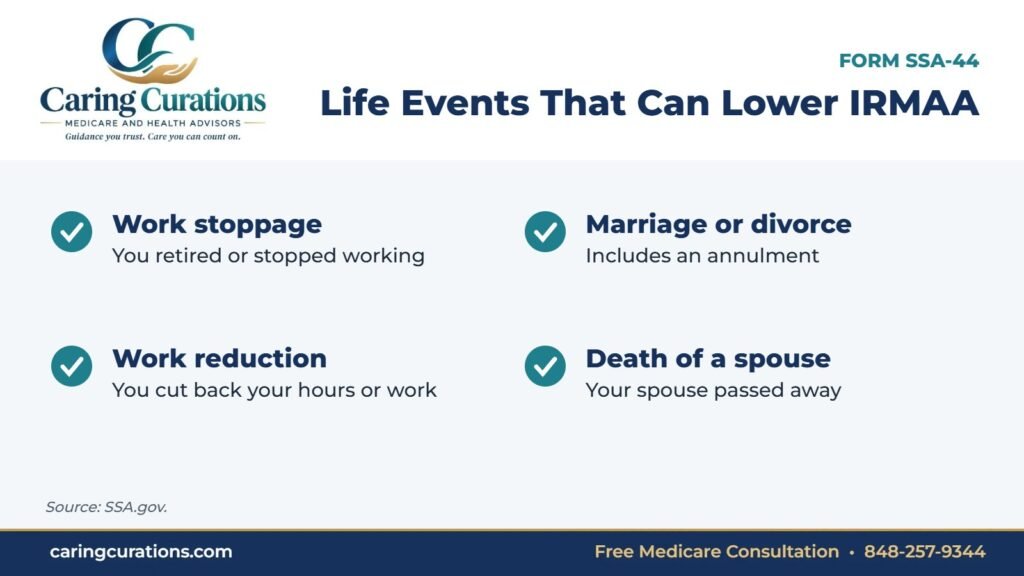
If your income has gone down since the tax year Social Security used, you can ask Social Security to use a more recent year instead. This is called a request for a new initial determination, and it is done with Form SSA-44, “Medicare Income-Related Monthly Adjustment Amount – Life-Changing Event.” (SSA.gov)
Social Security accepts these life-changing events:
- Marriage
- Divorce or annulment
- Death of your spouse
- Work stoppage (for example, you retired)
- Work reduction
- Loss of income-producing property, such as a disaster or theft
- Loss of pension income
- Receipt of an employer settlement payment because of an employer’s closure or bankruptcy
What to include with your appeal
When you file Form SSA-44, you will usually need:
- Proof of the life-changing event, such as a retirement letter from your employer, a marriage certificate or a death certificate
- Your estimated income for the current year, or a copy of a more recent tax return
- Your Social Security number and contact details
You can mail the form, bring it to a local Social Security office, or call 1-800-772-1213 for help. If Social Security agrees, it will recalculate your premium, and any overpayment is usually credited back.
When an appeal won’t work
A one-time capital gain, selling a home or a Roth conversion is not a qualifying life-changing event. If your income was high because of one of these, you generally can’t reduce that year’s surcharge through Form SSA-44. If you believe Social Security used the wrong information, for example an amended return or a tax return that was filed incorrectly, you can request a reconsideration instead.
7 Ways to Lower or Avoid IRMAA
You can’t control every dollar of income, but planning can keep you below a bracket or soften the impact. Here are seven strategies people often discuss with their tax professional:
- Time large income events. If possible, spread a home sale, business sale or Roth conversion across tax years, or time it so it lands in a year before you enroll in Medicare.
- Watch the bracket edges. Before the end of the year, estimate your MAGI. A small adjustment can keep you below the next threshold.
- Use qualified charitable distributions. If you are 70½ or older, giving directly from your IRA to charity can satisfy required distributions without adding to your MAGI.
- Consider Roth savings earlier. Qualified Roth withdrawals don’t count toward your MAGI, so Roth conversions done before age 63 won’t affect your Medicare premiums.
- Be careful with tax-exempt interest. Municipal bond interest is tax-free but still counts toward MAGI.
- Use health savings accounts wisely. HSA contributions made before Medicare can be used tax-free for qualified medical costs, including Medicare premiums, without increasing your income.
- File Form SSA-44 promptly after a qualifying life-changing event, so you don’t overpay for a full year.
Every situation is different, so it is smart to review these ideas with a tax advisor before you act. The goal is to make sure Medicare premiums are part of your retirement income plan, not an afterthought.
What to Do When You Get an IRMAA Notice
If a letter from Social Security says you owe IRMAA, don’t ignore it. Taking a few simple steps can help you confirm the amount is correct and decide whether to act:
- Check the tax year used. The notice lists the tax year and the income amount Social Security received from the IRS. Compare it with your own copy of that return.
- Look for errors. If the income is wrong, or you filed an amended return, gather your paperwork and request a reconsideration.
- Ask whether your income has dropped. If you retired, lost a spouse, divorced or had another life-changing event, you may be able to use Form SSA-44.
- Plan for the cost. If the notice is correct, build the higher premium into your monthly budget. It is usually deducted from your Social Security benefit automatically.
- Review your plan choices. While IRMAA itself doesn’t change with your plan, the rest of your Medicare costs do. A plan review can help balance the total.
Keep a copy of the letter with your tax records. If you plan to appeal, act quickly. Social Security generally expects a request for reconsideration within 60 days of receiving the notice, although you can file Form SSA-44 at any time a qualifying event happens.
IRMAA for Married Couples and Widows
Marriage and the loss of a spouse both change how IRMAA works, and both can catch people off guard.
Married couples filing jointly
When you file jointly, Social Security looks at your combined income. If your joint MAGI is above $218,000, both spouses pay IRMAA, even if only one of you earned most of the income. If only one spouse is on Medicare, only that spouse pays.
After the death of a spouse
Surviving spouses often move from joint brackets to single brackets, which are much lower. A widow with $150,000 of income would pay no IRMAA on a joint return but could pay IRMAA on a single return. The death of a spouse is a life-changing event, so if your income drops after a loss, Form SSA-44 can help Social Security use a more accurate year.
If you are helping a parent after the loss of a spouse, review their IRMAA notice along with the rest of their Medicare paperwork. These changes are easy to miss during a hard time.
IRMAA and Medicare Advantage vs Original Medicare
Some people ask whether choosing a different type of Medicare plan can help them avoid IRMAA. The answer is no. IRMAA is based on income, not on your plan choice.
- With Original Medicare, you pay the Part B premium plus IRMAA, plus your Medigap and Part D premiums, plus the Part D IRMAA.
- With Medicare Advantage, you pay the Part B premium plus IRMAA, any plan premium, plus the Part D IRMAA if the plan includes drug coverage.
Medigap premiums themselves are not affected by IRMAA. If you are comparing paths, our guide to Medicare Advantage vs Original Medicare explains how the total costs compare.
IRMAA 2026 Example: Two Real-World Scenarios
Example 1: The last working year
Linda, 66, retired in March 2025. Her 2024 income was $150,000 from her salary. For IRMAA 2026, Social Security places her in the $137,001–$171,000 bracket, so she pays $405.80 a month for Part B and an extra $37.50 for Part D.
Because she retired, Linda qualifies for a work stoppage life-changing event. She files Form SSA-44 with her retirement letter and an estimate of her 2026 income, which is about $60,000. If Social Security approves, her Part B premium drops to the standard $202.90 and the Part D surcharge goes away, saving her more than $2,800 for the year.
Example 2: The home sale
Robert and Maria, both 70, sold a rental property in 2024 and their joint income jumped to $300,000. For IRMAA 2026, they each pay $405.80 a month for Part B and $37.50 for Part D. A property sale is not a life-changing event, so they can’t appeal. But in 2027, their premiums will be based on their 2025 income, which returned to normal, so the surcharge should disappear.
Looking Ahead: IRMAA in 2027
IRMAA brackets are adjusted for inflation each year. For 2027, Social Security will use your 2025 tax return. CMS normally announces the new Part B premium and IRMAA amounts in the fall. If your 2025 income was close to a threshold, watch for your notice and check whether the new brackets change your amount.
Want to see the bigger picture of what you will pay? Read our guide on how much Medicare costs in 2026.
Frequently Asked Questions About IRMAA 2026
What is the IRMAA threshold for 2026?
The IRMAA 2026 threshold is 2024 MAGI above $109,000 for individuals and above $218,000 for married couples filing jointly.
Is IRMAA charged per person?
Yes. Each spouse who has Medicare pays IRMAA separately, so a married couple above the threshold pays the surcharge twice.
Can I pay IRMAA if I don’t get Social Security yet?
Yes. If you aren’t receiving Social Security benefits, Medicare will bill you directly, usually every three months.
Does IRMAA last forever?
No. IRMAA is recalculated every year. If your income drops below the threshold, your surcharge goes away in the year that income is used.
Does IRMAA affect my Medigap premium?
No. IRMAA only applies to Part B and Part D. Your Medigap premium is set by the insurance company. Learn more in our guide, What Is Medigap?
Who can help me understand my IRMAA notice?
Social Security can explain how your amount was calculated, and a tax professional can help with income planning. Caring Curations can help you review your Medicare plan choices so your total costs make sense.
Related guides: Medicare Part B and Medicare when working past 65.
Get Help With Your Medicare Costs
IRMAA 2026 can feel confusing, but you don’t have to figure it out alone. Caring Curations is an independent Medicare agency in Staten Island, New York, licensed in 25 states and contracted with 15 insurance carriers. We can’t give tax advice, but we can help you compare Medicare plans so your premiums, drug costs and coverage fit your budget.
Book a free Medicare consultation or call 848-257-9344. There is no cost and no obligation.







2 Responses