If you live in the five boroughs, on Long Island or upstate, Medicare in New York follows the same federal rules as everywhere else, but the state adds protections and programs that many people never hear about. New York residents get year-round access to Medigap, a state drug program called EPIC, generous Medicare Savings Programs and free local counseling.
This guide explains the New York rules that matter most, how EPIC and the Medicare Savings Programs can lower your costs, how Medicaid and dual plans fit in, what Medicare Advantage looks like in New York City and Staten Island, and where to get free local help.
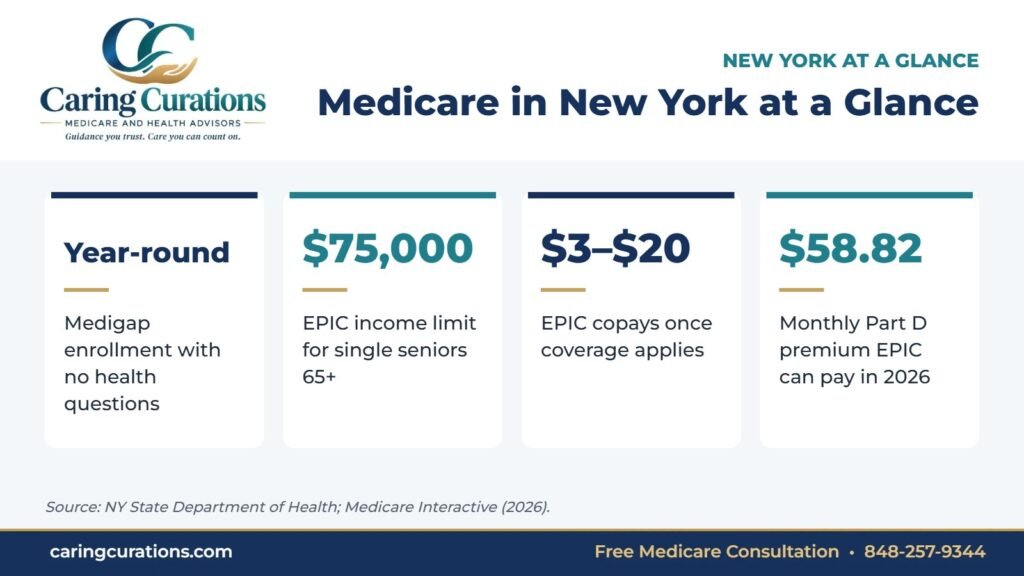
Quick answer: New York lets people with Medicare buy a Medigap policy at any time of year, and Medigap premiums are community rated, so insurers can’t charge more because of your age or health. The state’s EPIC program helps seniors 65 and older with incomes up to $75,000 (single) or $100,000 (married) pay for Part D drugs. New York’s Medicare Savings Programs have higher income limits than many states and no asset test. Free counseling is available through HIICAP at 1-800-701-0501. (NY State Department of Health)
Why Medicare in New York Works Differently
Medicare itself is a federal program. Your Part A and Part B benefits, the $202.90 monthly Part B premium in 2026 and the $283 Part B deductible are the same in Brooklyn as they are in Arizona.
What changes from state to state is everything around Medicare: the rules for Medigap policies, the state programs that help with costs, and how Medicaid works with Medicare. New York is unusual on all three counts.
- Medigap rules: New York requires insurers to sell Medigap year-round and to price it the same regardless of age.
- Drug help: EPIC is one of the largest state drug assistance programs in the country.
- Savings programs: New York raised its Medicare Savings Program income limits and has no asset test for them.
- Integrated plans: New York offers special plans that combine Medicare and Medicaid for people who qualify for both.
Because these rules are so different, advice you read online for other states can be wrong for people on Medicare in New York. That is especially true for anything about Medigap “open enrollment” windows.
Medigap and Medicare in New York: Year-Round Enrollment
In most states, your best chance to buy a Medigap policy is your six-month Medigap Open Enrollment Period, which starts when you are 65 and enrolled in Part B. After that window closes, insurers in most states can ask health questions and turn you down.
New York is different. Under state law, people with Medicare in New York have continuous open enrollment. Insurers that sell Medigap in New York must accept you at any time of year, regardless of your age or health. You can apply in March, July or November, and the insurer can’t deny you because of a medical condition.
A possible waiting period for pre-existing conditions
There is one catch. If you had no recent health coverage before your Medigap policy starts, the insurer may be allowed to delay coverage for a pre-existing condition for a limited time. If you are moving from other coverage, such as a Medicare Advantage plan or an employer plan, without a long gap, this waiting period usually doesn’t apply. Ask the insurer to confirm before you apply.
Community rating: same price at 65 or 85
New York Medigap policies are community rated. That means an insurer charges everyone who buys the same plan in the same area the same premium, whether they are 65 or 85, healthy or managing a chronic illness. Premiums can still change from year to year, and they vary by region of the state, but they don’t climb just because you get older.
In many other states, Medigap is priced by age, so a policy that looks cheap at 65 gets steadily more expensive. With Medicare in New York, the starting price can look higher, but there are no age-based increases built in.
Medigap for people under 65 on Medicare in New York
New York also requires Medigap insurers to make their plans available to people under 65 who have Medicare because of a disability or kidney failure. Because of community rating, they pay the same premium as older members for the same plan. In many states, people under 65 have few or no Medigap options.
To learn how Medigap works in general, read What Is Medigap? If you are deciding between the two most popular plans, see Medigap Plan G vs Plan N.
Why Year-Round Medigap Changes Your Choices
The biggest practical effect of the rules for Medicare in New York is that choosing Medicare Advantage is less of a one-way door. In most states, if you leave Original Medicare for a Medicare Advantage plan and later want to go back, you may not be able to get a Medigap policy because of your health.
With Medicare in New York, you can generally switch from Medicare Advantage back to Original Medicare and buy a Medigap policy without health questions. You still need to follow Medicare’s enrollment periods to leave your Medicare Advantage plan, such as the Annual Enrollment Period from October 15 to December 7 or the Medicare Advantage Open Enrollment Period from January 1 to March 31. But the Medigap side is open all year.
This also means you can change Medigap policies if your premium goes up or you want a different plan letter. Many New Yorkers review their Medigap price every year and switch if a similar plan costs much less. Just make sure the new policy is approved and active before you cancel the old one.
EPIC: Prescription Help for Seniors on Medicare in New York
EPIC stands for the Elderly Pharmaceutical Insurance Coverage program. It is run by the New York State Department of Health and helps residents 65 and older pay for prescription drugs. EPIC works as secondary coverage on top of a Medicare Part D plan.
To qualify in 2026, you must be a New York resident aged 65 or older with yearly income up to $75,000 if single or $100,000 if married. You must also be enrolled in a Part D plan, or in a Medicare Advantage plan that includes Part D drug coverage, to receive and keep EPIC benefits. You can apply at any time of the year.
The EPIC Fee Plan
The Fee Plan is for people with income up to $20,000 if single or $26,000 if married. Members pay an annual fee that ranges from $8 to $300, based on income. In exchange, they pay reduced copays at the pharmacy.
The EPIC Deductible Plan
The Deductible Plan is for people with income from $20,001 to $75,000 if single or $26,001 to $100,000 if married. Members meet an annual EPIC deductible, which ranges from $530 to $3,215 based on income, before EPIC copays apply. Drug costs paid through your Part D plan count toward meeting the EPIC deductible.
EPIC copays and premium help
Once EPIC coverage applies, copays are $3, $7, $15 or $20, depending on the cost of the drug. EPIC also pays Part D premiums up to $58.82 a month in 2026 for Fee Plan members and lower-income Deductible Plan members. For many seniors, that means a basic Part D plan costs little or nothing each month.
EPIC can also cover some approved drugs that your Part D plan excludes once you are enrolled. You can reach the EPIC Helpline at 1-800-332-3742.
How EPIC Works With Part D and Extra Help
Think of EPIC as a second layer, and one of the best tools for drug costs under Medicare in New York. Your Part D plan pays first, under its own formulary, deductible and copays. EPIC then helps with what is left. Because 2026 Part D plans cap your yearly out-of-pocket drug costs at $2,100, EPIC mainly helps you reach that cap more slowly and pay less along the way.
A few practical points:
- Choose your Part D plan carefully. EPIC doesn’t replace a good Part D plan. Your plan’s formulary and pharmacy network still matter most.
- Apply for Extra Help too. If your income is low, EPIC may help you apply for the federal Extra Help program, which lowers Part D costs further. See our guide to Medicare Extra Help.
- Watch for plan changes. EPIC members may have a Special Enrollment Period to change Part D plans once a year, outside the fall enrollment period. Call EPIC or a counselor to confirm before you switch.
For a full explanation of drug plans, read our Medicare Part D guide.
Medicare Savings Programs in New York
Medicare Savings Programs, or MSPs, are run by each state’s Medicaid program and help pay Medicare costs. For Medicare in New York, the state’s version is more generous than federal minimums. In 2023, the state raised its income limits and folded the old SLMB program into a larger QMB program.
In 2026, Medicare in New York offers two main savings levels:
- QMB (Qualified Medicare Beneficiary): for monthly countable income up to about $1,836 if single or $2,489 for a couple. QMB pays your Part B premium and can also cover Medicare deductibles, copays and coinsurance.
- QI (Qualifying Individual): for monthly income above the QMB limit, up to about $2,474 if single or $3,355 for a couple. QI pays your Part B premium only.
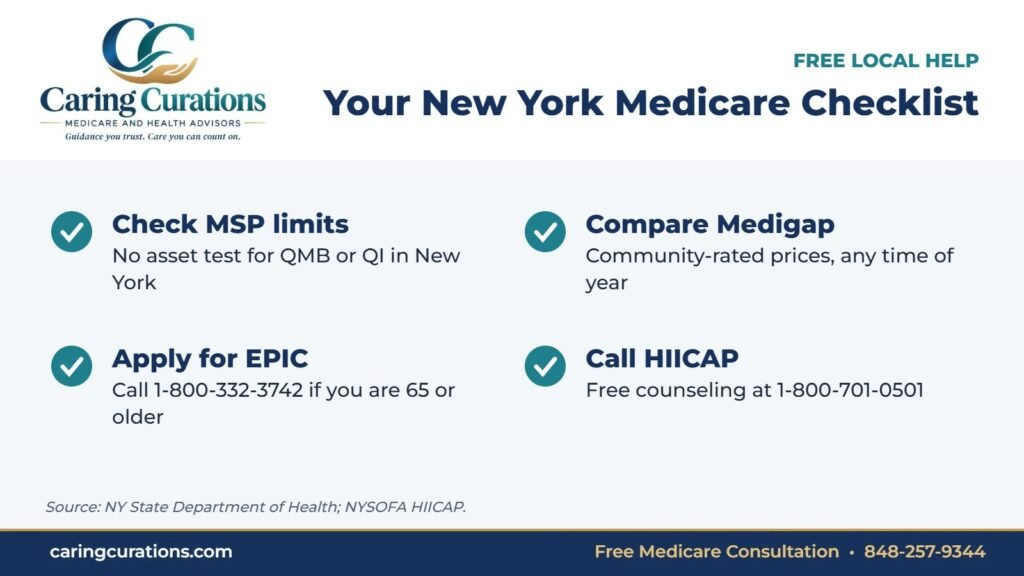
New York doesn’t use an asset test for these programs, so savings in the bank won’t disqualify you. Certain income is also not counted, such as the first $20 of most unearned income. In New York City, you apply through the Human Resources Administration (HRA). Outside the city, you apply through your county Department of Social Services. (Medicare Interactive)
An MSP also qualifies you automatically for Extra Help with Part D. That combination can save thousands of dollars a year. Learn more in our guide to Medicare Savings Programs.
Medicaid, Dual Plans and Medicare in New York
Some New Yorkers qualify for both Medicare and full Medicaid. This is called being dual eligible. Medicare pays first, and Medicaid covers most of what Medicare leaves behind, plus services Medicare doesn’t cover, such as long-term care at home or in a nursing home for those who qualify.
New York Medicaid for people 65 and older has income and asset limits, and the rules for long-term care are detailed. If you are close to the limits, a free screening is worth it, because certain income and assets don’t count.
Plans that combine Medicare and Medicaid
People with Medicaid and Medicare in New York have special plan choices:
- Dual Eligible Special Needs Plans (D-SNPs): Medicare Advantage plans designed for people with Medicare and Medicaid, often with extra benefits such as dental, vision, transportation and over-the-counter allowances.
- Integrated plans: New York offers plans that combine Medicare and Medicaid benefits under one plan, including options for people who need long-term care services at home.
- Original Medicare with Medicaid: You can also keep Original Medicare and use Medicaid as secondary coverage, with Part D through Extra Help.
Dual eligible members have special chances to change plans during the year. Our guide to dual eligible Medicare and Medicaid explains how it works.
Medicare Advantage Options in New York City
New York City has one of the most crowded Medicare Advantage markets in the country. Residents of Staten Island, Brooklyn, Queens, Manhattan and the Bronx can usually choose from many HMO and PPO plans from national and local carriers, and many of them have a $0 monthly premium.
Networks matter most in the city
For Medicare in New York City, the right plan often comes down to doctors and hospitals. Before you join, check that your primary care doctor, your specialists and the hospital you would want to use are in the plan’s network for the coming year. On Staten Island, that often means checking hospitals such as Staten Island University Hospital and Richmond University Medical Center, plus any Manhattan hospital you might use for specialty care.
HMO or PPO
HMOs usually have lower costs but require you to stay in network and may require referrals. PPOs let you see out-of-network providers for a higher cost. If you split time between New York and another state, a PPO or Original Medicare with Medigap may be a better fit. Compare the two in Medicare Advantage HMO vs PPO.
Costs to compare
Look past the premium. Compare doctor and specialist copays, hospital copays, drug coverage and the yearly out-of-pocket limit, which can be as high as $9,250 for in-network care in 2026. Some city plans also offer a Part B premium giveback, dental, vision and hearing allowances, or transportation benefits.
Help Programs for Medicare in New York at a Glance
| Program | Who it helps | What it does | How to start |
|---|---|---|---|
| Medigap (state rules) | Anyone with Parts A and B | Year-round enrollment, community-rated premiums | Apply to any Medigap insurer |
| EPIC | Residents 65+ with income up to $75,000 single or $100,000 married | Lowers drug copays; pays some Part D premiums | EPIC Helpline 1-800-332-3742 |
| QMB | Lower incomes, no asset test | Pays Part B premium plus cost-sharing | HRA in NYC or county DSS |
| QI | Incomes above QMB, up to the QI limit | Pays Part B premium | HRA in NYC or county DSS |
| Medicaid and dual plans | People who qualify for full Medicaid | Covers most costs Medicare leaves, plus long-term care | HRA, DSS or NY State of Health |
| HIICAP | Anyone with Medicare and their families | Free, unbiased counseling | 1-800-701-0501 |
HIICAP and Other Free Local Help
HIICAP, the Health Insurance Information Counseling and Assistance Program, is the state’s free counseling service for Medicare in New York. It is run through local offices for the aging, with trained counselors who answer questions about Medicare, Medigap, Medicare Advantage, drug coverage and long-term care insurance. Call 1-800-701-0501 and say your county to reach your local office. (NYSOFA)
Other free resources for Medicare in New York include:
- EPIC Helpline: 1-800-332-3742 for EPIC applications and questions.
- Medicare Rights Center: a New York-based nonprofit with a national helpline at 800-333-4114.
- New York Medicaid Helpline: 800-541-2831 for questions about Medicaid and the Medicare Savings Programs.
- 1-800-MEDICARE: for questions about your Medicare record, claims or enrollment.
Independent agencies like ours are another option. A licensed agent can compare plans from many carriers and help you enroll, at no cost to you.
Choosing Your Path: Medicare in New York Step by Step
- Enroll in Parts A and B on time. New York’s programs don’t replace Medicare’s own enrollment rules or late penalties.
- Check your income against the MSP limits. If you are close, apply. There is no asset test.
- Check EPIC if you are 65 or older. Most seniors on Medicare in New York with income under $75,000 single or $100,000 married can join.
- List your doctors, hospitals and prescriptions. This will drive your choice between Original Medicare and Medicare Advantage.
- Compare Medigap prices if you choose Original Medicare. Remember that prices are community rated and you can apply any time.
- Compare Medicare Advantage plans if you prefer one plan. Check networks borough by borough.
- Review your coverage every fall. Plans, networks and drug lists change every year.

Medicare in New York: Real-World Examples
Rosa, 72, Staten Island
Rosa joined a $0 premium Medicare Advantage HMO at 65. After a heart condition was diagnosed, she wanted to see a Manhattan cardiologist outside her plan’s network. During the Annual Enrollment Period, she switched to Original Medicare with a stand-alone Part D plan and applied for Medigap Plan G. Because of the year-round Medigap rules for Medicare in New York, the insurer accepted her without health questions, and her premium is the same as a healthy 65-year-old’s in her area.
Frank, 68, Queens
Frank is single with yearly income of about $19,000. He joined EPIC’s Fee Plan, pays a small annual fee and now pays EPIC copays of $3 to $20 at the pharmacy. EPIC also covers his Part D premium. A HIICAP counselor helped him see that he also qualified for QMB, which now pays his Part B premium.
Doris and Walter, 70 and 73, Brooklyn
Doris and Walter have combined monthly income just under the New York QI limit for a couple and about $60,000 in savings. They assumed their savings would disqualify them. Because Medicare in New York has no asset test for the savings programs, they qualified for QI, which pays both of their Part B premiums. That saves them more than $4,800 a year at 2026 rates.
Common Mistakes With Medicare in New York
- Following other states’ Medigap advice. With Medicare in New York, you don’t have to buy Medigap in a six-month window or risk being turned down later.
- Not applying for EPIC. Many seniors with moderate incomes don’t realize they qualify. The Deductible Plan reaches up to $75,000 single or $100,000 married.
- Dropping Part D because of EPIC. You must stay in a Part D plan, or a Medicare Advantage plan with drug coverage, to keep EPIC.
- Assuming savings rule you out. Savings programs for Medicare in New York have no asset test.
- Choosing a city plan by premium alone. A $0 plan that doesn’t include your doctors or hospital can cost more in the end.
- Canceling an old policy too early. When switching Medigap or plans, wait until the new coverage is confirmed.
- Skipping the yearly review. Networks and formularies change every January.
Frequently Asked Questions About Medicare in New York
Can I buy a Medigap policy any time with Medicare in New York?
Yes. New York has continuous open enrollment for people with Medicare, so insurers must accept you at any time of year, regardless of your health. A short waiting period for pre-existing conditions may apply if you had no recent coverage.
Are Medigap premiums higher for older people on Medicare in New York?
No. New York Medigap policies are community rated, so everyone in the same area pays the same premium for the same plan, regardless of age. Premiums can still change each year.
Who qualifies for EPIC?
Residents 65 and older on Medicare in New York with yearly income up to $75,000 if single or $100,000 if married. You must be enrolled in a Part D plan or a Medicare Advantage plan with drug coverage. People with full Medicaid aren’t eligible.
Does EPIC replace my Part D plan?
No. EPIC is secondary coverage. Your Part D plan pays first, and EPIC helps with the remaining costs and may pay some or all of your Part D premium.
Is there an asset limit for the Medicare Savings Programs in New York?
No. Medicare in New York has no asset test for QMB or QI. Eligibility is based on your countable monthly income.
Can I use my plan for Medicare in New York when I travel?
Most plans cover emergency and urgent care anywhere in the US, but routine care is usually limited to the plan’s network. If you spend months in another state, ask about travel benefits or consider a PPO or Original Medicare with Medigap.
Where can I get free help with Medicare in New York?
You can call HIICAP at 1-800-701-0501, the EPIC Helpline at 1-800-332-3742 or the Medicare Rights Center at 800-333-4114. Independent agencies such as Caring Curations also help at no cost.
Get Help With Medicare in New York
The rules for Medicare in New York give you more choices than most states, but they also mean more decisions: which Medigap plan, whether to try Medicare Advantage, and whether EPIC or a Medicare Savings Program can lower your costs. Caring Curations is an independent Medicare agency at 26 Bolivar St in Staten Island, New York. We help people on Medicare in New York, across the five boroughs and beyond, compare Medigap and Medicare Advantage plans from multiple carriers, and we can point you to EPIC and savings programs you may qualify for.
Book a free Medicare consultation or call 848-257-9344. We are licensed in 25 states, and our help is always free.