
Turning 65 comes with a lot of paperwork, and one of the most important questions on your list is when to sign up for Medicare. Sign up at the right time and your coverage starts without a gap. Wait too long, and you could face a delay in coverage and a late enrollment penalty that follows you for as long as you have Medicare.
The good news is that the rules are predictable once you understand them. This guide explains when to sign up for Medicare, when your coverage actually begins, what happens if you are still working, and the steps that help you avoid costly mistakes.
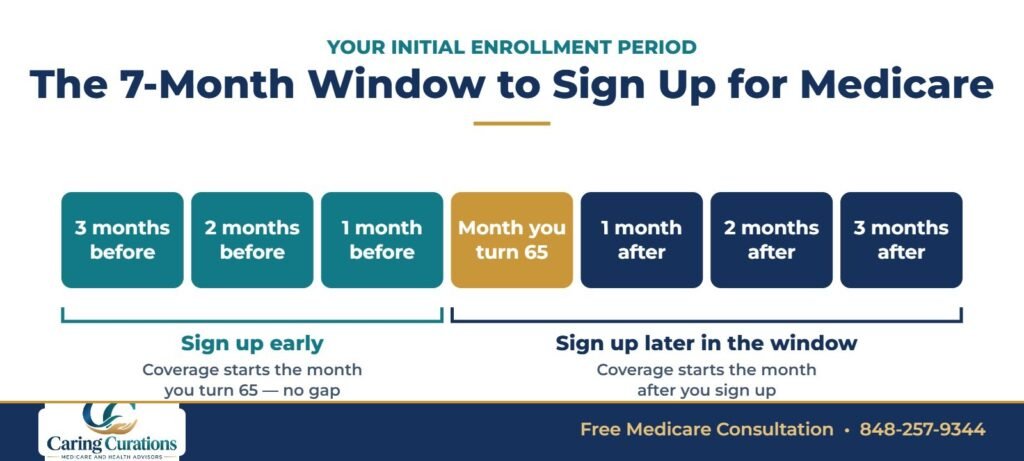
Quick answer: For most people, the best time to sign up for Medicare is during your Initial Enrollment Period, a 7-month window that starts 3 months before the month you turn 65 and ends 3 months after it. Signing up in the first 3 months of that window lets your coverage start the month you turn 65. (Medicare.gov)
When to Sign Up for Medicare: Your Initial Enrollment Period
Your Initial Enrollment Period (IEP) is your first chance to sign up for Medicare Part A and Part B. For most people, it is built around your 65th birthday:
- 3 months before the month you turn 65
- The month you turn 65
- 3 months after the month you turn 65
That adds up to 7 months. For example, if you turn 65 on July 14, your Initial Enrollment Period runs from April 1 through October 31.
If you are deciding when to sign up for Medicare and you don’t have other qualifying coverage, such as health insurance from a current employer, signing up during this window is usually the safest choice.
What if my birthday is on the 1st of the month?
Medicare treats people born on the first day of a month a little differently. If your birthday is on the 1st, your premium-free Part A coverage can start the month before you turn 65, and your Initial Enrollment Period shifts one month earlier as well. If that applies to you, check your exact dates with Social Security before you apply.
When Does Medicare Coverage Start?
When you sign up affects when your coverage begins. Medicare coverage always starts on the first day of a month.
| When you sign up | When Part B coverage starts |
|---|---|
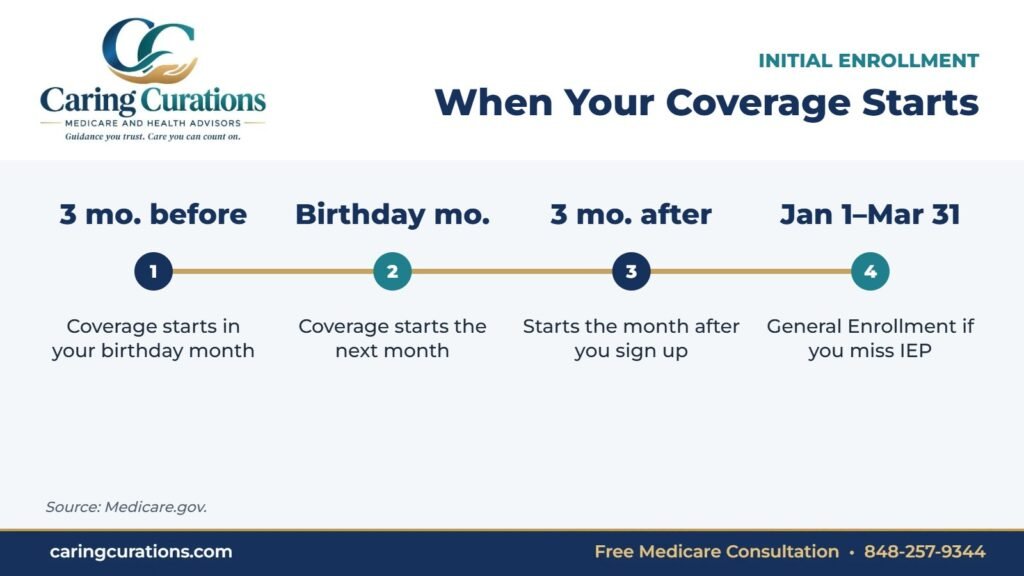
| 1 to 3 months before the month you turn 65 | The first day of your birthday month |
| During the month you turn 65 | The first day of the next month |
| 1 to 3 months after the month you turn 65 | The first day of the month after you sign up |
| General Enrollment Period (January 1 – March 31) | The first day of the month after you sign up |
If you get premium-free Part A, it generally starts the month you turn 65. Part B and any premium Part A follow the timing in the table above. (Medicare.gov)
Tip: If you want your coverage to begin on your birthday month with no gap, sign up for Medicare during the 3 months before you turn 65.
Will I Be Signed Up for Medicare Automatically?
Some people don’t need to apply at all. You are generally enrolled in Medicare Part A and Part B automatically if you have already started receiving Social Security or Railroad Retirement Board (RRB) benefits at least 4 months before you turn 65.
In that case, your Medicare card and welcome package usually arrive in the mail about 3 months before your coverage starts.
If you are not receiving Social Security benefits yet, which is common for people who plan to claim Social Security later, you will usually need to sign up for Medicare yourself. Turning 65 does not by itself trigger enrollment.
People under 65 who receive Social Security disability benefits are generally enrolled automatically after receiving disability benefits for 24 months. People with ALS are generally enrolled as soon as their disability benefits begin. (Medicare.gov)
How to Sign Up for Medicare
If you need to enroll yourself, Medicare enrollment is handled by Social Security, not by an insurance company. You can sign up for Medicare:
- Online at SSA.gov, which Medicare describes as the fastest option
- By phone by calling Social Security at 1-800-772-1213 (TTY 1-800-325-0778)
- In person at your local Social Security office
If you or your spouse worked for a railroad, contact the Railroad Retirement Board instead.
When you sign up through Social Security, your Medicare card generally arrives about 2 weeks later.
When to Sign Up for Medicare If You’re Still Working
Many people keep working past 65. If you have health coverage through your job or your spouse’s job, the answer to when to sign up for Medicare depends on the size of the employer and the type of coverage.
Employer with 20 or more employees
If your coverage comes from a current employer with 20 or more employees, that group plan generally pays first. Many people in this situation choose to delay Part B without a penalty and sign up later using a Special Enrollment Period. Some still sign up for premium-free Part A at 65.
Employer with fewer than 20 employees
If the employer has fewer than 20 employees, Medicare generally pays first. In that case, your employer plan may expect you to have Part A and Part B, and delaying could leave you with large gaps in coverage. Talk to your benefits administrator before deciding.
Have a Health Savings Account (HSA)?
Once you enroll in any part of Medicare, you can no longer contribute to an HSA. Premium-free Part A can also be backdated up to 6 months when you sign up after 65, so many people stop HSA contributions about 6 months before they plan to enroll. Check with your benefits or tax advisor for your situation.
The Special Enrollment Period after employment ends
If you delayed Part B because you had group health coverage based on current employment, you can generally sign up for Medicare during a Special Enrollment Period. It lasts for 8 months after your employment or group health coverage ends, whichever happens first.
Important: COBRA and retiree health coverage do not count as coverage based on current employment. Having COBRA does not extend your 8-month window, so don’t wait until COBRA runs out to sign up for Medicare. (Medicare.gov)

What Happens If You Miss Your Medicare Enrollment Window?
If you miss your Initial Enrollment Period and don’t qualify for a Special Enrollment Period, you can usually sign up for Medicare during the General Enrollment Period, which runs from January 1 through March 31 each year. Your coverage then starts the first day of the month after you sign up.
The trade-off is that you may have gone months without coverage, and you may owe a late enrollment penalty.
Part B late enrollment penalty
Your monthly Part B premium can go up 10% for each full 12-month period you could have had Part B but didn’t. In most cases, you pay this penalty for as long as you have Part B.
For example, Medicare explains that waiting 2 full years would mean a 20% penalty. In 2026, that would add $40.58 to the $202.90 standard premium. (Medicare.gov)
Part D late enrollment penalty
If you go 63 days or more in a row without Part D or other creditable prescription drug coverage after your Initial Enrollment Period ends, you may owe a Part D late enrollment penalty. It adds 1% of the national base beneficiary premium for each month you went without coverage, and it generally lasts as long as you have Medicare drug coverage.
Part A late enrollment penalty
Most people get Part A premium-free, so this penalty doesn’t apply to them. If you have to buy Part A and don’t sign up when first eligible, your premium can go up 10%, for twice the number of years you didn’t sign up.
Learn more about prescription coverage in our Medicare Part D guide and about current premiums in How Much Does Medicare Cost in 2026?
When to Sign Up for Medicare If You’re Covered by Your Spouse’s Plan
The same rules apply if your health insurance comes from your spouse’s current job. If your spouse is still actively working and the employer has 20 or more employees, you may be able to delay Part B and use a Special Enrollment Period later.
Keep in mind that your coverage is tied to your spouse’s employment. If your spouse retires, changes jobs or loses that coverage, your 8-month Special Enrollment Period clock starts too. Couples who are close in age often find it helpful to map out both enrollment timelines together so neither person misses a window.
If you get coverage through the Health Insurance Marketplace, the rules are different. Marketplace coverage doesn’t give you a Special Enrollment Period to delay Medicare, and you generally can’t keep receiving Marketplace premium tax credits once you are eligible for premium-free Part A. Most people with Marketplace plans should sign up for Medicare during their Initial Enrollment Period and then end their Marketplace coverage so it stops when Medicare starts.
What You’ll Need to Sign Up for Medicare
Having your information ready makes the application faster. When you sign up for Medicare through Social Security, be prepared to provide:
- Your Social Security number and date of birth
- Your current health insurance information, if you have any
- Details about your current or past employment and employer-based coverage
- Your spouse’s information, if your coverage is through their job
- Form CMS-L564 (Request for Employment Information), completed by your employer, if you are signing up during a Special Enrollment Period after delaying Part B
If you are using a Special Enrollment Period, keep copies of everything you submit. Proof of your group coverage helps show that you qualify to avoid the late enrollment penalty.
After You Sign Up for Medicare: Choosing Your Coverage
Signing up for Part A and Part B is only the first step. Once you know when to sign up for Medicare, the next decision is how you want to receive the rest of your coverage. Your main options are:
- Original Medicare (Part A and Part B), often paired with a separate Part D prescription drug plan and, if you choose, a Medicare Supplement Insurance (Medigap) policy
- Medicare Advantage (Part C), an all-in-one alternative offered by Medicare-approved private companies that often includes drug coverage
Not sure which path fits you? Read our comparison of Medicare Advantage vs Original Medicare.
Why timing matters for Medigap
Your Medigap Open Enrollment Period is a one-time, 6-month window that begins the first month you are 65 or older and enrolled in Part B. During this window, insurance companies generally can’t use your health history to deny you a policy or charge you more. Because it starts when Part B starts, when you sign up for Medicare Part B also sets the clock for Medigap. Read more in our guide, What Is Medigap?
7 Essential Tips for Signing Up for Medicare on Time
1. Mark your Initial Enrollment Period on a calendar
Count back 3 months from your 65th birthday month and write down the start and end dates of your 7-month window.
2. Sign up early for coverage with no gap
Enrolling in the 3 months before your birthday month lets coverage start the month you turn 65.
3. Confirm whether you’ll be enrolled automatically
If you are not already collecting Social Security, you will most likely need to apply yourself.
4. Ask your employer how their plan works with Medicare
Find out how many employees the company has and whether the plan pays first or second once you are 65.
5. Check whether your drug coverage is creditable
Your plan should send a yearly notice saying whether its prescription coverage is creditable. Keep it in a safe place.
6. Don’t count on COBRA
COBRA doesn’t extend your Part B Special Enrollment Period. Sign up for Medicare within 8 months of your job or group coverage ending.
7. Plan your next coverage decision early
Give yourself time to compare Medicare Advantage, Medigap and Part D options, especially your doctors, prescriptions and budget.
Medicare Enrollment Periods at a Glance
| Enrollment period | When it happens | What it’s for |
|---|---|---|
| Initial Enrollment Period | 7 months around your 65th birthday | First sign-up for Part A and Part B |
| Special Enrollment Period | Up to 8 months after employment or group coverage ends | Signing up after delaying for job-based coverage |
| General Enrollment Period | January 1 – March 31 | Signing up if you missed other windows |
| Medigap Open Enrollment | 6 months starting when you’re 65+ and in Part B | Buying Medigap with key protections |
| Annual Open Enrollment | October 15 – December 7 | Changing Medicare Advantage or Part D plans for next year |
Already on Medicare? Read our tips on Medicare Open Enrollment 2027 mistakes to avoid.
Frequently Asked Questions About When to Sign Up for Medicare
Can I sign up for Medicare before I turn 65?
Yes. Your Initial Enrollment Period starts 3 months before the month you turn 65, and signing up during those first 3 months lets your coverage start in your birthday month.
Do I have to sign up for Medicare if I’m still working?
Not always. If you have group health coverage from a current employer with 20 or more employees, you may be able to delay Part B without a penalty. Check with your employer’s benefits administrator first.
Is it too late to sign up for Medicare if I missed my window?
Usually not. You can generally sign up during the General Enrollment Period from January 1 to March 31, although a late enrollment penalty may apply.
Do I sign up for Medicare through an insurance company?
No. You sign up for Part A and Part B through Social Security. Medicare Advantage, Part D and Medigap plans are offered by private insurance companies after you have Medicare.
Does COBRA count as employer coverage for Medicare?
No. COBRA does not count as coverage based on current employment, so it does not protect you from the Part B late enrollment penalty.
Related guides: Medicare Part A, Medicare Part B, the Medicare late enrollment penalty and Medicare when working past 65.
Get Personal Help Deciding When to Sign Up for Medicare
Every situation is a little different. Your birthday, your job, your spouse’s coverage, your HSA and your Social Security plans can all change the right answer for when to sign up for Medicare.
At Caring Curations Medicare and Health Advisors, we take the time to understand your situation and walk you through your timing and coverage options in clear, simple language, with no pressure. Whether you are turning 65 this year, working past 65, or helping a parent through the process, we can help you build a simple timeline so nothing is missed.
Guidance you trust. Care you can count on.
Phone: 848-257-9344
Email: RamiAA@caringcurations.com
Schedule your free Medicare consultation or contact Caring Curations today.
This article is for general educational purposes and is not affiliated with or endorsed by the U.S. government or the federal Medicare program. Rules can change, so confirm your dates with Medicare.gov or Social Security.







7 Responses