

Your eyes change as you get older, and many people are surprised to learn what Medicare does and doesn’t pay for when it comes to eye care. Medicare vision coverage is real, but it focuses on medical eye problems such as cataracts, glaucoma and macular degeneration, not routine exams or new glasses each year. Knowing where that line falls can save you hundreds of dollars and help you pick the right plan.
This guide explains Medicare vision coverage under Original Medicare, what it leaves out, what you pay in 2026, how Medicare Advantage vision benefits work, and when a standalone vision plan makes sense. We also walk through real-life examples and the most common mistakes we see.

Quick answer: Original Medicare does not cover routine eye exams, eyeglasses or contact lenses. Part B does cover medically necessary eye care, including cataract surgery, a yearly glaucoma test for people at high risk, a yearly diabetic eye exam, and tests and treatment for macular degeneration. After cataract surgery with an implanted lens, Part B also covers one pair of glasses with standard frames or one set of contact lenses. Many Medicare Advantage plans add routine vision benefits. (Medicare.gov)
What Is Medicare Vision Coverage?
When people talk about Medicare vision coverage, they usually mean two very different things. The first is medical eye care: diagnosing and treating eye diseases and injuries. The second is routine vision care: the yearly eye exam for a new prescription, plus the glasses or contacts that go with it.
Original Medicare is built around medical care. Part B, the part of Medicare that covers doctor visits and outpatient services, pays for eye care that treats a disease or condition. It generally does not pay for the routine side. That is the single most important thing to understand.
If you are new to how Part B works, our guide to Medicare Part B explains the premium, deductible and 20% coinsurance in detail.
What Medicare Vision Coverage Leaves Out
Under Original Medicare, you pay the full cost of:
- Routine eye exams done to check or update your prescription for glasses or contact lenses
- Eyeglasses and frames, except one pair after cataract surgery
- Contact lenses, except one set after cataract surgery
- Refraction, the part of an eye exam that measures your prescription
- LASIK and other elective vision correction surgery
- Upgraded frames or lens options, such as designer frames or special coatings
A Medigap policy won’t fill this gap in Medicare vision coverage either. Medigap plans help pay your share of costs for services Medicare already covers, so if Medicare doesn’t cover a routine eye exam, a Medigap plan won’t pay for it. That is why your choice of plan matters so much for routine eye care.
Medical Eye Care: The Core of Medicare Vision Coverage
Here is where Medicare does step in. Part B covers eye care when you have symptoms, an injury or a diagnosed eye disease. Common covered services include:
- Exams to diagnose and treat eye conditions, such as sudden vision changes, eye pain, flashes or floaters
- Cataract surgery that implants a conventional intraocular lens
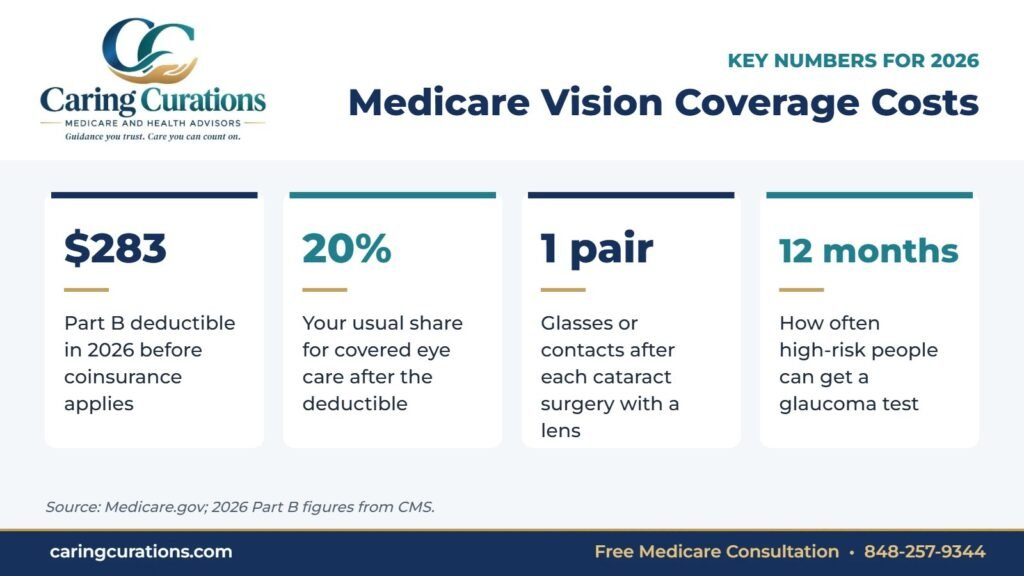
- Glaucoma tests once every 12 months for people at high risk
- Diabetic eye exams once a year for people with diabetes
- Tests and treatment for age-related macular degeneration, including some injectable drugs
- Treatment for eye injuries and infections
The key to Medicare vision coverage is the reason for the visit. If you see an eye doctor because your vision suddenly became blurry in one eye, that visit is medical. If you go because you want a new pair of reading glasses, it is routine.
Optometrist or ophthalmologist?
Both kinds of eye doctors can accept Medicare. An optometrist handles eye exams, prescriptions and many common eye conditions. An ophthalmologist is a medical doctor who also performs eye surgery and treats serious diseases such as advanced glaucoma or macular degeneration.
For Medicare vision coverage to apply, what matters most is that the doctor accepts Medicare. If the doctor accepts assignment, they agree to take the Medicare-approved amount as full payment, which keeps your share at 20%. If you have a Medicare Advantage plan, check that the doctor is in your plan’s network before you book.
Other items included in Medicare vision coverage
Part B can also help pay for certain medical eye items when a doctor orders them, such as a prosthetic eye after the loss or removal of an eye. As with other Part B items, you usually pay 20% of the Medicare-approved amount after the deductible.
2026 Costs for Medicare Vision Coverage Under Part B
For medical eye care under Medicare vision coverage, you pay the standard Part B costs. In 2026, that means:
- The Part B premium, which is $202.90 a month for most people
- The yearly Part B deductible of $283
- Usually 20% of the Medicare-approved amount after you meet the deductible
- A separate copayment if you get care in a hospital outpatient setting
There is no yearly cap on your 20% share under Original Medicare. That is why many people add a Medigap policy, which can pay some or all of that 20% for covered eye treatments like cataract surgery and macular degeneration injections.
Cataract Surgery and Medicare
Cataracts are one of the most common reasons older adults need eye surgery, and this is where Medicare vision coverage is strongest. Part B covers cataract surgery that implants a conventional intraocular lens, whether the surgery is done in a hospital outpatient department, an ambulatory surgical center or a doctor’s office. Medicare.gov lists the details on its cataract surgery coverage page.
What you pay for cataract surgery
After you meet the Part B deductible, you generally pay 20% of the Medicare-approved amount for the surgeon and 20% for the facility. Your total depends on where you have the surgery and whether your doctor accepts assignment, so ask for an estimate before you schedule.
Premium lenses cost extra
Medicare pays for a standard, single-focus lens. If you choose an upgraded lens that also corrects astigmatism or reduces your need for reading glasses, you usually pay the extra cost of the upgrade yourself. The same is often true for laser-assisted techniques that go beyond the standard procedure. Ask your surgeon for a written breakdown of what Medicare covers and what you would pay.
Medicare vision coverage for glasses after cataract surgery
After each cataract surgery with an implanted lens, Part B covers one pair of eyeglasses with standard frames or one set of contact lenses. You pay 20% of the Medicare-approved amount after the deductible, plus the cost of any upgraded frames. The glasses must come from a supplier enrolled in Medicare, so check before you order.
Glaucoma Screening Under Medicare Vision Coverage
Glaucoma damages the optic nerve and often has no early symptoms, which is why screening matters. Part B covers a glaucoma test once every 12 months if you are at high risk. Medicare considers you high risk if at least one of these applies:
- You have diabetes
- You have a family history of glaucoma
- You are African American and 50 or older
- You are Hispanic and 65 or older
You can read the official rules on Medicare.gov’s glaucoma tests page.
After the deductible, you pay 20% of the Medicare-approved amount, plus a copayment in a hospital outpatient setting. If you are diagnosed with glaucoma, Part B covers your follow-up visits and treatment, while prescription eye drops are usually covered by your Part D plan. See our guide to Medicare Part D for how drug costs and the $2,100 out-of-pocket cap work in 2026.
Diabetic Eye Exams and Medicare Vision Coverage
Diabetes can damage the small blood vessels in the back of the eye, a condition called diabetic retinopathy. If you have diabetes, Part B covers an eye exam to check for diabetic retinopathy once a year.
The exam must be done by an eye doctor who is legally allowed to perform it in your state. You pay 20% of the Medicare-approved amount after the deductible, plus a copayment if you go to a hospital outpatient clinic. If you have diabetes, put this exam on your calendar every year. It is one of the most valuable eye benefits Medicare offers.
Medicare Vision Coverage for Macular Degeneration
Age-related macular degeneration, often called AMD, is a leading cause of vision loss in older adults. Part B may cover certain tests and treatments for AMD, including some injectable drugs given in your eye doctor’s office.
Because these injections are given by a doctor, they fall under Part B, not Part D. After the deductible, you generally pay 20% of the Medicare-approved amount for the drug and the doctor’s services. Injections may be needed every month or two, so that 20% can add up quickly. This is a situation where a Medigap plan or a Medicare Advantage plan’s out-of-pocket limit can make a big difference.
Medicare Vision Coverage at a Glance
| Eye care service | Original Medicare | What you usually pay |
|---|---|---|
| Routine eye exam for glasses | Not covered | 100% of the cost |
| Eyeglasses or contacts | Not covered, except after cataract surgery | 100%, or 20% for the post-surgery pair |
| Cataract surgery | Covered by Part B | 20% after the $283 deductible |
| Glaucoma test | Once every 12 months if high risk | 20% after the deductible |
| Diabetic eye exam | Once a year if you have diabetes | 20% after the deductible |
| Macular degeneration treatment | Certain tests and injectable drugs | 20% after the deductible |
| LASIK | Not covered | 100% of the cost |
Medicare Vision Coverage Through Medicare Advantage
Medicare Advantage plans, also called Part C, must cover everything Original Medicare covers for your eyes. Many plans go further and include routine vision benefits as an extra. These often include:
- A yearly routine eye exam with a low or $0 copay
- An allowance toward eyeglasses or contact lenses, often once a year or once every two years
- Discounts on frames, lens upgrades or LASIK
Medicare vision coverage varies a lot from one Advantage plan to the next. Some plans give a generous eyewear allowance, while others offer only a small amount. Many plans require you to use a specific vision network, and the allowance usually resets each year whether you use it or not.
Medicare Advantage plans also have a yearly out-of-pocket limit for covered medical care, up to $9,250 in network in 2026. That limit can help if you need ongoing treatment for macular degeneration or glaucoma. Learn more in What Is Medicare Advantage?
Questions to ask about a plan’s vision benefits
- How much is the eyewear allowance, and how often can I use it?
- Is my current eye doctor or optical shop in the vision network?
- Does the allowance cover contacts as well as glasses?
- What is the copay for a specialist visit to an ophthalmologist?
- Do I need a referral or prior authorization for cataract surgery or eye injections?
Standalone Plans to Fill Gaps in Medicare Vision Coverage
If you keep Original Medicare, you can buy a separate vision insurance plan or a vision discount plan to help with routine care. These are sold by private companies, not by Medicare.
A standalone vision plan usually charges a monthly premium and covers a yearly eye exam plus an allowance for glasses or contacts. Before you buy, add up the premiums for the year and compare them with what you would pay out of pocket. If you only need a basic exam and inexpensive glasses every couple of years, paying cash may cost less. If you wear progressive lenses or contacts, a plan may save you money.
Many people buy dental and vision coverage together. Our guide to Medicare dental coverage explains how dental plans work alongside Medicare.
Medicaid and Medicare Vision Coverage in New York
If you have limited income, you may qualify for both Medicare and Medicaid. In New York, Medicaid can help pay for some routine eye care and eyeglasses that Medicare doesn’t cover, subject to state rules. People with both programs may also qualify for a Dual Special Needs Plan, which often includes extra vision benefits.
Read our guide to dual eligible Medicare and Medicaid to see whether you might qualify.

How to Choose the Right Medicare Vision Coverage
- List your eye care needs. Do you wear glasses or contacts? Do you have cataracts, glaucoma, diabetes or macular degeneration?
- Estimate your yearly costs. Add up what you spend on exams, frames, lenses and contacts in a typical year.
- Check your eye doctors. Make sure your ophthalmologist and optometrist accept Medicare or are in the plan’s network.
- Compare Medicare Advantage vision allowances with the cost of a standalone vision plan.
- Think about medical eye treatment. If you need ongoing injections or surgery, compare the 20% coinsurance with a Medigap plan or a plan’s out-of-pocket limit.
- Review your coverage every fall during Annual Enrollment, October 15 to December 7, because vision benefits can change each year.
Still deciding between the two main paths? Read Medicare Advantage vs Original Medicare.
Tips to Get the Most From Medicare Vision Coverage
- Tell your doctor about symptoms. If you have eye pain, new floaters or changes in your vision, say so when you book. A visit for a medical problem may be covered by Part B.
- Ask how the visit will be billed. One appointment can include both a medical exam and a routine refraction. Medicare may pay for the medical part while you pay for the refraction.
- Use your plan’s allowance before it resets. Many Medicare Advantage eyewear allowances expire at the end of the year.
- Keep receipts. If you have a standalone plan that reimburses you, you’ll need proof of what you paid.
- Don’t skip your yearly exams. Diabetic eye exams and glaucoma tests can catch problems early, when treatment works best.
Medicare Vision Coverage Examples
Example 1: Margaret needs new reading glasses
Margaret, 67, has Original Medicare and a Medigap Plan G. She books a routine eye exam to update her reading prescription. Medicare vision coverage doesn’t include the exam or the new glasses, so she pays for both herself. Next year, she plans to compare a standalone vision plan to see if it would save her money.
Example 2: Frank has cataract surgery
Frank, 72, lives in Staten Island and has Original Medicare. His eye doctor recommends cataract surgery in his right eye. Medicare vision coverage under Part B pays for the surgery with a standard lens, and his Medigap plan pays his 20% share. After surgery, Medicare helps pay for one pair of glasses with standard frames. Frank chooses designer frames and pays the difference.
Example 3: Denise has diabetes and a Medicare Advantage plan
Denise, 69, has type 2 diabetes and a Medicare Advantage plan. Her plan covers her yearly diabetic eye exam and also includes a routine eye exam and an eyewear allowance each year. She uses an in-network optical shop, so she pays only a small copay for her new glasses.
Common Mistakes With Medicare Vision Coverage
- Assuming Medicare vision coverage includes routine eye exams. Original Medicare doesn’t, and neither does Medigap.
- Not mentioning symptoms. A visit for a medical concern may be covered, but only if the doctor documents the problem.
- Forgetting about premium lens costs. Upgraded cataract lenses can mean a large bill you didn’t expect.
- Buying post-surgery glasses from a non-Medicare supplier. Medicare only pays when the supplier is enrolled in Medicare.
- Ignoring the vision network. Many Medicare Advantage vision benefits work only with certain eye doctors and stores.
- Skipping yearly screenings. People with diabetes or other risk factors can lose vision that early treatment might have saved.
Frequently Asked Questions About Medicare Vision Coverage
Does Medicare cover eye exams?
Original Medicare doesn’t cover routine eye exams for glasses or contacts. Part B does cover eye exams to diagnose or treat a medical eye problem, a yearly diabetic eye exam if you have diabetes, and a yearly glaucoma test if you are at high risk.
Does Medicare pay for glasses?
Only in one case. After cataract surgery with an implanted lens, Part B covers one pair of glasses with standard frames or one set of contact lenses. You pay 20% after the deductible.
Is cataract surgery covered by Medicare?
Yes. Part B covers cataract surgery with a conventional lens. You usually pay 20% of the Medicare-approved amount after the deductible, plus extra if you choose a premium lens.
Do Medicare Advantage plans include vision benefits?
Many do. Common benefits include a yearly routine eye exam and an allowance for glasses or contacts. The amount and rules vary by plan, so check the plan’s Evidence of Coverage.
Does Medigap add to Medicare vision coverage?
No. Medigap plans help with your share of Medicare-covered services, such as the 20% for cataract surgery, but they don’t cover routine eye exams or glasses.
Does the Welcome to Medicare visit include a vision test?
Your “Welcome to Medicare” preventive visit includes a simple vision test, but it is not a full eye exam. See our guide to the Medicare annual wellness visit to learn what those visits include.
Can I add to my Medicare vision coverage with a separate plan?
Yes. You can buy a standalone vision plan or a vision discount plan from a private company. Compare the yearly premium with what you normally spend on eye care.
Get Help Choosing Medicare Vision Coverage
The right Medicare vision coverage depends on your eyes, your doctors and your budget. Caring Curations is an independent Medicare agency at 26 Bolivar St in Staten Island, New York. We can compare Medicare Advantage vision benefits, Medigap options and standalone vision plans from multiple carriers, and help you find a plan that keeps your eye doctor in network.
Book a free Medicare consultation or call 848-257-9344. We are licensed in 25 states, and our help is always free.